
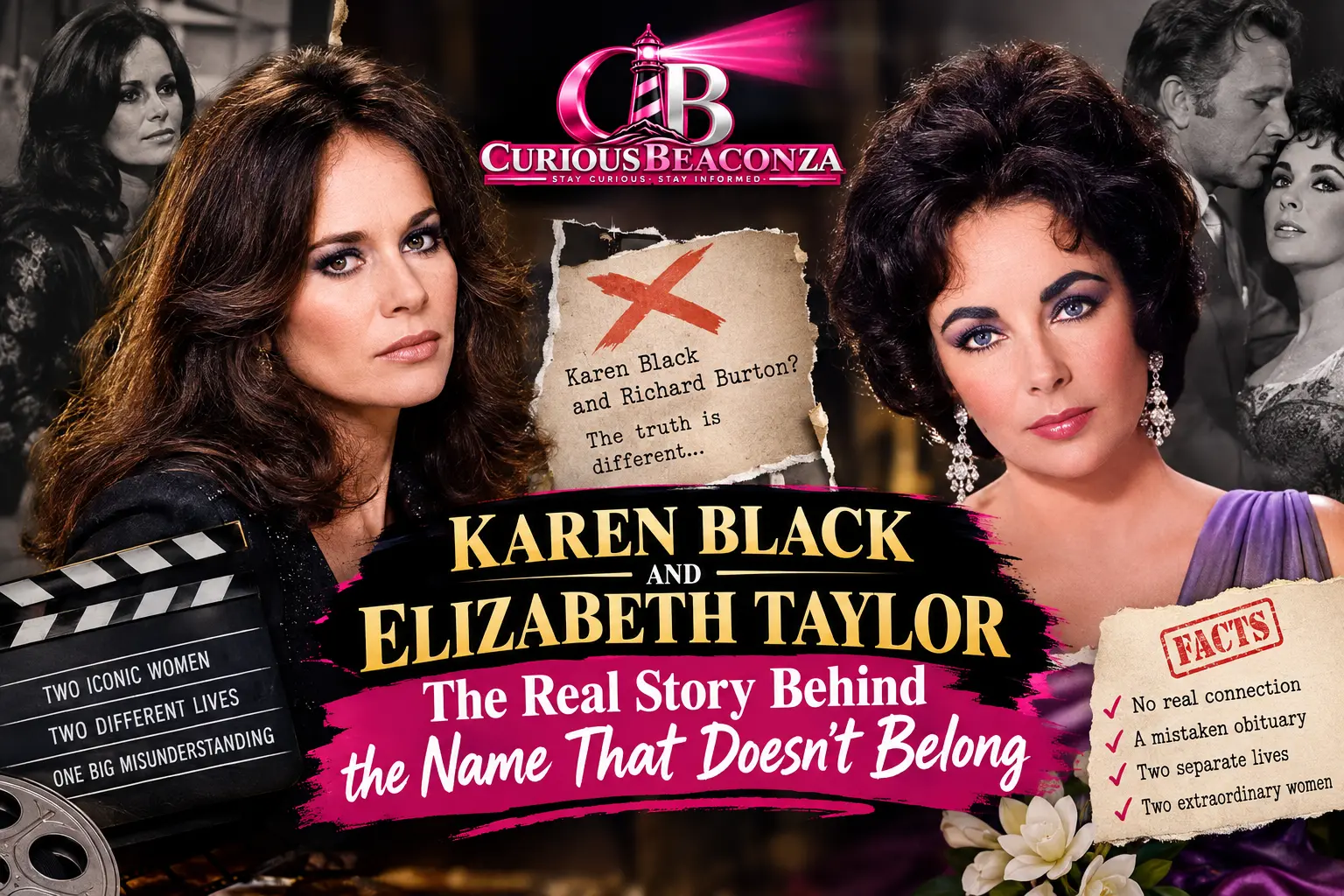
Karen Lynch and Elizabeth Taylor have no documented connection. The persistent confusion surrounding these two names stems from a widely repeated factual error in Karen Black’s obituaries, which incorrectly claimed the actress was “formerly married to Elizabeth Taylor’s paramour, Richard Burton”. Karen Black was never married to Richard Burton. She was, however, married to an actor named Robert Burton from 1973 to 1974 a coincidence that likely fueled the misunderstanding. This article unravels that error while examining what the real women behind these names actually accomplished.
To clarify the legacies of both Karen Lynch and Elizabeth Taylor, it is essential to explore their individual contributions to the entertainment industry and how their unique paths diverged. Elizabeth Taylor, an iconic figure known for her stunning beauty and formidable talent, captivated audiences with her performances in classic films such as “Cleopatra” and “Who’s Afraid of Virginia Woolf?” Her off-screen life was equally dramatic, marked by high-profile marriages and a passionate commitment to humanitarian causes, particularly her advocacy for AIDS research.
In contrast, Karen Lynch, often overshadowed by the monumental fame of Taylor, carved her own niche in the industry with a focus on character-driven roles in both film and television. Her work, though less celebrated, showcased a range of performances that reflected her versatility as an actress. By examining their distinct careers, we can appreciate how each woman navigated the complexities of fame and personal identity in a changing Hollywood landscape, ultimately recognizing that their stories, while intertwined in public perception, are separate narratives deserving of their own recognition.
The Obituary That Got It Wrong
When Karen Black died in August 2013 at age 74, obituaries around the world celebrated her extraordinary career: the Oscar nomination for Five Easy Pieces, the Golden Globe wins, the collaborations with Coppola, Altman, and Hitchcock. But one line in at least one published obituary introduced an error that has since metastasized across the internet. This error claimed that Black had won an Academy Award for her role in Five Easy Pieces, when in fact she had only received a nomination.
This misrepresentation not only diminishes the significance of her actual achievements but also reflects a broader trend in how the legacies of artists can be misremembered or distorted over time. As tributes poured in, many focused on her versatility and the indelible mark she left on American cinema, yet this simple mistake served as a reminder of the importance of accuracy in honoring those who have shaped our cultural landscape.
Bustle’s obituary stated plainly: “Black, who starred in dozens of films, boasted a dramatic personal life as well the actress was formerly married to Elizabeth Taylor’s paramour, Richard Burton”.This is false.Karen Black’s four husbands are a matter of public record: Charles Black (1955–1962), Robert Burton (1973–1974), L. M. Kit Carson (1975–1983), and Stephen Eckelberry (1987–2013). Richard Burton is not among them. He was never married to Karen Black. He was married to Elizabeth Taylor twice, and to Sybil Burton, Susan Hunt, and Sally Hay.
The confusion almost certainly arises from the name Robert Burton a working actor who appeared alongside Black in the 1975 television film Trilogy of Terror. A careless writer, perhaps working quickly under deadline, likely conflated “Robert Burton” with “Richard Burton,” and from there, the false connection to Elizabeth Taylor was born. This mix-up highlights not only the pitfalls of hasty journalism but also the enduring impact of celebrity associations in public perception.
Richard Burton, renowned for his tumultuous relationship with Elizabeth Taylor, has cast a long shadow over the entertainment industry, making it all too easy for less discerning writers to blur the lines between fact and fiction. As a result, Robert Burton’s modest contributions to film risk being overshadowed by the more scandalous narratives surrounding his namesake. This phenomenon serves as a reminder of the importance of diligence in research, especially in an age where misinformation can spread rapidly and shape public discourse.
Deep Analysis: How Errors Become Facts
This is not merely a trivial correction. It illustrates a fundamental problem in how celebrity history is transmitted. Obituaries are often written on tight deadlines, drawing from pre-prepared templates and wire copy. When an error enters that pipeline, it can propagate across dozens of outlets within hours. The “Karen Black was married to Richard Burton” claim likely originated from a single mistaken line and was then repeated sometimes verbatim by other publications that trusted the first source.
The lesson for readers is straightforward: when a claim about a celebrity’s romantic history appears without a primary source, treat it with skepticism. Elizabeth Taylor’s marriages are exhaustively documented. Karen Black’s are equally clear. The error exists only because someone, somewhere, confused two Burtons.
Elizabeth Taylor: The Definitive Chronology
Elizabeth Rosemond Taylor was born in London on February 27, 1932, and died in Los Angeles on March 23, 2011. She was married eight times to seven men. This is not trivia; it is the framework through which her public life was understood for decades.
The Burton marriages were the gravitational center of Taylor’s romantic life. They met on the set of Cleopatra in Rome in 1961, both married to other people. Their affair triggered an international scandal the Vatican issued a statement denouncing Taylor for “erotic vagrancy”. They married in 1964, divorced in 1974, remarried in 1975, and divorced for the final time in 1976. Burton died in 1984. When Taylor died in 2011, she had outlived him by 27 years.
Beyond the Marriages
To reduce Elizabeth Taylor to her husbands is to miss the point of her life. She won two Academy Awards and was named the seventh-greatest female screen legend by the American Film Institute. More significantly, she became the first globally recognized celebrity HIV/AIDS activist. In 1985, she co-founded amfAR, and in 1991 she established the Elizabeth Taylor AIDS Foundation. She lobbied President Reagan and Congress when silence and stigma were killing thousands.
Karen Black: The Real Life and Loves
Karen Blanche Ziegler was born near Chicago in 1939 and died in Santa Monica in 2013. She adopted the surname Black from her first husband, Charles Black, and kept it throughout her career even after their 1962 divorce.
Her career arc was remarkable for its range and its refusal to follow conventional stardom. She made her film debut in 1960’s The Prime Time, which she later called “the worst film ever made”. She returned to theater, earned a New York Drama Critics’ Circle nomination for The Playroom, and then broke through with Francis Ford Coppola’s You’re a Big Boy Now in 1966.
The run that followed defined an era. Easy Rider (1969). Five Easy Pieces (1970), which earned her an Oscar nomination and a Golden Globe. Nashville (1975), where she also contributed songs. The Great Gatsby (1974), another Golden Globe. Trilogy of Terror (1975), which made her a horror icon. Alfred Hitchcock cast her in his final film, Family Plot (1976).
Her personal life was as unconventional as her career. At nineteen, she gave birth to a daughter and placed her for adoption; they reconnected in 2012, the year before Black’s death. She married four times. She became a Scientologist. She never stopped working.
The Robert Burton Marriage
Karen Black married actor Robert Burton on April 18, 1973, in Los Angeles. They divorced in October 1974. Robert Burton was a working actor he appeared with Black in Trilogy of Terror but he was not Richard Burton, and he had no connection to Elizabeth Taylor. This brief marriage is the sole factual basis for the false claim that Karen Black was married to Elizabeth Taylor’s paramour. It is a case of mistaken identity compounded by sloppy journalism.
The Burton Confusion Explained: A Side-by-Side Comparison
The confusion is understandable on a surface level: two actors named Burton, both working in the same era, both connected to women in the public eye. But the error becomes less forgivable when you consider that Richard Burton’s life is among the most documented in Hollywood history. His marriage to Elizabeth Taylor was called “the marriage of the century”. His relationship with Karen Black did not exist.
What This Error Reveals About Hollywood Memory
The persistence of the “Karen Black married Richard Burton” claim tells us something uncomfortable about how we remember women in Hollywood. Karen Black was an artist of extraordinary range a woman who worked with the most important directors of her generation, who wrote songs, who created performances that still unsettle and move audiences. Yet in one obituary, she was reduced to a one-line footnote in another woman’s romantic history.
Elizabeth Taylor, for her part, was so famous that her name became a gravitational force, pulling other women into its orbit whether they belonged there or not. The error is a small but telling example of how celebrity history flattens individual lives into simplistic narratives.
The Deeper Lesson
When you encounter a claim about a famous person’s romantic past, ask: What is the source? Is it a primary document, a reputable biography, or a hastily written obituary? The internet rewards speed over accuracy, and errors propagate because they are repeated without verification. The Karen Black–Richard Burton error is a case study in why that matters.
FAQ
Was Karen Black married to Richard Burton?
No. Karen Black was married to Charles Black, Robert Burton, L. M. Kit Carson, and Stephen Eckelberry. Richard Burton was married to Sybil Burton, Elizabeth Taylor (twice), Susan Hunt, and Sally Hay.
Who was Karen Lynch?
There is no evidence that a “Karen Lynch” had any connection to Elizabeth Taylor. The name appears to be a conflation or misspelling of Karen Black.
How many times was Elizabeth Taylor married?
Eight times to seven different men: Conrad Hilton, Michael Wilding, Mike Todd, Eddie Fisher, Richard Burton (twice), John Warner, and Larry Fortensky.
Did Karen Black ever meet Elizabeth Taylor?
There is no public record of the two women ever meeting or working together.
Why do people confuse Karen Black with Richard Burton’s wives?
The error likely stems from Black’s brief marriage to an actor named Robert Burton, whose surname was mistaken for Richard Burton’s.
Final Thoughts
The real story of Karen Black and Elizabeth Taylor is not a story of connection but of two extraordinary women whose lives have been tangled by error. Elizabeth Taylor was married eight times, won two Oscars, and changed the world’s response to AIDS. Karen Black earned an Oscar nomination, worked with the greatest directors of her era, and brought an unsettling intelligence to every role. Neither woman needs a fabricated connection to be remembered.
The truth is more than enough. Their paths crossed not as allies but as contemporaries, each navigating the tumultuous waters of fame in their own distinctive ways. Taylor’s public battles and triumphs often overshadowed the quieter, yet equally impactful, achievements of Black, who found her niche in roles that challenged societal norms and explored the complexities of the human psyche.
While Taylor’s life was a whirlwind of glitz and glamour, Black’s journey was marked by a profound introspection, revealing that resilience can manifest in myriad forms. Together, they painted a portrait of womanhood that was both vibrant and haunting, showcasing the dualities of strength and vulnerability in an industry that often seeks to define them in singular terms. Their legacies, rooted in authenticity and artistry, serve as a reminder that the narratives we create can be as compelling as the lives we lead.
Read Also: Kobe Bryant and Lynn Good: The Truth Behind the Unlikely Connection