
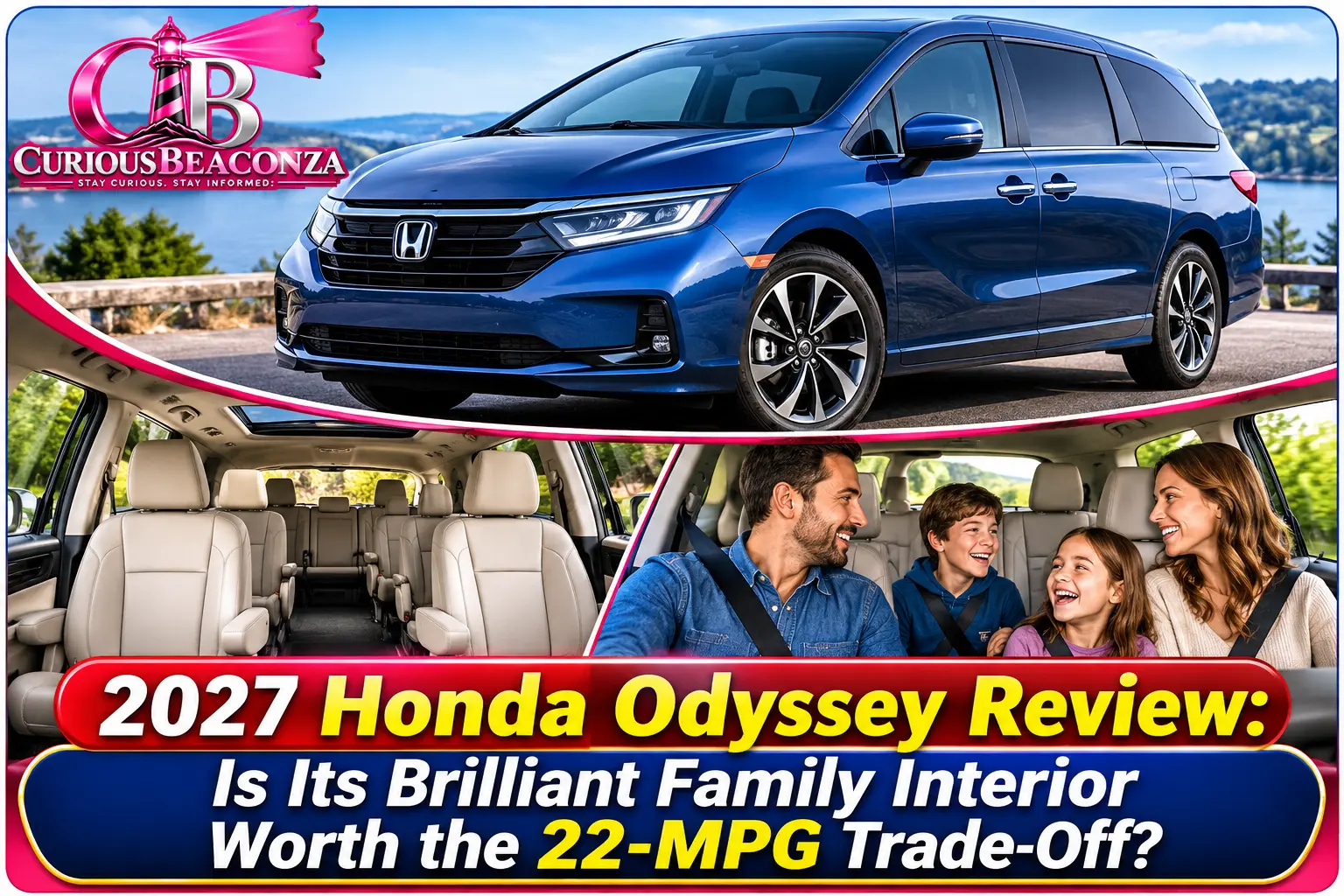
The 2027 Honda Odyssey remains one of the smartest new vehicles for families who value easy child-seat access, adult-friendly third-row space and flexible cargo capacity more than hybrid fuel economy or all-wheel drive. Its Magic Slide second-row seats address real daily frustrations, while its smooth V-6 delivers unusually strong performance for an eight-seat family vehicle.
However, the Honda Odyssey’s 22-mpg combined rating, front-wheel-drive-only layout, modest 9-inch touchscreen and Poor result in one important IIHS crash test prevent an unconditional recommendation. As of November 1, 2026, it starts at $43,195, or $44,790 including destination. For most growing families, the Touring is the best-equipped sweet spot; value-focused buyers should choose the EX-L and let passengers use tablets instead of paying for built-in entertainment hondanews.
How this Honda Odyssey review was researched
This is a research-based evaluation rather than a claimed first-person road test. It combines Honda’s official 2027 pricing and specifications, current IIHS safety results, NHTSA recall information, a car-seat evaluation conducted by certified child-passenger-safety technicians, and instrumented road tests of the refreshed 2025 model.
Those 2025 driving results remain useful context because the 2027 Honda Odyssey has the same listed 3.5-liter V-6, 10-speed automatic transmission, front-wheel-drive layout and major exterior dimensions. Actual performance can still vary by vehicle, tires, road and weather conditions hondanews.
2027 Honda Odyssey specifications at a glance
| Specification | 2027 Honda Odyssey |
|---|---|
| Starting MSRP | $43,195 before destination |
| Base price with destination | $44,790 before options, taxes and registration |
| Engine | 3.5-liter naturally aspirated V-6 |
| Output | 280 horsepower and 262 lb-ft of torque |
| Transmission | 10-speed automatic |
| Drivetrain | Front-wheel drive only |
| EPA fuel economy | 19 city/28 highway/22 combined mpg |
| Seating | Eight in every trim |
| Cargo space | 32.8 cu. ft. behind row three; up to 155.8 cu. ft. maximum |
| Maximum towing capacity | 3,500 pounds |
| Touchscreen | 9 inches |
| Recommended trim | Touring for families; EX-L for value |
Honda’s official specifications confirm that every trim receives the same engine, transmission, seating capacity, fuel-economy ratings and towing limit automobiles.
The real reason to buy one: family geometry
Many reviews concentrate on horsepower and screens. Those features matter, but they are not the Honda Odyssey’s central advantage. Its real strength is how intelligently the interior can be rearranged around children, adults, child seats and cargo.
Every model seats eight and includes a removable second-row center seat. With that center section removed, the two outboard Magic Slide seats can move laterally as well as forward and backward. A parent can slide a child closer to the front, create a central walkway or separate siblings without permanently sacrificing seating capacity automobiles.
The third row is not merely an emergency bench. Honda lists 38.1 inches of third-row legroom, along with 38.3 inches of headroom and 60 inches of shoulder room. Those measurements help explain why the Odyssey can carry adults in all three rows more convincingly than many three-row SUVs automobiles.
This interior flexibility is the Honda Odyssey’s unique value proposition: it reduces everyday friction. Children can enter through low, power-operated sliding doors without swinging a door into the neighboring car. Parents can reach a child more easily. Grandparents do not have to climb over a wheel arch. And the third row can be reached without treating it like a punishment seat.
Car-seat installation is a genuine strength
For households using multiple child restraints, the Honda Odyssey deserves a place near the top of the shopping list.
IIHS gives the current Odyssey a Good+ rating for LATCH ease of use, noting four rear seating positions with complete LATCH hardware and an additional position with a tether anchor. The rating applies to 2018–2027 models iihs.
Cars.com’s certified child-passenger-safety technicians gave the 2025 Odyssey an A for second-row LATCH access, infant-seat installation, rear-facing convertible-seat fit, forward-facing installation and third-row access. With the removable center seat installed, the van can accommodate three child restraints across the second row cars.
There are some details to test personally. Cars.com found that the flexible seat-belt buckles may be difficult for younger booster-seat users to grasp, while the third-row middle belt drops from the ceiling and can interfere with rearward visibility when occupied. Your own seats and children may fit differently, so bring every regularly used restraint to the dealership before buying.
Cargo capacity: enormous, but not completely effortless

Behind the third row, the Honda Odyssey provides 32.8 cubic feet of standard cargo volume, enough to preserve useful luggage or grocery space while carrying a full passenger load. Capacity rises to 86.6 cubic feet behind the second row and 140.7 cubic feet behind the first row under Honda’s standard measurement. The published maximum is as high as 155.8 cubic feet automobiles.
There is an important catch: the third row folds into the floor, but the second-row seats must be physically removed to access maximum cargo space. You therefore need somewhere to store them, and removing them is less convenient than Chrysler Pacifica models whose second-row Stow ’n Go seats fold into the floor. The 2027 Pacifica offers up to 140.5 cubic feet with its seats folded or removed automobiles.
The trade-off is that the Odyssey’s substantial removable seats deliver better everyday passenger comfort and lateral Magic Slide movement. Buyers must decide which kind of flexibility matters more: better people management or faster conversion into a cargo van.
Performance: quicker and quieter than expected
All 2027 Honda Odyssey models use a naturally aspirated 3.5-liter V-6 producing 280 horsepower and 262 lb-ft of torque. A 10-speed automatic sends power to the front wheels, and regular unleaded gasoline is recommended. Maximum towing capacity is 3,500 pounds when the vehicle is properly equipped automobiles.
Car and Driver tested a refreshed 2025 Odyssey Elite at 6.4 seconds from zero to 60 mph, an impressive result for a three-row van weighing more than 4,500 pounds. Its test vehicle also returned 28 mpg in a 75-mph highway fuel-economy test. Because the 2027 model retains the same listed engine and transmission, those figures indicate the kind of performance buyers can reasonably expect, though they are not guaranteed 2027 results caranddriver.
The V-6 should appeal to drivers who dislike the strained sound or gradual response of some four-cylinder hybrids. There is ample power for highway merging, passing and carrying a full passenger load. The 10-speed automatic also allows the engine to remain relaxed during steady cruising.
Ride quality is another strong point. MotorTrend praised the Odyssey’s soft ride and harmonious controls, although its testing revealed noticeable body roll and a long, softly calibrated brake-pedal stroke. Car and Driver similarly identified the brake pedal’s soft initial response as its main dynamic complaint motortrend.
In practical terms, the Honda Odyssey is tuned to transport sleeping children and fragile cargo smoothly, not to imitate a sports sedan. The light steering and softer brake response deserve attention during a test drive, but the overall behavior suits its mission.
Fuel economy is the largest ownership compromise
The EPA rates every 2027 Honda Odyssey at 19 mpg city, 28 highway and 22 combined. There is no hybrid version, and Honda does not offer all-wheel drive. Snow mode adjusts traction-control behavior, but it does not create the additional driven wheels or low-speed traction of a true AWD system automobiles.
The fuel penalty becomes significant for high-mileage or urban drivers. The front-wheel-drive 2026 Toyota Sienna is rated at 36 mpg combined, while the 2027 Kia Carnival Hybrid is rated at 32 mpg combined. The Sienna also offers all-wheel drive toyota.
Consider a hypothetical driver traveling 15,000 miles annually:
- At 22 mpg, the Honda Odyssey would consume approximately 682 gallons.
- At 36 mpg, a Sienna would consume approximately 417 gallons.
- The difference is roughly 265 gallons per year.
- At an assumed $3.50 per gallon, that equals approximately $928 annually.
That calculation is illustrative not a fuel-cost forecast, but it shows why city-heavy families should compare total ownership costs rather than purchase prices alone.
The picture is less severe for long-distance drivers. The Odyssey’s 28-mpg highway rating matches the result Car and Driver recorded in its 75-mph test, so the efficiency gap narrows considerably on road trips caranddriver.
Technology: practical rather than class-leading
Every Honda Odyssey includes a 9-inch touchscreen, a 7-inch digital instrument display, wireless Apple CarPlay, wireless Android Auto and a wireless phone charger. Physical controls remain available for frequently used functions, which may be more convenient than navigating touchscreen menus while driving automobiles.
The interface is functional, but the screen is small by current family-vehicle standards. The 2027 Kia Carnival, for comparison, offers a 12.3-inch touchscreen even on its LXS Hybrid trim kia.
Touring and Elite models add the features that make the Honda Odyssey feel purpose-built for families:
- A 12.8-inch rear entertainment screen
- CabinWatch rear-seat camera
- CabinTalk in-car communication system
- Navigation
- Wi-Fi hotspot capability
- Front and rear parking sensors
- Third-row sunshades
The Elite adds an 11-speaker, 500-watt audio system, ventilated front seats, a heated steering wheel, power-folding mirrors and a hands-free tailgate automobiles.
One frustrating omission is that parking sensors are limited to Touring and Elite models. The Odyssey is 205.2 inches long and has a 39.64-foot turning diameter, so parking assistance would be genuinely useful on every trim, not merely a luxury upgrade.
Safety: strong equipment, but one result cannot be ignored
Every trim includes forward collision warning, automatic emergency braking with pedestrian detection, adaptive cruise control with low-speed follow, lane-departure warning, lane-keeping assistance, road-departure mitigation, blind-spot monitoring, rear cross-traffic monitoring and automatic high beams automobiles.
The current IIHS results are mixed:
- Good: driver- and passenger-side small-overlap protection
- Good: updated side-impact test
- Acceptable: headlights
- Acceptable: pedestrian crash prevention
- Good: seat-belt reminders
- Good+: LATCH ease of use
- Poor: updated moderate-overlap front test
In the updated moderate-overlap test, the structure and driver protection were rated Good, but the rear passenger received a Poor head-and-neck injury rating and a Marginal chest rating. That result applies to 2023–2027 Honda Odyssey models.
This does not mean the Odyssey performs badly in every crash scenario. It means shoppers should avoid relying on a single badge or overall score. For a vehicle designed primarily to carry families, the rear-occupant result deserves serious consideration alongside its strong side-impact, small-overlap and child-seat-anchor performance.
Which 2027 Honda Odyssey trim should you buy?
| Trim | Price including destination | Best for | Important features |
|---|---|---|---|
| EX-L | $44,790 | Best value | HondaTex seats, heated front seats, power doors and tailgate, Magic Slide seats, wireless phone integration |
| Sport-L | $45,890 | Style-focused buyers | 19-inch black wheels, red stitching and sport-themed trim |
| Touring | $49,490 | Most families | Leather, parking sensors, CabinWatch, 12.8-inch entertainment screen, navigation and third-row sunshades |
| Elite | $53,690 | Maximum comfort | Ventilated seats, heated wheel, premium audio, acoustic side glass, folding mirrors and hands-free tailgate |
Prices include Honda’s $1,595 destination charge but exclude taxes, registration, options and premium paint hondanews.
Best value: EX-L
The EX-L contains nearly every functional feature that defines the Honda Odyssey: eight seats, Magic Slide capability, power sliding doors, a power tailgate, heated front seats, tri-zone climate control, second-row sunshades and wireless smartphone integration.
Despite its name, the 2027 EX-L uses HondaTex upholstery rather than leather. Buyers wanting genuine leather must move to the Touring automobiles.
Best overall: Touring
The Touring is the recommendation for families who regularly use all three rows. Its parking sensors make a long van easier to position, while CabinWatch, third-row charging, rear entertainment and third-row sunshades are features passengers can use daily, not decorative upgrades.
The $4,700 MSRP difference over the EX-L is substantial, but the Touring represents a more meaningful functional upgrade than the appearance-focused Sport-L.
Elite: desirable but unnecessary
The Elite is comfortable and quiet, particularly for drivers facing hot summers or cold winters. However, its $53,690 delivered price enters territory occupied by efficient hybrid and AWD alternatives. Choose it because you specifically want ventilated seats, enhanced acoustic glass and better audio, not because it carries people or cargo more effectively.
Honda Odyssey reliability and recall considerations
The 2027 Honda Odyssey is too new to have meaningful long-term reliability data. Buyers should not assume that past brand reputation automatically predicts the ownership experience of a newly manufactured vehicle.
Honda includes scheduled maintenance for the first 12 months or 12,000 miles through Honda Service Pass. Coverage includes the first qualifying oil and filter change, tire rotation and multipoint inspection hondainfocenter.
Used-vehicle shoppers need to be particularly careful. NHTSA recall campaign 26V332 includes certain 2018–2026 Honda Odyssey models for a front-passenger seat-weight sensor that could affect airbag operation. The listed recall population does not include the 2027 model, but every new or used vehicle should still be checked by VIN because recall information can change static.nhtsa.gov
Who should buy the Honda Odyssey?
Buy it if you:
- Carry three or more children regularly.
- Need three child restraints across the second row.
- Want a third row that adults can use.
- Prefer strong V-6 performance to maximum fuel economy.
- Frequently alternate between passenger and cargo duty.
- Value sliding doors and flexible seating more than SUV styling.
Consider something else if you:
- Drive enough city miles to make hybrid savings meaningful.
- Require all-wheel drive.
- Want a larger, more contemporary digital interface.
- Need second-row seats that disappear into the floor.
- Are uncomfortable with the IIHS updated moderate-overlap result.
The Toyota Sienna is the logical alternative for fuel economy and AWD; the Kia Carnival Hybrid offers better efficiency and more modern cabin technology; and the Chrysler Pacifica deserves consideration when fold-flat second-row seating or AWD is the priority toyota.
Final verdict: Is the 2027 Honda Odyssey worth buying?
Yes, provided you are buying it for what it does exceptionally well. The 2027 Honda Odyssey is not the efficiency leader, technology leader or all-weather leader. It is the family-organization leader: spacious, quick, quiet, car-seat-friendly and unusually adaptable to changing passenger needs.
The EX-L is the sensible purchase for buyers who want maximum utility at the lowest price. The Touring is the better long-term choice for families who will use the third row, parking sensors, CabinWatch and entertainment system regularly. The Elite is a comfort upgrade rather than a practical necessity.
The deciding test is not a highway acceleration run. Load your child seats, stroller, sports bags and regular passengers into the van. Move the Magic Slide seats. Enter the third row. Park it in a tight space. If those tasks become noticeably easier, the Honda Odyssey’s value will be clear every day, even when the fuel receipt reminds you why hybrid rivals remain compelling.