
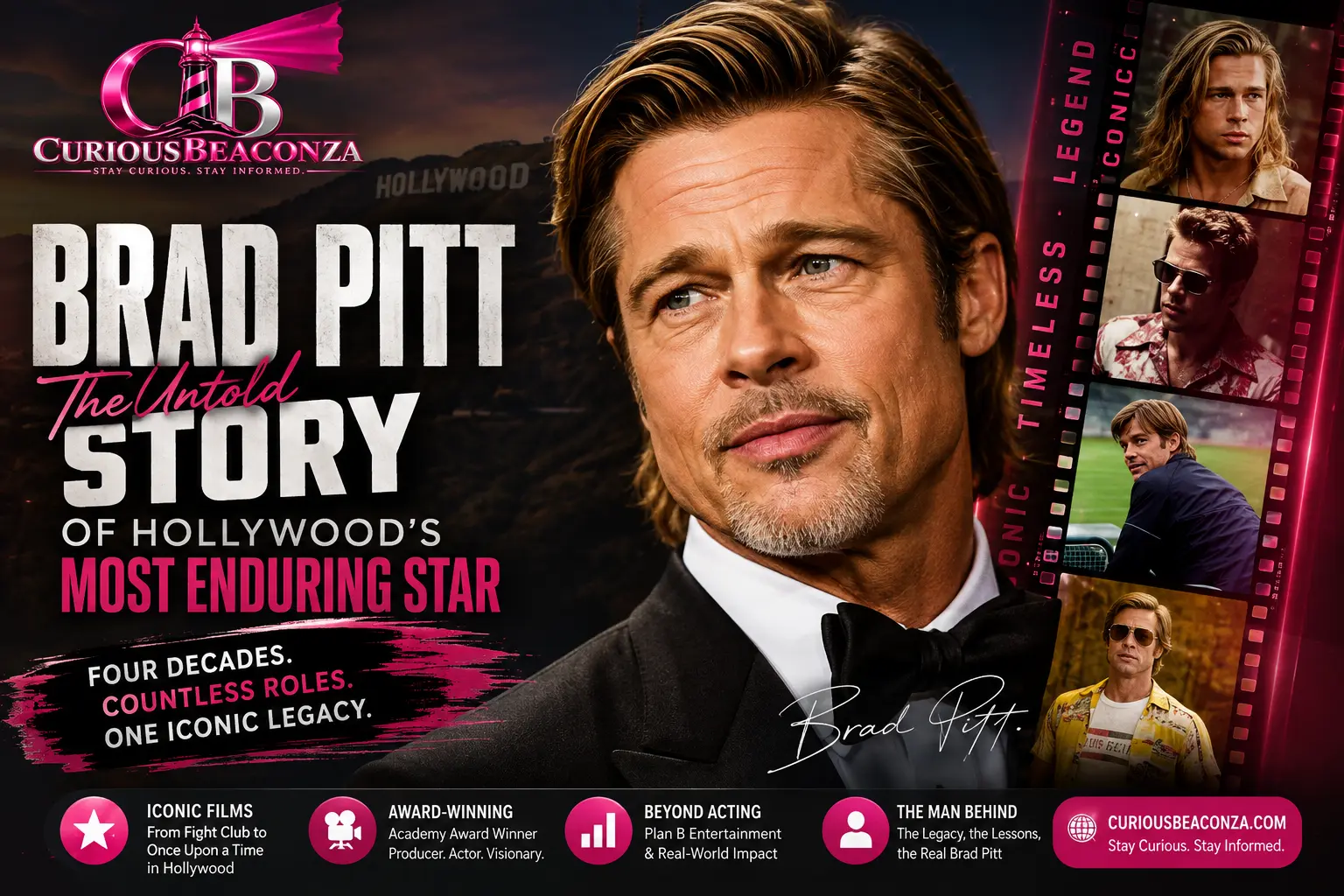
Few names in modern entertainment carry the weight that Brad Pitt does. He’s been a heartthrob, a serious dramatic actor, a producer with an Oscar on his shelf, and, more recently, a symbol of quiet reinvention in an industry that rarely lets its biggest stars grow old gracefully. More than three decades after he first caught the public’s eye, Brad Pitt is still headlining major productions, still selling out theaters, and still generating headlines not because of manufactured controversy, but because his work keeps holding up.
This remarkable longevity can be attributed not only to his undeniable talent but also to his keen choice of projects that often challenge the status quo. From the gritty realism of Fight Club to the poignant storytelling of Once Upon a Time in Hollywood, Pitt has consistently sought roles that push boundaries and provoke thought.
His recent collaborations with visionary directors showcase an artist willing to evolve, adapting to the shifting landscape of cinema while still maintaining his distinctive presence. As audiences have become more discerning, his ability to resonate with both critics and fans speaks volumes about his commitment to authentic storytelling. In a world where fleeting fame often overshadows substance, Brad Pitt remains a beacon of resilience and artistry, reminding us that true stars shine brightest when they embrace complexity and vulnerability.
This article breaks down who Brad Pitt really is beneath the tabloid noise: his career trajectory, the roles that defined him, his business ventures, and why his story continues to resonate with audiences and aspiring actors alike. If you’ve ever wondered what makes Brad Pitt different from the dozens of other leading men who came up in the same era, the answer lies in one word adaptability.
Early Life: From Springfield, Missouri to Hollywood
William Bradley Pitt was born in Shawnee, Oklahoma, and raised in Springfield, Missouri, a place about as far from the glamour of Los Angeles as you can imagine. He studied journalism at the University of Missouri, with an eye toward advertising, but famously left just two credits shy of graduation to chase acting in Los Angeles. Upon arriving in Hollywood, Pitt faced the harsh realities of an industry that often favors the established over the aspiring. He took on a series of minor roles in television shows and films, gradually building his resume while honing his craft.
It wasn’t until his breakout performance in “Thelma & Louise” that he captured the attention of audiences and critics alike, showcasing not just his striking looks but also his undeniable talent. This pivotal moment set the stage for a career that would see him evolve into one of the most versatile actors of his generation, effortlessly transitioning from heartthrob to serious actor, and eventually, a respected producer.
That decision is often glossed over in celebrity profiles, but it’s actually the most instructive part of his story. Pitt didn’t arrive in Hollywood with connections, a famous last name, or a guaranteed audition. He drove limos, dressed up as a giant chicken for a fast-food chain, and took small television roles before anyone knew his name. It’s a classic underdog beginning and it’s part of why his eventual success feels earned rather than handed to him.
The Breakthrough: Thelma & Louise and Beyond

Brad Pitt’s first real moment in the spotlight came with a relatively small role as a charming drifter in Thelma & Louise (1991). It wasn’t a lead role, but it was the kind of performance that makes casting directors sit up. From there, his career accelerated quickly with a string of films that showcased his range:
- A River Runs Through It (1992) — established him as a leading man with emotional depth
- Legends of the Fall (1994) — cemented his status as a bona fide heartthrob
- Se7en (1995) — proved he could handle dark, psychologically demanding material
- 12 Monkeys (1995) — earned him his first Academy Award nomination
- Fight Club (1999) — became a cult classic and one of the most quoted films of its generation
What’s notable about this stretch of his career is the variety. Rather than settling into one genre or persona, Pitt moved fluidly between romantic drama, psychological thriller, and dark comedy. That refusal to be boxed in became a career-long pattern.
Building a Legacy: Signature Roles That Defined a Career
By the 2000s, Brad Pitt had shifted from “promising young star” to established leading man, and his role choices reflected a deliberate strategy of mixing blockbuster appeal with critically respected work.
The Ocean’s trilogy, alongside George Clooney and an ensemble of A-list actors, showed his effortless charisma in big-budget, crowd-pleasing entertainment. Meanwhile, films like The Assassination of Jesse James by the Coward Robert Ford, Babel, and The Curious Case of Benjamin Button demonstrated his willingness to take artistic risks, often working with acclaimed directors rather than chasing the biggest paycheck.
His performance in Moneyball (2011) earned widespread critical praise and another Oscar nomination, proving he could anchor a film with subtlety rather than spectacle. Then came 12 Years a Slave, which he also produced — a signal that Pitt was becoming as influential behind the camera as in front of it.
The turning point for many critics was Once Upon a Time in Hollywood (2019), where his performance as stuntman Cliff Booth won him his first Academy Award for acting, after years of nominations. It was widely seen as a career-culminating moment a role that let him be funny, cool, and quietly devastating all at once.
Brad Pitt the Producer: Plan B Entertainment
What separates Brad Pitt from many of his peers is his second career as a producer. Through his production company, Plan B Entertainment, he has backed some of the most acclaimed films of the last two decades, including 12 Years a Slave, Moonlight, and The Big Short all of which won or were nominated for Best Picture.
This is a crucial part of understanding his lasting relevance. Plenty of actors start production companies as vanity projects. Plan B has instead built a reputation for backing serious, often socially conscious filmmaking, giving Pitt influence over the kinds of stories that get told in Hollywood, not just the roles he personally plays.
A Quick Look: Brad Pitt’s Career at a Glance
| Category | Details |
|---|---|
| Full Name | William Bradley Pitt |
| Born | December 18, 1963, Shawnee, Oklahoma |
| Breakthrough Role | Thelma & Louise (1991) |
| Signature Films | Se7en, Fight Club, Ocean’s Eleven, Moneyball, Once Upon a Time in Hollywood |
| Academy Award (Acting) | Best Supporting Actor, Once Upon a Time in Hollywood (2020) |
| Academy Award (Producing) | Best Picture, 12 Years a Slave (2014) |
| Production Company | Plan B Entertainment |
| Other Ventures | Skincare and lifestyle brand, winery investment, architecture and design projects |
| Notable 2026 Projects | The Adventures of Cliff Booth, Heart of the Beast, The Riders |
Life Beyond the Screen: Business and Passion Projects
Brad Pitt has never limited himself to acting and producing. He’s spoken openly about his fascination with architecture and design, going as far as studying under respected architects and lending his name to housing rebuilding efforts after natural disasters. He co-founded a skincare line and has invested in a winery in the south of France, reflecting an interest in craftsmanship that extends well beyond film sets.
This diversification matters for his public image. Rather than being a celebrity who simply endorses products for a paycheck, Pitt has cultivated ventures that seem to align with genuine personal interests something audiences tend to respect more than obvious cash grabs.
Why Brad Pitt’s Career Strategy Still Works
Here’s my honest take: what makes Brad Pitt’s career genuinely remarkable isn’t just talent it’s pacing. Many actors who become heartthrob-status stars in their twenties either fade out or get stuck playing variations of the same character for the rest of their careers. Pitt did the opposite. He used his early fame as leverage to take creative risks in his thirties and forties, then used the credibility from those risks to become a producer with real industry influence in his fifties and sixties.
That’s a rare career arc, and it’s instructive beyond Hollywood. It’s a lesson in using early success not as a finish line, but as capital to reinvest into longer-term relevance. Most actors chase the next big role. Pitt has spent the last fifteen years chasing the next interesting one and that distinction has kept him culturally relevant far longer than his early 90s contemporaries.
What’s Next for Brad Pitt in 2026 and Beyond
Brad Pitt’s slate for 2026 shows no signs of slowing down. <cite index=”1-1,5-1″>He’s reprising the role of stuntman Cliff Booth in a sequel to Once Upon a Time in Hollywood, while also starring in the survival thriller Heart of the Beast, playing a former Special Forces soldier navigating the Alaskan wilderness with his combat dog after a plane crash.</cite> <cite index=”3-1″>He’s also attached to Jeff Nichols’ dystopian drama Land of Opportunity, and there’s continued buzz around a long-awaited Ocean’s Eleven franchise revival, Ocean’s 14, reuniting him with original cast members including George Clooney, Julia Roberts, and Matt Damon.</cite>
This mix of legacy franchise work and new creative partnerships is a pattern worth watching. It suggests Pitt isn’t interested in coasting on nostalgia alone, nor is he abandoning the properties that built his career. Instead, he’s doing both at once a balancing act few actors his age manage successfully.
Lessons From Brad Pitt’s Career
For anyone studying long-term career longevity whether in entertainment or otherwise Brad Pitt’s trajectory offers a few clear takeaways:
- Range beats typecasting. Constantly shifting between genres kept him from being pigeonholed.
- Behind-the-scenes influence extends relevance. Producing gave him a second career track that doesn’t rely on aging gracefully in front of the camera.
- Diversify outside your core skill. His ventures in design, skincare, and wine show the value of interests that exist independently of fame.
- Patience pays off. It took nearly three decades of nominations before his first acting Oscar — a reminder that recognition often lags behind quality work.
Final Thoughts
Brad Pitt’s career isn’t a straight line from stardom to legend it’s a series of deliberate pivots, calculated risks, and a willingness to be patient with recognition. That’s rare in an industry built on instant fame and even faster burnout. Whether you’re a longtime fan or new to his filmography, there’s a genuine lesson in longevity buried in his story: talent gets you noticed, but adaptability is what keeps you relevant. Pitt’s choices reflect a profound understanding of both the craft and the market; he seamlessly transitions from blockbuster hits to indie gems, showcasing his versatility while also embracing roles that challenge societal norms and push artistic boundaries.
This willingness to explore complex characters, often in films that might not guarantee box office success, reveals an artist unafraid to risk his star power for something deeper. Each project becomes a testament to his belief that true artistry lies not just in the accolades but in the stories told and the impact they leave behind. As he steps into the producer’s role with Plan B Entertainment, he further cements his legacy, championing narratives that might otherwise go unheard, proving that his influence extends far beyond the silver screen.
Frequently Asked Questions
What is Brad Pitt best known for? Brad Pitt is best known for films like Fight Club, Se7en, the Ocean’s franchise, and Once Upon a Time in Hollywood, for which he won his first Academy Award for acting.
Does Brad Pitt produce movies as well as act in them? Yes. Through his production company, Plan B Entertainment, Pitt has produced acclaimed films including 12 Years a Slave, Moonlight, and The Big Short.
What is Brad Pitt working on in 2026? His upcoming projects include a sequel centered on his Once Upon a Time in Hollywood character Cliff Booth, the survival thriller Heart of the Beast, and the dystopian drama Land of Opportunity.
Read Also: Jovan Arriaga: The Fascinating Life of Selena’s Nephew
[…] Read Also: Brad Pitt: The Remarkable Story of Hollywood’s Enduring Star […]
[…] an era where the boundaries between music and film often blurred, their paths crossed in ways that would echo through the annals of pop culture, […]
[…] by Fortune as one of the Most Powerful Women in business and received the Thomas A. Edison Legacy Award from the Edison Electric Institute (EEI) in March […]
[…] personal life has been subject to intense public scrutiny in Hollywood. She was married to Ryan Reynolds from 2008 to 2011, to Romain Dauriac from 2014 to 2017 (with whom […]