
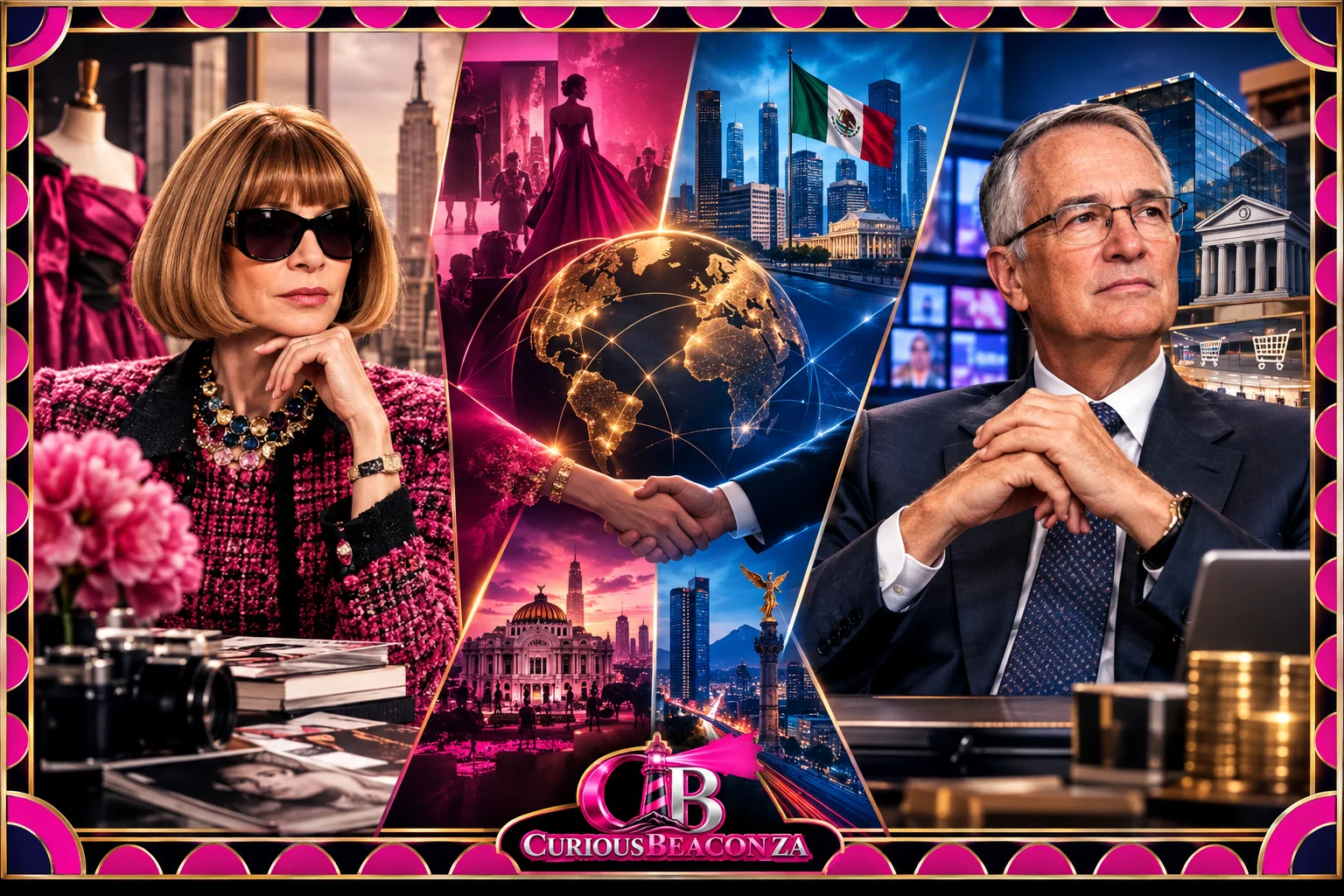
Anna Wintour and Ricardo Salinas Pliego are two of the most powerful figures in their respective fields, one commands global fashion from Vogue’s corner office, the other controls a sprawling Mexican business empire spanning banking, media, and retail. Anna Wintour is the legendary editor who transformed Vogue into a cultural powerhouse and inspired The Devil Wears Prada. Ricardo Salinas Pliego is Mexico’s combative billionaire whose Grupo Salinas empire includes TV Azteca and Banco Azteca, and who now finds himself in a high-stakes battle with the Mexican government over billions in taxes. While they occupy vastly different worlds, both exemplify how ambition, controversy, and strategic power shape modern influence.
| Event | Anna Wintour | Ricardo Salinas Pliego |
|---|---|---|
| Born | 1949, London | 1955, Mexico City |
| Known For | Editor-in-Chief, US Vogue (1988–2025) | Founder/Chairman, Grupo Salinas |
| Net Worth | Not publicly disclosed; estimated in the hundreds of millions | $3.7 billion (Forbes, 2026) |
| Signature Entity | Vogue / Condé Nast | TV Azteca / Banco Azteca / Elektra |
| Current Role | Global Editorial Director, Vogue; Chief Content Officer, Condé Nast | Battling $1.9B+ tax settlement; shares suspended |
Who Is Anna Wintour?
The Making of Fashion’s Most Powerful Editor
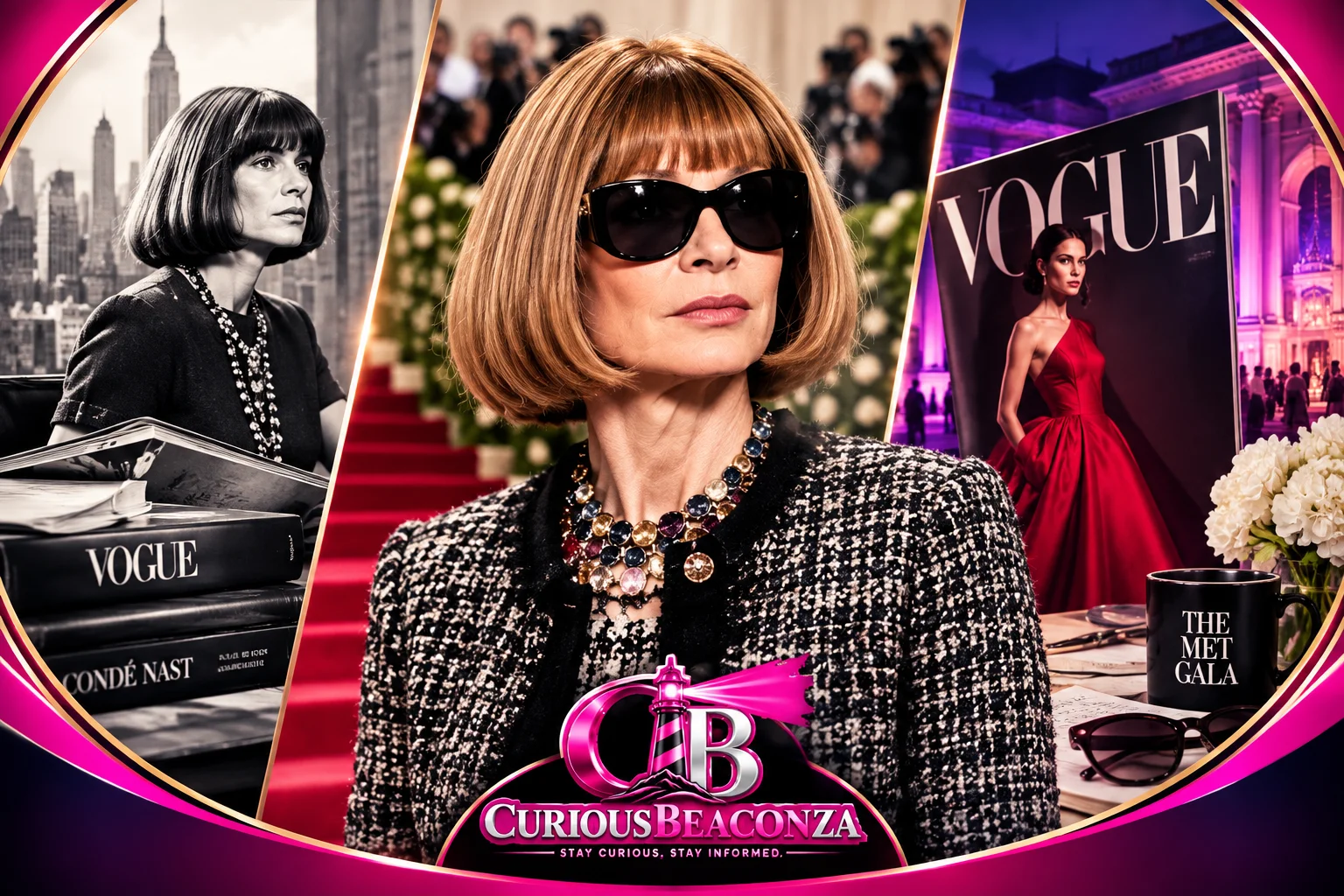
Anna Wintour was born in London in 1949 and grew up surrounded by journalism, her father, Charles Wintour, was the influential editor of the Evening Standard. After dropping out of school, she worked in a boutique before landing her first magazine job as an editorial assistant at Harper’s & Queen in the early 1970s. Her rise was neither linear nor easy: she was fired from Harper’s Bazaar after nine months, then worked at Viva and Savvy before joining New York magazine as fashion editor.
Condé Nast came calling in the early 1980s, and Wintour joined Vogue as its first creative director. The transition was brutal. She famously told then-editor Grace Mirabella that she wanted her job, and got it in 1988 after Mirabella was ousted. Her nickname, “Nuclear Wintour,” captured her reputation for ruthless efficiency and an uncompromising editorial vision.
Reshaping Vogue and Fashion Itself
Wintour’s first Vogue cover in November 1988 featured model Michaela Bercu in a $50 Christian Lacroix jacket paired with $100 jeans, a startling departure from Vogue’s polished close-ups. The magazine’s printers actually called to ask if there had been a mistake. That single image signaled a fundamental shift: fashion could be approachable, youthful, and culturally attuned. She also foresaw the celebrity cover strategy before her competitors, arguably changing the economics of magazine publishing.
Over nearly four decades, Wintour became the most recognizable figure in fashion, with her signature bob and sunglasses. She was made a British dame in 2017 and a Companion of Honour in 2025. She inspired Miranda Priestly in The Devil Wears Prada, though the book and film painted a far harsher portrait than many who actually worked with her describe.
Wintour’s Legacy and Transition
In June 2025, Wintour stepped down as US Vogue’s editor after 37 years, though she remains global editorial director and Condé Nast’s chief content officer, overseeing publications including Wired, Vanity Fair, and GQ. Her influence now extends beyond fashion into the Met Gala, which she has transformed into one of the most lucrative celebrity events in the world.
Her current role is broader than many realize. As Condé Nast’s chief content officer and Vogue’s global editorial director, Wintour oversees every major Condé Nast brand globally, including Wired, Vanity Fair, GQ, AD, Glamour, Bon Appétit, Tatler, and Allure, with the sole exception of The New Yorker. This means her editorial fingerprints remain on publications that reach tens of millions of readers across radically different interest areas, from technology to food to architecture. The Met Gala, which she has chaired since 1995, has become a fundraising juggernaut for the Metropolitan Museum of Art’s Costume Institute, generating record-breaking revenues year after year and cementing the event as a global cultural moment rather than a niche fashion dinner.
Who Is Ricardo Salinas Pliego?
From Family Business to Billionaire
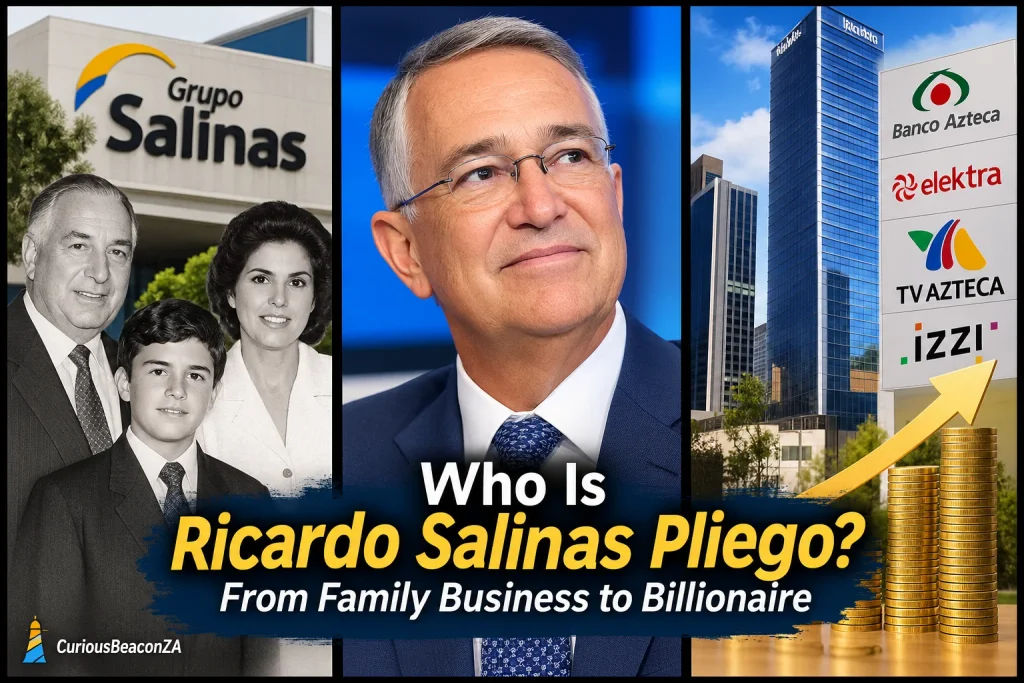
Ricardo Benjamín Salinas Pliego was born in Mexico City in 1955 and inherited both an entrepreneurial drive and a deeply austere upbringing. His father, Hugo Salinas Rocha, founder of the Elektra retail chain, kept the family on a tight budget despite their wealth, a fact Salinas has said taught him the value of earning money. He earned an accounting degree from Tecnológico de Monterrey and an MBA from Tulane University before joining the family business.
When Mexico’s economy collapsed in 1982, Elektra went bankrupt. Salinas became CEO at just 32 and engineered a remarkable turnaround. By reducing dependence on credit and slashing operational costs, he grew Elektra from 50 stores to nearly 400 within a decade. Today, Grupo Elektra operates thousands of locations across Latin America.
How the TV Azteca Deal Really Worked
The 1993 acquisition of Imevisión was not a simple cash purchase. Salinas has acknowledged that he had only around $400 million of the $645-650 million purchase price when he won the bidding. To close the gap, he issued convertible debt, and one of the investors who bought into that debt was Raúl Salinas de Gortari, brother of then-President Carlos Salinas de Gortari, who contributed approximately $29 million.
This detail has fueled decades of speculation about political favoritism. In a 2022 interview with Pati Chapoy, Salinas explained that Raúl Salinas had been part of a competing bidding group, and when Salinas won, Raúl asked for “his part.” Salinas’s response, as he recalled it: “No, buddy, you were in another group, see you later.” But he allowed Raúl to participate in the debt structure instead
Building the Grupo Salinas Empire
Salinas’s pivotal move came in 1993, when he acquired the state-owned network Imevisión for $645 million, transforming it into TV Azteca, Mexico’s second-largest broadcaster and a genuine competitor to Televisa. In 2002, he launched Banco Azteca, embedding bank branches inside Elektra stores to serve Mexico’s unbanked “base of the pyramid”. The bank used biometric verification and kept extended hours, making financial services accessible to informal workers who had been excluded from traditional banking.
Today, Grupo Salinas employs over 116,000 people across six countries, with interests spanning retail, banking, telecommunications (Total Play), broadcasting, and even motorcycle manufacturing (Italika). Salinas’s personal fortune was estimated at $4.9 billion by Forbes in late 2025, down significantly from $13.4 billion a year earlier due to his legal battles.
The Battles That Define Salinas
Salinas has never avoided conflict. In 2005, the U.S. SEC accused him of using insider information for a $109 million personal gain; he settled for $8.5 million without admitting wrongdoing and was barred from serving as an officer or director of U.S. public companies for five years. He has faced repeated disputes over unpaid bills, including a 2022 New York ruling ordering TV Azteca to pay $24 million to Diamond Films.
His most consequential fight is with Mexican President Claudia Sheinbaum’s government. Authorities claim Salinas’s companies owe roughly $4 billion in back taxes; he disputes the figure and has offered $400 million. In November 2025, Mexico’s Supreme Court unanimously upheld $2.5 billion in tax claims, and two of his casinos were shut down amid money-laundering investigations. Salinas has framed himself as a victim of political persecution, channeling public anger and positioning himself as a potential presidential contender, some supporters compare him to Donald Trump or Javier Milei.
The stakes extend far beyond Salinas’s personal fortune. Grupo Elektra, the crown jewel of his empire, agreed in 2026 to pay nearly $1.9 billion to settle the government’s tax claims. That’s a massive outflow for a conglomerate that employs over 110,000 people. More significantly, the dispute has become a proxy war over the role of private power in Mexico.
Salinas has used his media platforms to cast the government’s actions as authoritarian overreach, while critics argue he represents a class of oligarchs who built fortunes through political connections rather than pure merit. His supporters’ comparisons to Trump and Milei are not casual, they reflect a genuine political realignment in which business titans position themselves as anti-establishment outsiders, regardless of how establishment their own histories might be.
Comparing the Two Titans
| Aspect | Anna Wintour | Ricardo Salinas Pliego |
|---|---|---|
| Field | Fashion media | Diversified business (media, banking, retail) |
| Base | New York / London | Mexico City |
| Key Entity | Vogue / Condé Nast | Grupo Salinas / TV Azteca |
| Source of Power | Cultural influence, editorial control | Media ownership, financial services, political connections |
| Controversy Style | Cold, exacting management; “Nuclear Wintour” | Aggressive litigation, political confrontation, tax disputes |
| Public Persona | Enigmatic, polished, reserved | Combative, populist, self-styled anti-establishment |
| Current Status | Stepped down as US Vogue editor (2025); still Condé Nast executive | Facing $4B tax battle; wealth declining amid legal pressure |
| Defining Controversy | Accused of fostering a toxic workplace culture; the “Nuclear Wintour” label and The Devil Wears Prada caricature | Tax disputes totaling billions; SEC settlement; political confrontations with Mexican government |
Is There a Connection Between Anna Wintour and Ricardo Salinas?
Beyond their shared status as powerful figures, there is no documented professional relationship or partnership between Anna Wintour and Ricardo Salinas Pliego. They operate in entirely different spheres: Wintour in global fashion and publishing, Salinas in Mexican media, banking, and retail. Their paths have not publicly intersected in any significant way.
However, the pairing is not arbitrary. The more useful question is not whether they’ve met, but what their parallel lives reveal. Both built institutions that became extensions of their personalities. Vogue under Wintour is not just a magazine; it is her taste, her priorities, her vision of what matters. Grupo Salinas is not just a conglomerate; it is his empire, his fight, his narrative of persecution and triumph.
This personalization is both their greatest strength and their most glaring vulnerability. When the institution is the person, succession becomes existential and criticism becomes personal. Wintour’s 2025 transition was carefully managed to avoid this trap; Salinas’s battle with the Mexican government suggests he has no such plans. Both represent a specific archetype: the individual who built an institution around their personal vision and became inseparable from it. Both have faced accusations of wielding power ruthlessly. And both have demonstrated that in their respective worlds, fashion and Mexican business, institutional power and personal mythology are deeply intertwined.
Final Analysis: What These Two Reveal About Modern Power
Anna Wintour and Ricardo Salinas Pliego offer contrasting templates for how influence is built and maintained.
Wintour’s power is cultural and aesthetic. She shapes what people wear, what designers become famous, and what “good taste” means. Her authority comes from an almost mystical ability to sense cultural currents before they become obvious, and from an uncompromising willingness to enforce her vision.
Salinas’s power is structural and confrontational. He controls infrastructure: television signals, bank branches, retail shelves. His influence comes from occupying space in people’s daily lives and from his willingness to fight anyone, regulators, competitors, presidents, who threatens that occupation.
What unites them is a refusal to be constrained by conventional limits. Wintour was told fashion wasn’t serious enough; she made Vogue a cultural institution. Salinas was told he couldn’t build a bank for poor people; he did it anyway and made it one of his most profitable ventures. Whether you admire or criticize them, both demonstrate that lasting power in any field requires a certain willingness to be disliked, and to keep going anyway.