
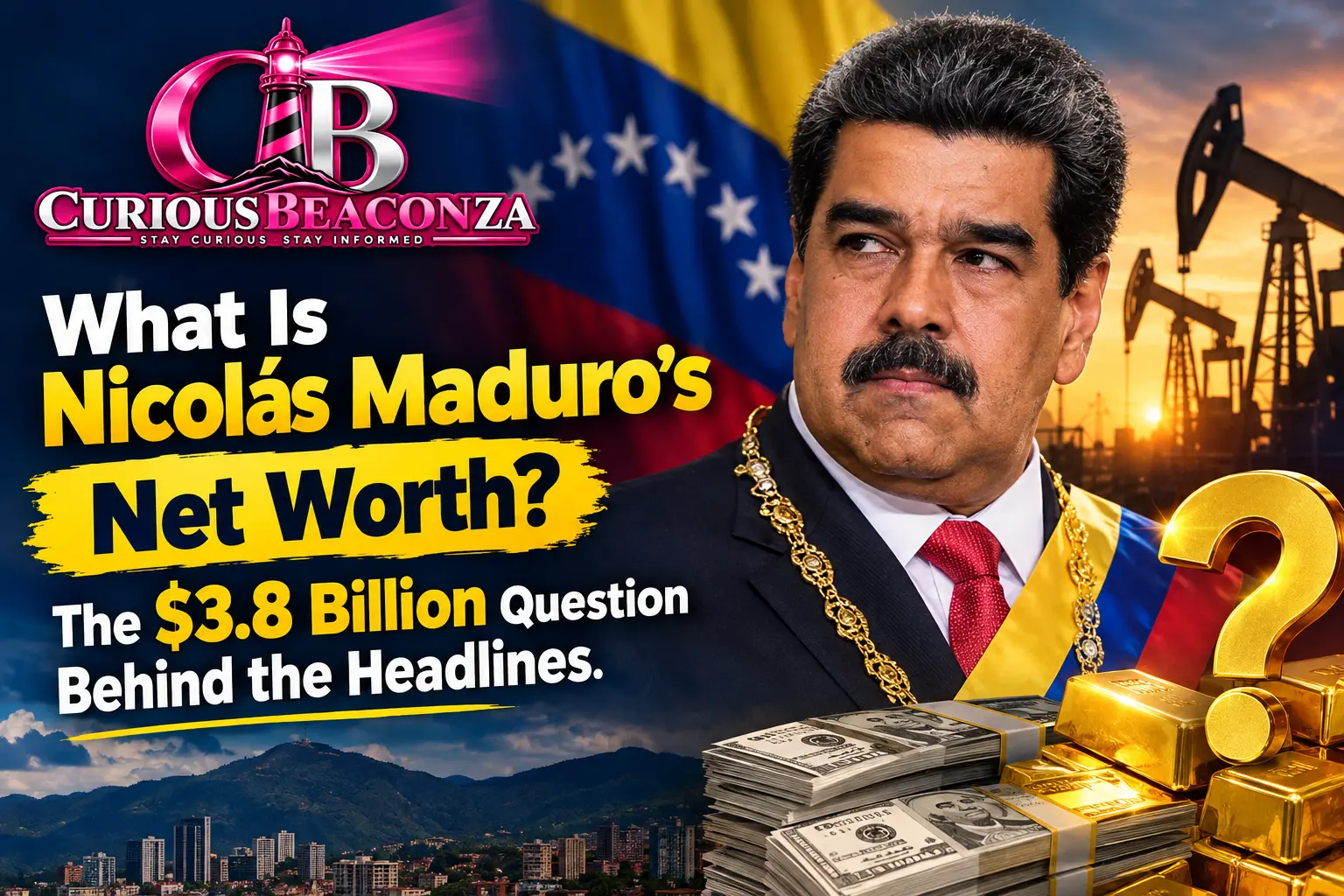
There is no verified, official figure for Nicolás Maduro net worth. The most widely cited estimate of $3.8 billion comes from Transparencia Venezuela, which describes it as a provisional estimate of wealth accumulated over two decades of Chavista control. Maduro, meanwhile, claims he earns just $120 per month as president, reportedly paid in “two petros,” Venezuela’s state-created cryptocurrency. The truth remains uncertain, caught between a self-reported salary that has drawn skepticism and a multibillion-dollar estimate that no independent auditor has confirmed. Understanding Nicolás Maduro net worth is not simply a matter of accounting; it also reveals how political power, financial secrecy, and international sanctions can make tracing a leader’s wealth extraordinarily difficult, and why uncovering the facts still matters.
The Two Men in the Mirror: A President Who Claims Poverty and Investigators Who See a Fortune
When you search for Nicolás Maduro net worth, you are stepping into a paradox that defines modern Venezuelan politics. On one side stands a man who calls himself a “working president” (presidente obrero), insists he has “only one little savings account,” and jokes that his wife, Cilia Flores, spends his salary before he can touch it La Nación. On the other stands a mountain of investigative reporting, sanctions documents, and seized assets suggesting a fortune spanning Miami, the Dominican Republic, Switzerland, and beyond.
This is not a case of disputed bookkeeping. It is a case of designed opacity. Venezuela does not publish presidential financial disclosures. Transparencia Venezuela has explicitly stated that there is no publicly verifiable information about Maduro’s salary or personal assets La Nación. Every figure you encounter, including the $3.8 billion estimate, is built from fragments: a seized jet here, a sanctioned relative there, a property record uncovered by a journalist. Understanding Maduro’s net worth means understanding why the number cannot be known, and what that unknowability reveals about how impunity works.
Maduro’s Own Numbers: $120 a Month and a “Little Savings Account”
In late December 2025, just days before his capture by U.S. forces, Maduro made a public statement that would have been remarkable in any political context. Speaking at a community event in Macarao, Caracas, he declared that his monthly presidential salary amounted to “two petros”, Venezuela’s state-created cryptocurrency, which at the government’s official rate equals roughly $120.
“I have only one little savings account where they deposit my little presidential salary, which I barely even see,” Maduro said, adding with a smile that his wife usually got to the money first. He insisted: “I am not a tycoon, nor do I want material wealth for my life”.
There is a problem with this narrative. No independent mechanism exists to verify it. Transparencia Venezuela, the local chapter of Transparency International, has confirmed that Venezuela publishes no presidential asset declarations and no auditable salary records. The “two petros” figure is self-reported, denominated in a currency Maduro himself created, and critically, at odds with the lifestyle and assets attributed to him by international investigators.
For context, the contrast with ordinary Venezuelans is stark. At the time of Maduro’s statement, Venezuela’s minimum wage was 130 bolívares per month, about 50 cents La Nación. Maduro’s claimed $120 was already 240 times the minimum wage. And if the $3.8 billion estimate is even partially accurate, his actual economic reality is something else entirely.
The $3.8 Billion Estimate: Where It Comes From and What It Actually Means
The most frequently cited figure in discussions of Nicolás Maduro net worth is $3.8 billion. This number originates from Transparencia Venezuela, which described it as a “provisional estimate” of wealth accumulated during more than two decades of chavista control over Venezuela’s state institutions and oil wealth.
Crucially, this is not an audited figure. It is not derived from bank records, property registries, or corporate filings. It is an estimate built from patterns of corruption, known asset seizures, and the testimonies of former officials and cooperating witnesses. Transparencia Venezuela has been careful to frame it as a working figure rather than a definitive accounting.
What makes the estimate plausible to investigators is the pattern of assets attributed to Maduro and his inner circle:
Reports in international media and statements from U.S. officials have mentioned asset seizures linked to Maduro, but no single verified figure has been confirmed by an official U.S. government source accessible in this search. This represents only the traceable portion of the alleged fortune, the assets investigators could locate and legally attach.
Why the Numbers Don’t Add Up
The gap between $120 a month and $3.8 billion is not a mere accounting discrepancy. It is the central tension in understanding Maduro’s wealth: the mechanisms of concealment are designed to make verification impossible.
According to U.S. authorities and investigative journalists, Maduro’s assets are distributed globally through testaferros, frontmen and straw owners who hold property and accounts in their names. This structure is not unique to Venezuela; it is the standard architecture of high-level political corruption. The result is that any net worth figure is necessarily an estimate built from fragments: a seized jet here, a sanctioned associate there, a property record uncovered by a journalist.
Switzerland’s response to Maduro’s capture illustrates how seriously international authorities take this hidden wealth. On January 5, 2026, two days after Maduro’s detention, the Swiss Federal Council ordered the preventive freezing of any assets that Maduro and his associates might hold in Switzerland Swiss Federal Council. The freeze is valid for four years and is based on the Federal Act on the Freezing and Restitution of Illicit Assets Held by Foreign Politically Exposed Persons (FIAA). Switzerland has committed to returning any proven illicit funds “for the benefit of the Venezuelan people” Swiss Federal Council.
What makes the Swiss action significant is its legal logic. The freeze does not require a criminal conviction. It requires only that a head of state has fallen from power and that future legal proceedings are possible. As the Swiss government explained: “The reasons behind Mr Maduro’s fall from power do not play a decisive role… The decisive factor is that a fall from power has occurred and that it is now possible that the country of origin will initiate legal proceedings”.
The Family Network: Where the Wealth Actually Lives
One of the most underreported aspects of the Nicolás Maduro net worth question is that the wealth may not be held by Maduro personally. U.S. Treasury sanctions from December 2025 reveal a familial financial architecture that extends far beyond the president and his wife.
The key figure is Carlos Erik Malpica Flores, Cilia Flores’s nephew. OFAC sanctioned him on December 11, 2025, for being a current or former official of the Venezuelan government and for being “repeatedly linked to corruption at Venezuela’s state-run oil company, PDVSA” U.S. Treasury. Malpica Flores has leveraged his family connections for “transnational financial operations,” according to the Treasury Department.
On December 18, 2025, OFAC expanded the sanctions to include Malpica Flores’s immediate family members: his mother Eloisa Flores de Malpica (Cilia Flores’s sister), his father Carlos Evelio Malpica Torrealba, his sister Iriamni Malpica Flores, his wife Damaris del Carmen Hurtado Perez, and his adult daughter Erica Patricia Malpica Hurtado U.S. Treasury. The Treasury described these individuals as being sanctioned for “being immediate adult family members of Malpica Flores, a person determined to be responsible for or complicit in… deceptive practices or corruption and the Government of Venezuela”.
This is not a case of one man’s hidden bank account. It is a multi-generational network that used state positions to accumulate and conceal wealth. Any honest estimate of Maduro’s net worth must account for the possibility that some assets attributed to him are held by, or shared with, this broader familial structure.
What the Seized Assets Tell Us That Estimates Cannot
Estimates are useful for scale, but seized assets are evidence. The $700 million in assets confiscated by U.S. authorities provides a concrete, if partial, picture of what Maduro and his family actually controlled.
The Dassault Falcon 900EX is the most symbolically potent item. Valued at approximately $13 million, it was seized in the Dominican Republic in 2024 and transferred to Florida U.S. DOJ. The fact that it was allegedly held in violation of sanctions means its ownership structure was deliberately obscured.
Then there are the watches. Journalistic investigations cited by Maldita.es estimated a Rolex Maduro wore in public at between $77,000 and $85,000, roughly 640 to 708 months of his claimed $120 salary Maldita.es. Maduro was filmed trying to hide the watch with his sleeve during a televised address, a gesture that only drew more attention to it ANSA Latina.
These are not abstractions. They are objects with serial numbers, purchase records, and customs declarations. Each seizure creates a paper trail that investigators can follow toward the larger network of assets that remain hidden.
The Human Equation: What $3.8 Billion Means for a Broken Country
The Nicolás Maduro net worth question is not just curiosity about a number. It is a question about accountability. How did a man who claims to earn $120 a month become associated with billions? Where did the money go while Venezuelans faced medicine shortages, blackouts, and mass emigration?
According to UNHCR, nearly 7.9 million people have left Venezuela in search of protection and a better life UNHCR. More than 6.9 million are hosted in Latin American and Caribbean countries. Half of all Venezuelan refugees and migrants in the region cannot afford three meals a day and lack access to adequate housing UNHCR. This is the context in which the $3.8 billion figure acquires its moral weight. It is not simply a number on a spreadsheet. It is a measure of what was diverted from a country that once had the largest proven oil reserves on earth.
For Venezuelans, the net worth question is also about what comes next. Switzerland has committed to returning illicit assets to benefit the Venezuelan people. The $700 million already seized could, in theory, fund humanitarian programs or reconstruction. Every additional dollar traced is a potential resource for a country that has lost so much.
The Legal Context: Sanctions, Prosecution, and the Limits of Net Worth
Maduro’s financial story cannot be separated from his legal predicament. Following his capture on January 3, 2026, he was transferred to the United States Swiss Federal Council. The exact charges and court proceedings remain matters of ongoing legal process.
The sanctions architecture surrounding Maduro and his associates is complex. The U.S. Treasury’s OFAC maintains blocking sanctions on dozens of Venezuelan officials, including the Malpica Flores network. Switzerland’s asset freeze operates on a different legal basis: preventive detention of potentially illicit assets rather than punishment. The Swiss approach reflects a growing international consensus that heads of state should not be able to shelter wealth in foreign jurisdictions while their countries suffer economic collapse.
What this means for the net worth question is that any figure is inherently provisional and contested. The $3.8 billion estimate may be revised upward as investigations uncover more assets. It may be revised downward if some alleged holdings are proven to belong to others. What will not change is the structural opacity that made the estimate necessary in the first place.
The Bottom Line: What We Know and What We Don’t
What we know:
- Maduro claims a presidential salary of ~$120/month, which is unverifiable and widely doubted La Nación.
- Transparencia Venezuela estimates his potential fortune at $3.8 billion, a provisional figure based on corruption patterns and known assets ANSA Latina.
- U.S. authorities have seized ~$700 million in traceable assets, including mansions, aircraft, and luxury vehicles.
- Switzerland has frozen any assets Maduro and associates may hold in the country, with a commitment to return illicit funds to Venezuela.
- OFAC has sanctioned Malpica Flores and his immediate family for corruption linked to PDVSA.
- Nearly 7.9 million Venezuelans have left the country, and many require humanitarian assistance.
What we don’t know:
- The full extent of Maduro’s hidden wealth, if any, beyond what has been traced.
- The exact ownership structures of many alleged assets, which remain obscured by frontmen and shell companies.
- Whether the $3.8 billion figure will prove accurate, overstated, or conservative as investigations continue.
The honest answer to “What is Nicolás Maduro net worth?” is that no one outside a small circle of investigators and financial enablers knows for certain. The $3.8 billion estimate is the most credible public figure available, but it is a starting point for investigation, not a confirmed balance sheet. What is certain is that the gap between Maduro’s proclaimed austerity and the evidence of hidden wealth is not an accident. It is the architecture of impunity, and measuring it is the first step toward dismantling it.