
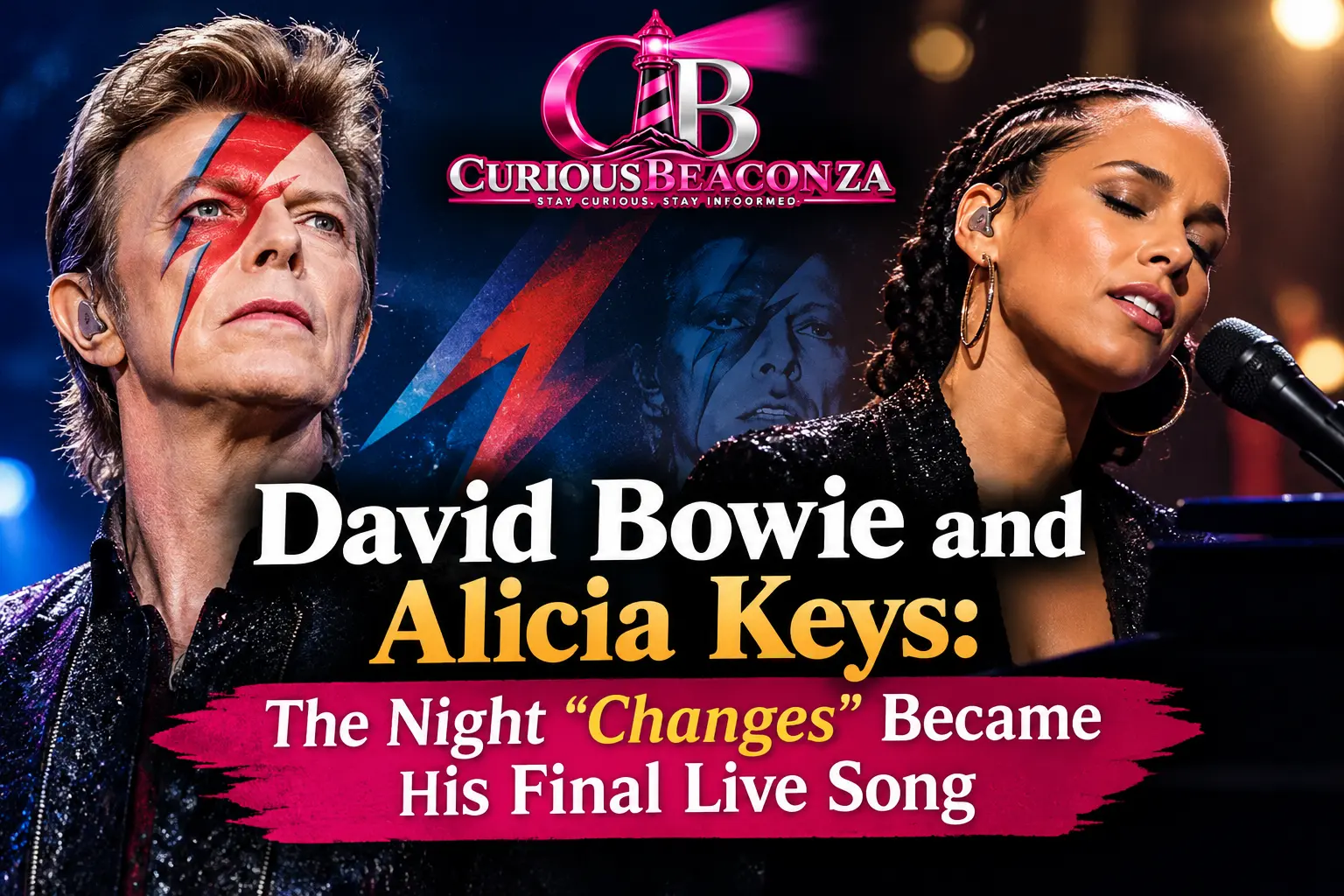
David Bowie and Alicia Keys shared a stage exactly once that mattered to music history: 9 November 2006, at the Hammerstein Ballroom in New York, during the third annual Keep a Child Alive Black Ball. Bowie sang three songs, “Wild Is the Wind,” “Fantastic Voyage,” and finally “Changes,” a duet with Keys (setlist.fm). That duet turned out to be the last song David Bowie ever performed live in public. He never played another concert, never toured again, and never returned to a stage, not for The Next Day in 2013, not for Blackstar in 2016 (Louder).
Nobody in the room knew they were watching a farewell. That is what makes this story strange, moving and far deeper than a celebrity-duet trivia question.
Quick facts table
| Question | Answer |
| Date | 9 November 2006 |
| Venue | Hammerstein Ballroom, New York City |
| Event | Keep a Child Alive’s 3rd Annual Black Ball |
| Song they sang together | “Changes” (from Hunky Dory, 1971) |
| Bowie’s full set | “Wild Is the Wind” → “Fantastic Voyage” → “Changes” (with Alicia Keys) |
| Pianist | Mike Garson |
| Hosts | Alicia Keys and Iman (Bowie’s wife) |
| Also on the bill | Damian “Jr. Gong” Marley, Angélique Kidjo, Louis XIV |
| Significance | Bowie’s final live performance |
| Official footage | None — only grainy fan video exists |
Why Bowie was even there: the Iman connection nobody explains
Most articles treat Bowie’s appearance as a random act of charity. It wasn’t.
Keep a Child Alive was co-founded by Alicia Keys and activist Leigh Blake to get antiretroviral treatment to families devastated by HIV/AIDS in Africa and India (AllMusic). The Black Ball was its signature fundraiser, and in 2006 it was co-hosted by Keys and Iman — the Somali supermodel who had been married to Bowie since 1992 (davidbowie.com).
So the chain is simple and human: Iman hosts a benefit for children in Africa; her husband, who had quietly disappeared from public life after a cardiac emergency two years earlier, agrees to sing three songs. Keys, then 25 and already a multi-Grammy-winning star, was not just a co-host, she acted as the evening’s musical director (Billboard).
That detail reframes everything. The David Bowie and Alicia Keys duet wasn’t a label-arranged “moment.” It was a 59-year-old legend stepping into a room musically run by a younger artist he respected, on behalf of his wife’s cause.
What actually happened on stage (from people who were in the room)
Bowie’s own website published eyewitness reports from fans (“BowieNetters”) within 24 hours — an unusually direct primary source for a 2006 event.
According to those reports, Bowie walked on to a roar, in black tie, and opened with “Wild Is the Wind” accompanied only by Mike Garson on piano, an arrangement close to the one the pair had performed at a Yahoo! event back in July 2000 (davidbowie.com). “Wild Is the Wind” is itself a cover, a Dimitri Tiomkin/Ned Washington song popularised by Johnny Mathis in 1957, which Bowie recorded for Station to Station in 1976.
Then came “Fantastic Voyage,” the gentle, politically anxious opener from 1979’s Lodger, a deep cut, not a hits-package choice. Think about that programming for a second: a man who could have sung “Heroes” or “Let’s Dance” chose a near-forgotten album track about dignity in the face of catastrophe, at an AIDS benefit.
Finally, Alicia Keys joined him for “Changes.” Billboard described it as a “neo soul-injected” reading of the song. One attendee’s report captured the mood better than any press release: the two voices “meld beautifully together,” and change itself was “the underlying theme of the evening” (davidbowie.com).
A song whose most quoted line is an instruction to turn and face the strange, sung at a gala about changing the odds for children with HIV, and, unknowingly, as a closing statement on a 40-year stage career.
See Also: María Asunción Aramburuzabala and Susan Wojcicki
The detail almost everyone misses: “Changes” opened and closed Bowie’s live story
Here is the piece of knowledge that elevates this from anecdote to history.
Mike Garson, the pianist on stage that night, first entered Bowie’s orbit in 1972, and the piece of music involved in that first meeting was “Changes.” As AllMusic’s account puts it, the song that began a 34-year partnership between Garson and Bowie was also the song that ended Bowie’s entire live career (AllMusic).
Garson went on to become the single most-featured musician in Bowie’s live history, from the Ziggy Stardust era through Aladdin Sane, Diamond Dogs, the 1990s reinventions and the Reality tour. The circle closing on the same song, with a 25-year-old R&B singer completing it — is the kind of symmetry you could never plan.
Bowie didn’t announce a retirement. He simply stopped. And the last thing anyone heard him sing in concert was a song he wrote at 24 about never standing still.
Why there’s no good video, and why that was deliberate
Search “David Bowie and Alicia Keys Changes” and you’ll find a shaky, dim, audience-shot clip. There’s a reason.
Bowie did not want the performance filmed, and the only surviving footage is an unofficial fan recording (AllMusic, citing Louder). Louder’s own assessment is that the footage is “rather sketchy,” reduced to grainy fan-filmed takes, “but Bowie’s voice sounds as grand as ever” (Louder).
That choice is revealing. In the YouTube era, a legend’s comeback duet with a reigning R&B star is a guaranteed viral asset. Bowie, the most media-literate musician of his generation, the man who built MTV-era iconography, chose to let it exist only as memory. The grain in that video isn’t a flaw. It’s consent.
Myth-busting: four things people get wrong
Myth 1: “They performed three duets together.” Before the show, a rumour circulated that Bowie would sing three songs, all duets with Keys. Bowie’s own site flagged it plainly as “Rumor, not true” (davidbowie.com). Keys joined only on “Changes.”
Myth 2: “The Black Ball was Bowie’s last public appearance.” It was his last musical performance. He appeared again in May 2007 at Madison Square Garden’s WaMu Theater, where he introduced Ricky Gervais on stage during the High Line Festival he had curated a clip Gervais himself later shared, calling it Bowie’s last live appearance (Radio X; setlist.fm gig timeline). A comic introduction isn’t a concert which is why the Keys duet holds the title.
Myth 3: “The Black Ball was his last proper gig.” His last full headline show was on the Reality tour. He suffered a heart attack at the end of a show in Scheessel, Germany, during the European leg in June 2004, and the remaining dates were cancelled (Louder). His final full UK concert was closing the Isle of Wight Festival on 13 June 2004 (Radio X).
Myth 4: “Bowie and Alicia Keys recorded together.” They didn’t. There is no studio collaboration between David Bowie and Alicia Keys in either artist’s official discography. The Black Ball duet is the whole of it which is exactly why it carries so much weight.
Timeline: how Bowie’s stage life wound down
| Date | Event |
| 13 June 2004 | Closes Isle of Wight Festival — last full UK concert |
| 25 June 2004 | Heart attack after Scheessel, Germany show; Reality tour dates cancelled |
| Sept 2005 | Guest appearance with Arcade Fire (Fashion Rocks, NYC) |
| May 2006 | Joins David Gilmour at London’s Royal Albert Hall |
| 9 Nov 2006 | Black Ball: “Changes” with Alicia Keys — final live performance |
| May 2007 | Introduces Ricky Gervais at MSG’s WaMu Theater (High Line Festival) |
| March 2013 | The Next Day released — no tour, no live shows |
| 8 Jan 2016 | Blackstar released on his 69th birthday |
| 10 Jan 2016 | Bowie dies, two days after Blackstar (AllMusic) |
Alicia Keys’ own night, the part that gets edited out
Because Bowie’s farewell dominates the retelling, Keys’ performance is usually reduced to a footnote. The eyewitness accounts say otherwise.
That evening she sang two duets with Damian “Jr. Gong” Marley, delivered a cover of Janis Joplin’s “Piece of My Heart,” and joined Angélique Kidjo for a floor-shaking “Afrika.” Several fans in the room rated the Marley duets and the Joplin cover as the night’s non-Bowie highlights (davidbowie.com; Billboard).
Earlier in the evening, a film shot in Africa showed Keys visiting a Keep a Child Alive clinic, speaking with teenagers and young adults who had lost parents to AIDS and were now running their own households (Billboard). That’s the context the duet lived inside — not spectacle, but fundraising with faces attached.
The Black Ball continued long after: the 4th annual edition in October 2007 featured Gwen Stefani, Sheryl Crow and Bono, and a London edition launched in July 2008 with Annie Lennox, Jennifer Hudson and a young Adele (Wikipedia: The Black Ball).
Why this one duet keeps resurfacing
Every 9 November, the David Bowie and Alicia Keys pairing trends again. It endures for three reasons:
- It’s a genuine ending, not a staged one. Bowie never gave the world a farewell tour. This is all there is.
- It’s generationally generous. Bowie handed his most quoted song to a 25-year-old R&B artist and let her reshape it.
- It was for someone else. The last note of a career spanning Ziggy, the Thin White Duke, Berlin and Blackstar was sung at a charity gala hosted by his wife.
For anyone writing the cultural history of Bowie, the David Bowie and Alicia Keys moment is the quiet rebuttal to the myth of the restless chameleon who only served himself.
FAQ
What song did David Bowie and Alicia Keys sing together?
“Changes,” from Hunky Dory (1971), closing the Black Ball on 9 November 2006 (setlist.fm).
Was it really Bowie’s last performance?
Yes, his last live musical performance (Louder).
Is there official video?
No. Bowie didn’t want it filmed; only fan footage survives (AllMusic).
Who played piano?
Mike Garson, Bowie’s longest-serving musician.Di