
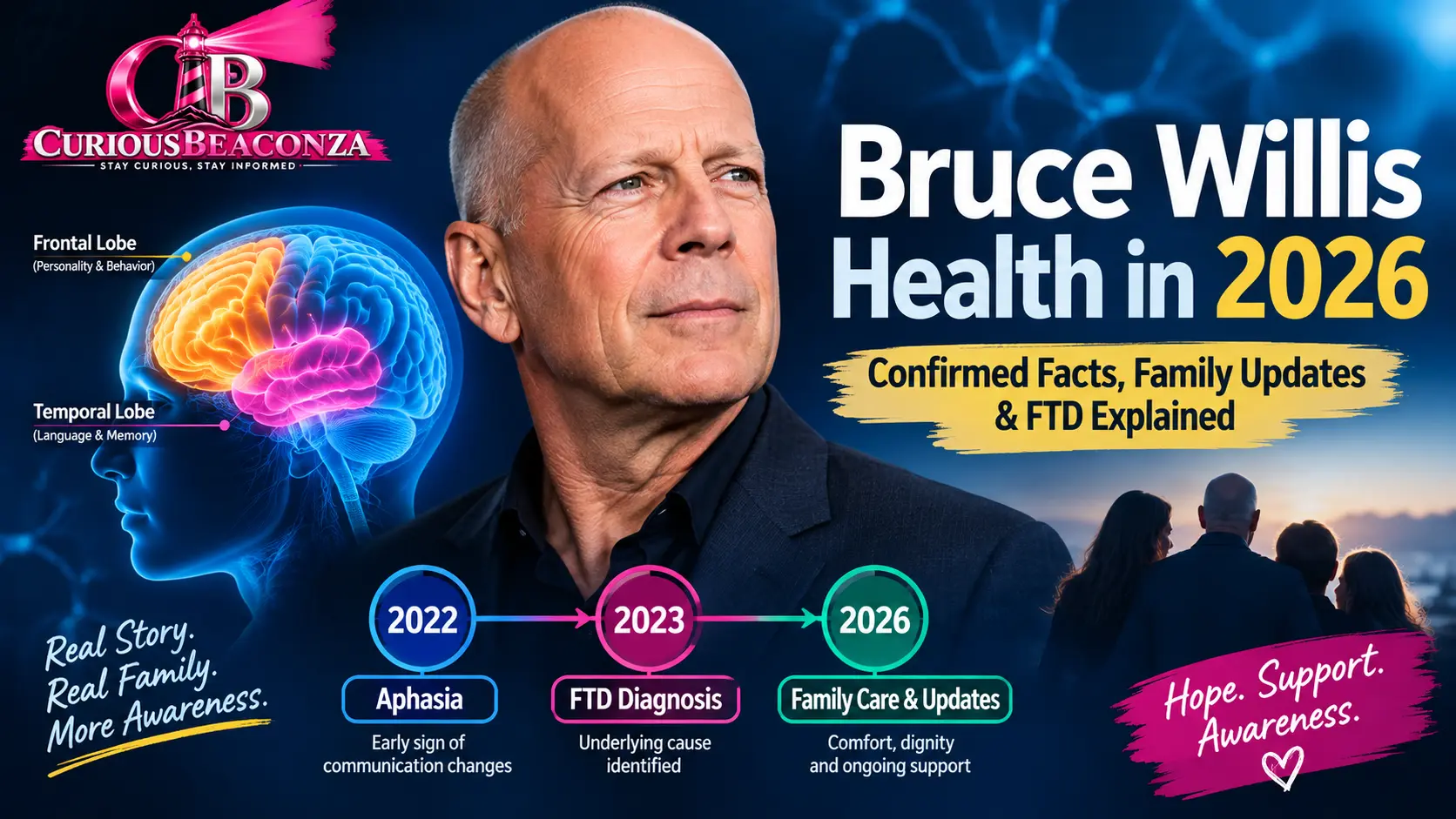
Bruce Willis health remains a topic of widespread interest in 2026 as his family continues to share verified updates about his condition. Bruce Willis is living with frontotemporal dementia (FTD), a progressive brain disease diagnosed in February 2023 after an earlier aphasia diagnosis in 2022. Although he is physically healthy overall, he is largely non-verbal and receives round-the-clock care at home from his family. According to his wife, Emma Heming Willis, and daughter, Rumer Willis, he is often calm, smiles during family visits, and appears unaware of his diagnosis.
While there is currently no cure for FTD, his family has focused on providing comfort, preserving his dignity, and raising awareness about the disease. In their efforts to advocate for those affected by FTD, the family has participated in various awareness campaigns and fundraising events, aiming to educate the public about the challenges faced by patients and caregivers alike. Emma has emphasized the importance of community support, sharing that they often connect with other families navigating similar experiences, which has provided a sense of solidarity and understanding during this challenging journey.
Rumer, too, has used her platform to speak candidly about her father’s condition, reminding fans of the need for compassion and patience as society grapples with the complexities of neurological disorders. While the family acknowledges the heart-wrenching nature of Bruce’s illness, they remain committed to cherishing each moment together, celebrating the love and joy that still resonate in their lives.
If you’ve searched “Bruce Willis health” hoping for a quick, honest answer instead of speculation, that’s it. Below is the fuller story what actually happened, what frontotemporal dementia is, how the Willis family is coping, and what doctors say the future may hold. Frontotemporal dementia (FTD) is a progressive neurological condition that primarily affects the frontal and temporal lobes of the brain, leading to changes in personality, behavior, and language. For Bruce Willis, the diagnosis came as a shock to both him and his family, as the symptoms often begin subtly, manifesting as difficulties with communication and shifts in social conduct.
The Willis family has been remarkably open about their journey, sharing insights into how they are adapting to this new reality while striving to maintain a sense of normalcy amidst the challenges. Experts emphasize the importance of understanding FTD, not just for those diagnosed, but for their loved ones as well, as it can help foster compassion and support through the emotional and practical hurdles that lie ahead. As they navigate this difficult path, the Willis family continues to cherish the moments they have together, leaning on their strong bonds to face the uncertainties of the future.
How It Started: From a Stutter to a Diagnosis
Bruce Willis’s health decline didn’t begin with headlines. It began quietly, at home, in a way many families dealing with dementia will recognize. Emma Heming Willis has said the earliest sign was a change in her husband’s speech pattern. Because Willis had a childhood stutter, she initially assumed the change was related to that old habit rather than anything new. It wasn’t until the pattern worsened that the family sought medical evaluation.
In March 2022, the Willis family publicly announced that Bruce had been diagnosed with aphasia a language disorder that affects a person’s ability to speak, write, or understand language, usually caused by damage to the brain’s communication centers. At the time, the statement said Willis was “experiencing some health issues” that were “impacting his cognitive abilities,” and that he would be stepping away from acting.
Aphasia on its own is not a diagnosis of a specific disease it’s a symptom. It can be caused by a stroke, a head injury, or a degenerative brain condition. For nearly a year, the exact cause of Willis’s aphasia remained unclear to the public. That changed in February 2023.
The Frontotemporal Dementia Diagnosis
Just under a year after the aphasia announcement, the Willis family shared a follow-up statement through the Association for Frontotemporal Degeneration (AFTD), a leading U.S. nonprofit dedicated to FTD research and family support. The family confirmed that Willis’s condition had progressed and that doctors had reached a more specific diagnosis: frontotemporal dementia.
“While this is painful, it is a relief to finally have a clear diagnosis,” the family wrote, adding that FTD “is a cruel disease that many of us have never heard of and can strike anyone.”
That statement was significant for two reasons. First, it gave the public a name for what Willis was experiencing. Second, it turned one of the world’s most recognizable action stars into an unlikely, highly visible advocate for a disease that most people had never heard of despite the fact that FTD is the most common form of dementia in people under 60.
Aphasia vs. FTD: How the Two Diagnoses Connect
| Diagnosis | Announced | What It Means | Primarily Affects |
|---|---|---|---|
| Aphasia | March 2022 | A symptom involving difficulty with speech, writing, or language comprehension | Communication |
| Frontotemporal Dementia (FTD) | February 2023 | A progressive brain disease that was the underlying cause of the aphasia | Behavior, personality, and language (memory is often preserved longer than in Alzheimer’s) |
This distinction matters for anyone searching “Bruce Willis health” for accurate information: aphasia was the visible warning sign; FTD is the underlying disease driving it. Understanding the difference between these two terms is crucial, as it highlights the complexities of the condition and the importance of seeking comprehensive medical insights. While aphasia may manifest as difficulty in communication, FTD a form of dementia impacts the brain’s ability to process information, ultimately affecting behavior and personality. This distinction not only emphasizes the necessity for accurate reporting but also fosters a deeper empathy for those affected by such debilitating conditions.
What Frontotemporal Dementia Actually Is
According to the Mayo Clinic and the AFTD, frontotemporal dementia refers to a group of brain disorders caused by the progressive degeneration of the brain’s frontal and temporal lobes the regions responsible for personality, behavior, judgment, and language. Unlike Alzheimer’s disease, which typically begins with memory loss, FTD often starts with changes in behavior, social conduct, or the ability to speak and understand language, while memory can remain relatively intact in the early stages.
Researchers studying the disease have linked many cases to the misfolding of specific proteins in the brain including tau protein and TDP-43 that gradually damage brain cells. Because these underlying mechanisms are different from Alzheimer’s, FTD often doesn’t respond to Alzheimer’s medications, and there is currently no treatment that slows or stops the disease’s progression.
FTD is also notoriously difficult to diagnose early. It’s frequently mistaken for a psychiatric condition, a stroke, or normal aging, which is part of why the Willis family has emphasized public education so heavily earlier awareness could mean earlier diagnosis for other families.
Bruce Willis’s Health Status in 2026
Public updates on Bruce Willis’s health continue to come almost exclusively from his family, primarily his wife Emma Heming Willis and his eldest daughter, Rumer Willis. Here’s what has been confirmed in interviews through 2026:
- Physically, he remains in good health. Emma Heming Willis told ABC News’ Diane Sawyer that Bruce is “still very mobile” and “in really great health overall” it’s specifically his brain function that has declined, not his general physical condition.
- He is largely unaware of his own diagnosis. In a 2026 podcast interview, Heming Willis said Bruce “never tapped in” to the reality of his condition he hasn’t connected his current state to a diagnosed disease, which she describes as “the blessing and the curse” of the disease’s progression.
- He recognizes his family. Rumer Willis has said her father still lights up and smiles when family visits, and that despite the loss of verbal communication, warmth and connection remain.
- He receives round-the-clock, specialized care, reportedly in a private, single-story home designed around his needs, allowing him to avoid stairs and navigate his space safely as mobility and coordination needs evolve.
- The disease continues to progress. As with all forms of FTD, doctors and the family have been clear that decline is expected to continue over time, though the pace varies from person to person.
The Emotional Toll on the Willis Family
Emma Heming Willis has become one of the most visible caregiver-advocates in American media, describing dementia repeatedly as a “family disease” rather than an individual one. In multiple interviews, she has explained that when one person receives a diagnosis like FTD, the effects ripple through the entire household spouses and children shift almost overnight from partner or child into caregiver, often without formal preparation or training.
She has also used a phrase that captures the disease’s deceptive nature: “FTD whispers, it doesn’t shout.” Unlike a stroke or heart attack, which arrives suddenly, FTD creeps in gradually, making it difficult to pinpoint exactly when the person you knew began to change.
Rumer Willis, the eldest of Bruce’s five daughters three with ex-wife Demi Moore, and two with Emma Heming Willis has spoken candidly about grieving a version of her father while he is still alive, and about the specific sadness of knowing her own daughter may not get to fully know the grandfather she once did.
Separating Fact From Rumor
Because Bruce Willis is no longer doing interviews himself, a large amount of speculative and sometimes false content circulates online about his condition including unverified claims about treatment breakthroughs, sudden hospitalizations, or dramatic changes in prognosis. Reputable outlets covering his health (TODAY, Variety, Reader’s Digest, People, and the AFTD’s own statements) consistently trace back to on-the-record family interviews rather than anonymous sources.
A good rule of thumb: if a headline about Bruce Willis’s health cites “sources close to the family” without naming Emma Heming Willis, Rumer Willis, Demi Moore, or an official AFTD statement, treat it with skepticism. The family has been unusually open, which means there’s rarely a need for unnamed sourcing to know the real story.
Why Bruce Willis’s Diagnosis Matters Beyond Hollywood
FTD affects an estimated 50,000 to 60,000 people in the United States, but public awareness of it remains extremely low compared to Alzheimer’s disease. Because Willis is one of the most famous faces to be diagnosed with it, his family’s openness has done something rare: it has pushed a relatively obscure diagnosis into mainstream conversation, prompting more people to ask questions about early symptoms in their own relatives particularly behavioral or personality changes that might otherwise be dismissed as stress, depression, or “just getting older.”
Emma Heming Willis has since authored a memoir on caregiving and continues to partner with organizations focused on FTD research and family support, framing public curiosity about her husband’s condition as an opportunity rather than an intrusion provided it’s channeled toward funding and awareness rather than tabloid speculation.
What This Story Really Teaches Us
Having gone through the full timeline, the most important thing about Bruce Willis’s health story isn’t the diagnosis itself it’s how his family chose to handle it. They didn’t disappear behind a wall of publicists and vague statements. They named the disease, corrected the record when the diagnosis changed, and kept talking even when there was nothing hopeful left to report. That’s unusual for Hollywood, where health struggles are often minimized until they can’t be hidden anymore. This level of transparency not only humanizes Bruce Willis in a world that often idolizes its stars, but it also opens up a critical dialogue about the realities of living with a degenerative condition.
By sharing their journey, his family invites fans and the public to grapple with the complexities of illness, the emotional toll it takes, and the importance of support systems. In doing so, they challenge the stigma that often surrounds health discussions in the entertainment industry, encouraging others facing similar battles to speak out and seek help rather than suffer in silence. This candid approach can reshape perceptions and foster a sense of community among those navigating similar hardships, ultimately highlighting the resilience of the human spirit in the face of adversity.
The other lesson is more personal: FTD’s early signs are easy to miss precisely because they look like everyday quirks a stutter, a slower sentence, a shorter temper. Willis’s story is a reminder that persistent, unexplained changes in speech or behavior are worth a real medical evaluation, not just an assumption that someone is “having an off year.” It’s crucial to recognize that these subtle shifts can often be dismissed as normal aging or stress, leading to delays in diagnosis and treatment.
By bringing awareness to these signs, we empower not only ourselves but also those around us to seek help sooner rather than later. Early intervention can make a significant difference in managing symptoms and improving quality of life. Conversations about mental health and neurological conditions need to be normalized, allowing families to share their concerns without fear of stigma. It’s a call to action for us all to be more observant, compassionate, and proactive in the face of such daunting challenges.
Frequently Asked Questions
Is Bruce Willis still alive in 2026?
Yes. As of the most recent family interviews in 2026, Bruce Willis is alive and living at home with round-the-clock care.
Does Bruce Willis know he has dementia?
According to his wife Emma Heming Willis, he does not appear to be aware of the specific diagnosis, though the family has not hidden the disease from the public.
Can frontotemporal dementia be cured?
No. There is currently no cure and no treatment proven to slow FTD’s progression, though research including studies referenced by the Association for Frontotemporal Degeneration continues into potential future therapies.
Who provides updates on Bruce Willis’s health?
Nearly all verified updates come directly from his family primarily his wife Emma Heming Willis and daughter Rumer Willis through interviews and official statements, not from Bruce Willis himself.
You may also read: Hopie Carlson Wife: An Exclusive Look at Her Family and Personal Life.