
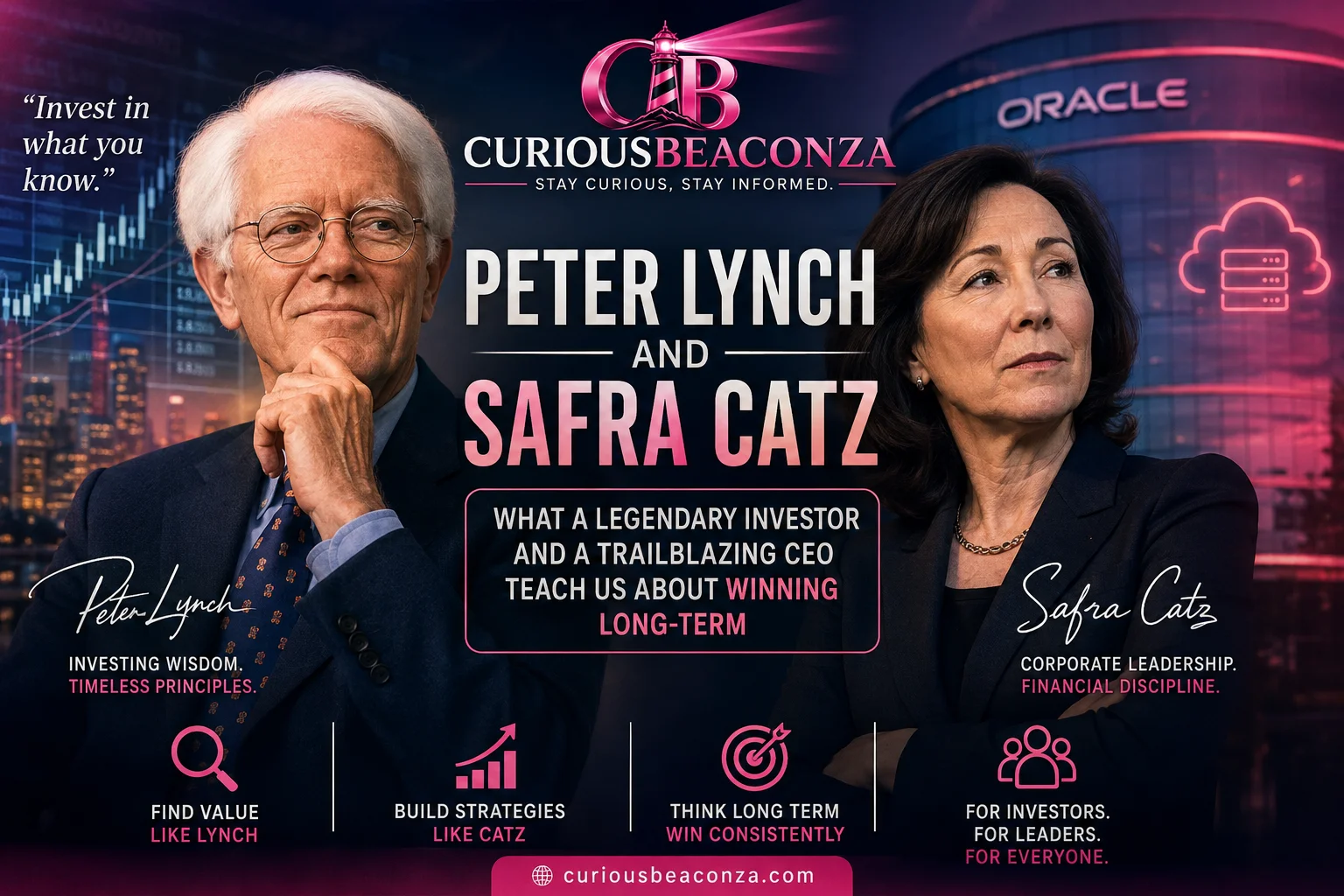
At first glance, Peter Lynch and Safra Catz don’t seem to belong in the same sentence. One is a soft-spoken stock-picking legend who ran a mutual fund out of Boston in the 1980s. The other is a razor-sharp, spreadsheet-obsessed executive who spent over a decade running one of the world’s largest enterprise software companies from Austin, Texas. Yet when you place their careers side by side, something interesting happens: both figures represent two sides of the same coin the art of finding value and the discipline of building it. Lynch, with his intuitive grasp of market trends and a talent for identifying undervalued stocks, championed the importance of doing thorough research and maintaining a long-term perspective.
In contrast, Catz exemplifies the strategic rigor required to scale a business, navigating complex financial landscapes and leveraging data to make informed decisions. Together, they embody a dual approach to success: Lynch’s instinct-driven insights encourage investors to look beyond the numbers, while Catz’s methodical execution showcases how those insights can be transformed into sustainable growth. This convergence of investment acumen and operational excellence highlights the multifaceted nature of value creation in today’s dynamic economic environment.
This article breaks down who Peter Lynch and Safra Catz actually are, what made each of them exceptional in their field, and more importantly what everyday investors, business owners, and professionals can actually take away from studying both of them. No fluff, no recycled Wikipedia summaries. Just a grounded, honest look at why these two names keep surfacing in conversations about business excellence.
To begin, Peter Lynch, renowned as the former manager of the Magellan Fund at Fidelity Investments, transformed the landscape of mutual fund management with his exceptional ability to identify undervalued stocks. His investment strategy, famously encapsulated in his mantra of “invest in what you know,” emphasizes the importance of personal insight and research over mere speculation. Lynch’s track record, which boasted an average annual return of 29%, showcases not just his financial acumen but also his belief in the power of thorough analysis and a deep understanding of market fundamentals.
On the other hand, Safra Catz, as the CEO of Oracle Corporation, has played a pivotal role in steering one of the world’s leading technology companies. Her strategic foresight and operational expertise have been instrumental in Oracle’s evolution, particularly as it shifts toward cloud computing. Catz’s leadership style is characterized by decisiveness and a keen focus on innovation, which offers vital lessons for business owners navigating an increasingly competitive landscape.
By examining their careers, we can uncover actionable insights that resonate with anyone looking to enhance their own professional journey, whether it’s through cultivating a disciplined investment approach or embracing a forward-thinking mindset in business operations.
Who Is Peter Lynch?
Peter Lynch is widely regarded as one of the greatest mutual fund managers in American financial history. From 1977 to 1990, he managed the Fidelity Magellan Fund, growing its assets from roughly $18 million to more than $14 billion, while delivering an average annual return that left Wall Street stunned. He didn’t do it with complex derivatives or algorithmic trading models. He did it with a philosophy that almost sounds too simple to work: buy what you know, understand the business behind the stock, and hold on when others panic. Lynch believed that individual investors could achieve success by leveraging their own experiences and insights, often emphasizing the importance of investing in companies whose products or services they personally used and trusted.
This hands-on approach allowed him to identify undervalued stocks, often before they caught the attention of Wall Street analysts. He famously encouraged investors to conduct their own research, scrutinizing financial statements and management practices, rather than relying solely on market trends or stock tips. By focusing on fundamentals and maintaining a long-term perspective, Lynch was able to navigate market volatility, demonstrating that patience and informed decision-making are key to investment success.
Lynch’s books, especially One Up on Wall Street and Beating the Street, turned him into a household name for retail investors who wanted to manage their own portfolios without a finance degree. His core message was democratizing: you don’t need to be a Wall Street insider to spot a great company. Sometimes the best investment ideas come from noticing what’s selling well at your local mall or which product your kids won’t stop talking about.
Peter Lynch’s Core Investing Principles
- Invest in what you understand. If you can’t explain a company’s business model in a few sentences, you probably shouldn’t own the stock.
- Do the homework. Lynch was famous for meeting hundreds of companies a year casual observation was only the starting point, not the whole strategy.
- Growth at a reasonable price (GARP). He looked for companies growing earnings steadily without an overinflated valuation.
- Patience beats timing. Lynch consistently warned against trying to predict market crashes or rallies.
- Categorize your stocks. He famously grouped companies into types like “slow growers,” “stalwarts,” “fast growers,” and “turnarounds” to set realistic expectations for each.
Who Is Safra Catz?
Safra Catz built her reputation in a completely different arena. Born in Israel and raised in the United States, she spent 14 years on Wall Street in investment banking before joining Oracle Corporation in 1999. Over the next two decades, she rose from executive vice president to president, then chief financial officer, before being named co-CEO alongside Mark Hurd in 2014. After Hurd’s passing in 2019, she became Oracle’s sole CEO a position she held for 11 years until September 2025, when she transitioned to Executive Vice Chair of Oracle’s board, handing the CEO reins to Clay Magouyrk and Mike Sicilia as the company pivoted harder into AI and cloud infrastructure.
During her tenure, Catz was instrumental in steering Oracle through a period of significant transformation, emphasizing innovation and strategic acquisitions to enhance the company’s capabilities in cloud computing and artificial intelligence. Her leadership style, characterized by a blend of analytical rigor and decisive action, helped Oracle not only to compete but to thrive in an increasingly competitive tech landscape. As she transitioned to her new role, Catz expressed her confidence in Magouyrk and Sicilia, highlighting their deep understanding of the industry and commitment to driving Oracle’s next chapter, which she believes will be defined by groundbreaking advancements in AI and machine learning technologies.
During her tenure, Catz oversaw more than 130 acquisitions, helped steer Oracle’s difficult but ultimately successful shift from legacy software licensing to cloud computing, and became known as one of the most financially disciplined executives in American corporate history. She has consistently ranked among the highest-paid female executives in the U.S., and her leadership style is often described as data-driven, detail-obsessed, and famously private she rarely gives long interviews, preferring to let Oracle’s numbers speak for themselves.
Safra Catz’s Leadership Principles
- Numbers don’t lie. Catz built her career on financial rigor, often reviewing spreadsheets personally rather than delegating detail to subordinates.
- Integrity above image. She has publicly stated that a person can recover from a mistake, but never from being a liar — a philosophy that shaped Oracle’s internal culture.
- Long-term repositioning over short-term comfort. Oracle’s multi-year, expensive pivot to cloud infrastructure wasn’t popular with every investor early on, but Catz stayed the course.
- Discretion as a strategy. Unlike many tech CEOs, Catz avoided the celebrity-executive spotlight, letting performance drive her reputation instead of personal branding.
- Operational precision. Her background in banking and acquisitions gave her an unusually sharp eye for deal structuring and cost control.
Peter Lynch and Safra Catz: A Side-by-Side Comparison
| Category | Peter Lynch | Safra Catz |
|---|---|---|
| Primary Field | Investment management (mutual funds) | Corporate executive leadership (enterprise tech) |
| Signature Role | Manager, Fidelity Magellan Fund (1977–1990) | CEO, Oracle Corporation (2014–2025); now Executive Vice Chair |
| Known For | “Buy what you know” investing philosophy | Financial discipline and Oracle’s cloud transformation |
| Famous Works | One Up on Wall Street, Beating the Street | Rarely publishes; known through interviews and Oracle earnings calls |
| Core Strength | Identifying undervalued growth companies early | Executing large-scale corporate strategy and M&A |
| Public Persona | Approachable, folksy, educational | Private, data-focused, low public profile |
| Legacy | Popularized retail stock investing | Reshaped Oracle into a cloud and AI infrastructure leader |
Why These Two Names Are Increasingly Mentioned Together
There’s a growing trend of pairing investing legends with modern corporate leaders in business commentary, and it’s not just clickbait. Peter Lynch and Safra Catz represent two ends of the same value chain. Lynch taught generations of investors how to evaluate a company from the outside — reading financial statements, understanding competitive advantages, and judging management quality. Catz is, in many ways, the type of executive Lynch would have wanted running a company he invested in: financially conservative, allergic to hype, and relentlessly focused on fundamentals over flashy promises.
If you ran Oracle through Lynch’s own investing checklist consistent earnings growth, a reasonable balance sheet, a management team that treats shareholder money like their own Catz-era Oracle checks nearly every box he championed. That’s likely why financial writers and educators increasingly reference both names together when discussing what disciplined, long-term-oriented business leadership actually looks like, whether you’re picking stocks or running the company itself.
Lessons for Investors: Applying Lynch’s Wisdom to Companies Like Oracle
One of the most practical exercises for retail investors is applying Peter Lynch’s own framework to real, modern companies including the one Safra Catz helped build. Here’s how that might look in practice:
- Understand the business. Oracle sells cloud infrastructure, databases, and enterprise applications. If you use software at work, there’s a decent chance Oracle is somewhere in that stack.
- Check the growth story. Lynch loved companies transitioning from a slower-growth phase into a faster one which mirrors Oracle’s multi-year cloud pivot under Catz.
- Evaluate management quality. Lynch placed enormous weight on whether leadership treated the company like owners, not just employees. Catz’s reputation for financial conservatism fits that mold closely.
- Avoid emotional investing. Just as Lynch warned against panic-selling during downturns, Oracle investors who stayed patient through its cloud transition years were rewarded as infrastructure revenue accelerated.
This isn’t a stock recommendation it’s a demonstration of how timeless investing principles can be applied to any modern company, using Oracle and Catz’s leadership as a real-world case study.
Lessons for Professionals: What Catz’s Career Teaches Beyond Finance
Not everyone reading this wants to pick stocks many are here because they’re curious about leadership itself. Safra Catz’s career offers a blueprint that has little to do with charisma and everything to do with consistency:
- Master the fundamentals of your industry before trying to lead it. Catz spent years in investment banking before ever stepping into an operating role.
- Build trust through transparency with numbers, not promises. Her reputation was built on financial credibility, not marketing spin.
- Know when to pass the torch. Her 2025 transition to Executive Vice Chair, handing the CEO role to a new generation focused on AI, reflects a leadership maturity that many long-tenured executives struggle to demonstrate.
Frequently Asked Questions
Did Peter Lynch and Safra Catz ever work together?
No. There’s no public record of a direct professional relationship between Peter Lynch and Safra Catz. Lynch built his career at Fidelity in asset management, while Catz built hers at Oracle in corporate operations and executive leadership. Their connection today is more thematic than historical both are frequently cited as models of disciplined, long-term thinking in their respective fields.
Is Safra Catz still CEO of Oracle?
No. Safra Catz stepped down as Oracle’s CEO in September 2025 after 11 years in the role. She now serves as Executive Vice Chair of Oracle’s board of directors, while Clay Magouyrk and Mike Sicilia serve as co-CEOs.
What is Peter Lynch’s most famous investing rule?
His most quoted principle is “invest in what you know” the idea that ordinary investors often have an edge by paying attention to products and companies they already understand in daily life, rather than chasing complex, unfamiliar sectors.
Why compare an investor and a corporate executive?
Comparing Peter Lynch and Safra Catz highlights two complementary skill sets: Lynch represents the outside view of evaluating a business as an investor, while Catz represents the inside view of actually running one with financial discipline. Together, they offer a fuller picture of what sustainable business success looks like from both sides of the table.
Final Thoughts
The comparison between Peter Lynch and Safra Catz isn’t about forcing a connection where none exists it’s about recognizing that great investing and great leadership are built on the same foundation: patience, fundamentals, and a refusal to chase hype. Lynch spent his career teaching individual investors how to spot that foundation in a stock. Catz spent hers building that same foundation inside a Fortune 500 company.
Whether you’re managing a portfolio or managing a team, their combined example is a reminder that boring, disciplined consistency tends to outperform flash in the long run a lesson worth remembering in any market environment. In a world often captivated by the allure of quick gains and rapid innovation, both Lynch and Catz remind us that true success comes from a deep understanding of the core principles that drive value.
Lynch, through his meticulous analysis of companies, emphasized the importance of knowing what you own and why you own it, while Catz’s tenure at Oracle has illustrated the significance of aligning strategic vision with operational excellence. Their journeys highlight that while trends may shift and technologies evolve, the fundamentals of diligent research and thoughtful decision-making remain constant. This enduring wisdom serves as a guiding light for both investors and leaders alike, encouraging them to cultivate resilience amid volatility and to prioritize substance over spectacle.
Note: For information and educational purposes only not financial advice. Please do your own research or talk to a licensed advisor before making any investment decisions.
[…] Read Also: Peter Lynch and Safra Catz: Powerful Lessons for Long-Term Success […]
[…] one forum retrospective on his career put it, he had never worked in investment banking before this, and his first position in the field was as Vice Chairman of Citigroup’s […]
[…] J. Good is an American business executive best known for her leadership at Duke Energy Corporation, one of the largest electric […]