
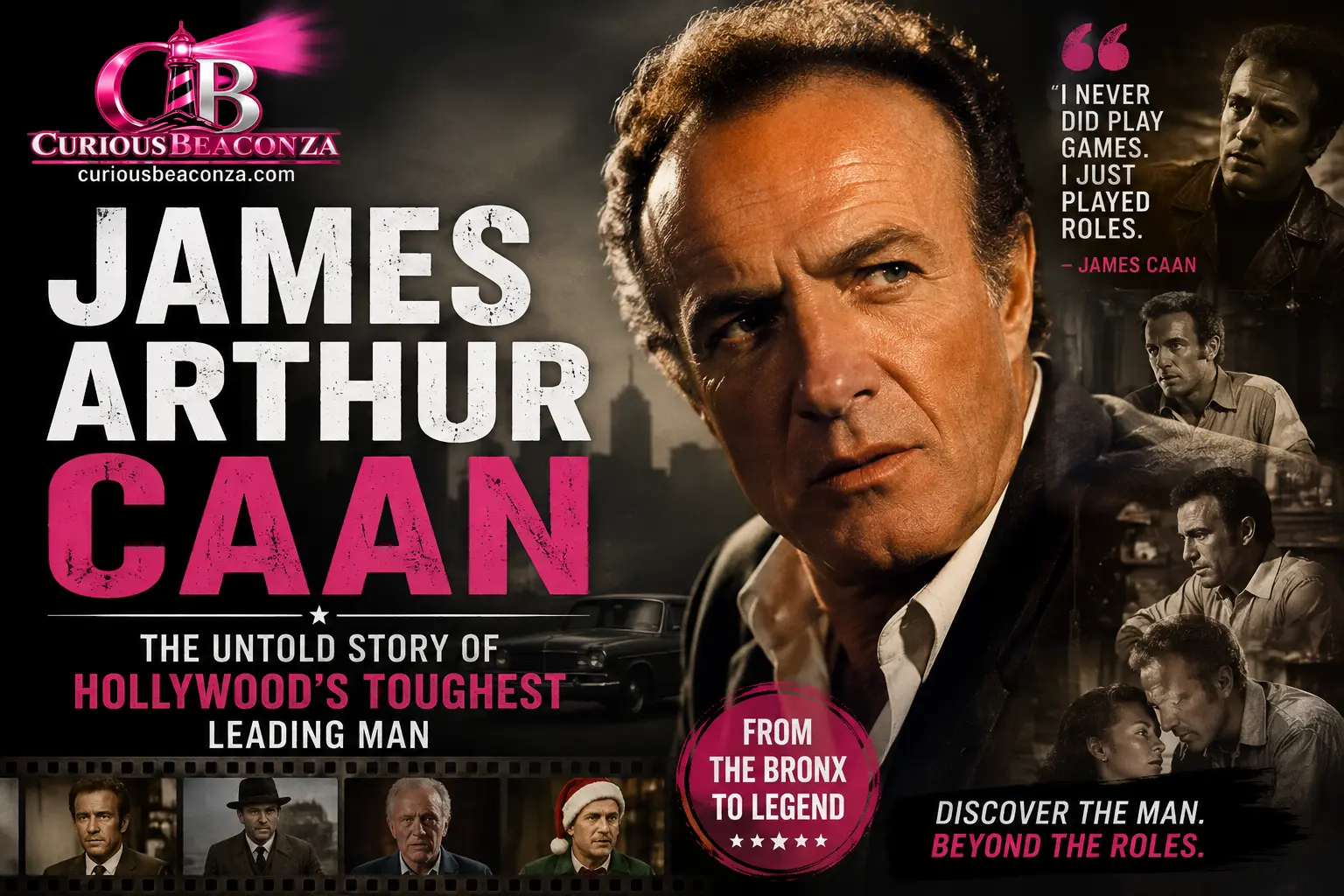
Type “James Arthur Caan” into Google and you’ll find yourself in the middle of a small mix-up that’s worth clearing up first: there is no famous actor officially named “James Arthur Caan.” The Hollywood legend most people are searching for is James Edmund Caan, and the confusion likely comes from the fact that his father’s name was Arthur Caan. Over the years, this small detail has blended into search habits, and “James Arthur Caan” has become one of the most common ways people look him up online.
This mix-up is not just a trivial slip; it underscores the impact of our digital age, where names and identities can easily become convoluted in the vast ocean of online information. For those unfamiliar, James Caan is best known for his iconic roles in classic films like “The Godfather” and “Misery,” where his performances have left an indelible mark on cinema. As a versatile actor, he has navigated a variety of genres, showcasing his talent in everything from drama to comedy. Understanding the nuances of his name can lead to a deeper appreciation of his work and the legacy he has created throughout his illustrious career.
Whatever brought you here, you’re in the right place. This article digs into the real man behind the name the Bronx-born son of German-Jewish immigrants who became one of the most magnetic, unpredictable, and genuinely talented actors of his generation. We’ll walk through his early life, his breakout in The Godfather, the rollercoaster of his career, his personal struggles, and why his work still matters today. From his humble beginnings, we’ll explore how the vibrant culture of the Bronx influenced his artistic sensibilities and shaped his worldview.
Through a blend of tenacity and raw talent, he navigated the treacherous waters of Hollywood, where the line between stardom and obscurity is often razor-thin. His portrayal of complex characters resonated with audiences, capturing a depth that few could match, and it’s this authenticity that helped him carve a unique niche in an industry known for its fleeting fame. As we delve deeper into his pivotal roles, we’ll also uncover the personal demons he battled struggles that, paradoxically, fueled his craft and made his performances all the more poignant. Ultimately, examining his legacy reveals not just an actor’s journey, but a testament to the power of resilience and the enduring impact of art on the human experience.
Who Was James Arthur Caan, Really?
James Edmund Caan was born on March 26, 1940, in the Bronx, New York City, to Sophie and Arthur Caan, Jewish refugees who had fled Germany. His father worked as a kosher meat wholesaler, and the family later moved to Sunnyside, Queens, where James grew up alongside his brother Ronald, who went on to become a producer, and his sister Barbara. From a young age, James displayed a passion for the arts, participating in school plays and local theater productions, which ignited his desire to pursue a career in acting.
After graduating from high school, he attended Hofstra University, where he honed his craft and became involved in the burgeoning theater scene. Following his studies, Caan moved to California to further his ambitions, eventually landing a role in the television series “The Untouchables” that marked the beginning of his ascent in Hollywood.
There was nothing glamorous about his upbringing. Caan was a scrappy, athletic kid he played football at Michigan State University while studying economics, and he later earned a black belt in karate. For a stretch of his youth, he even competed on the rodeo circuit, which earned him the nickname “The Jewish Cowboy.” It’s a detail that tells you a lot about who he was: someone who never quite fit the polished mold of a traditional movie star, and who seemed to prefer grit over glamour his entire life.
It was almost by accident that acting entered the picture. While attending Hofstra University, Caan became fascinated with performing and eventually auditioned for the Neighborhood Playhouse School of the Theatre in New York, studying under the legendary acting coach Sanford Meisner. That decision changed the course of his life and, in many ways, the course of American cinema.
From Broadway to the Big Screen
Before Hollywood came calling, Caan cut his teeth on stage. He made his Broadway debut in 1961 in Blood, Sweat, and Stanley Poole, and spent the early part of the decade building his craft in off-Broadway productions. His early film roles came through collaborations with some of the era’s most respected directors Howard Hawks cast him in El Dorado (1966) alongside John Wayne, Robert Altman gave him a role in Countdown (1967), and Francis Ford Coppola directed him in The Rain People (1969).
These weren’t starring roles, but they were the right rooms to be in. Caan was quietly building a reputation as an actor who brought raw, physical intensity to everything he touched a quality that would soon make him impossible to ignore.
The Godfather: The Role That Defined Him
If you ask most people why James Arthur Caan matters, the answer is almost always the same word: Sonny.
In 1972, Coppola cast Caan as Santino “Sonny” Corleone in The Godfather the hot-tempered, fiercely loyal eldest son of Vito Corleone. It’s hard to overstate how important this role was, not just for Caan’s career, but for film history itself. Sonny is volatile, protective, and doomed, and Caan played him with a physicality and emotional rawness that made the character unforgettable. The infamous toll booth ambush scene remains one of the most talked-about moments in American cinema.
The performance earned Caan an Academy Award nomination for Best Supporting Actor and a Golden Globe nomination in the same category. He reprised the role briefly in The Godfather Part II (1974) through a flashback appearance, cementing Sonny Corleone as one of the most iconic supporting characters ever put on film.
What’s easy to forget is that Caan was reportedly considered for other major roles of the era too, and turned down projects that later became massive hits a decision he later spoke about candidly, without much regret. That was part of his charm: he never seemed to chase stardom the way others did.
Table: Key Highlights of James Arthur Caan’s Career
| Year | Milestone | Details |
|---|---|---|
| 1961 | Broadway Debut | Appeared in Blood, Sweat, and Stanley Poole |
| 1966 | Film Breakthrough | Starred in El Dorado with John Wayne |
| 1971 | Emmy-Nominated TV Role | Brian’s Song, a widely praised TV movie |
| 1972 | Career-Defining Role | Sonny Corleone in The Godfather (Oscar nomination) |
| 1974 | Godfather Sequel | Cameo return in The Godfather Part II |
| 1990 | Career Revival | Paul Sheldon in Stephen King’s Misery |
| 2003–2006 | TV Comeback | “Big Ed” Deline in the series Las Vegas |
| 2003 | Family Comedy Hit | Walter Hobbs in Elf alongside Will Ferrell |
| 2022 | Passing | Died July 6, 2022, at age 82 |
The Highs, the Lows, and the Comeback
Caan’s career after The Godfather wasn’t a straight line upward and that’s part of what made him so relatable as an actor and as a person. He continued working steadily through the 1970s, but by the early 1980s, he stepped away from acting almost entirely for about five years. The reasons were personal: a difficult divorce, the death of his sister from leukemia, and a cocaine addiction that he later openly discussed in interviews took a serious toll on his life during this period.
His return to the spotlight came with 1990’s Misery, playing an author held captive by an obsessive fan (played by Kathy Bates). The film was a critical and commercial success, and it proved Caan still had the range and intensity that made him a star in the first place. From there, his career found a steady rhythm of character roles, television work, and the occasional major film.
Perhaps his most unexpected career chapter came in 2003, when he played Walter Hobbs, the gruff, workaholic father in the holiday comedy Elf, opposite Will Ferrell. For a generation that never watched The Godfather, this is likely the role that introduced them to James Arthur Caan proof that his talent translated across genres, decades, and audiences.
Around the same time, he took on the role of “Big Ed” Deline in the television series Las Vegas, which ran from 2003 to 2006 and introduced him to yet another wave of fans through the small screen. During this period, his portrayal of the shrewd casino boss not only showcased his versatility as an actor but also allowed him to delve into the dynamics of high-stakes gambling and the intricacies of running a Las Vegas resort. With a charismatic blend of humor and authority, he captivated audiences and became a beloved figure, solidifying his status in Hollywood.
Personal Life: A Man Who Lived Loudly
James Caan’s personal life was as colorful and complicated as many of the characters he played. He was married four times to Dee Jay Mathis, Sheila Marie Ryan, Ingrid Hajek, and Linda Stokes and had five children, including his son Scott Caan, who followed his father into acting and became known for his role in Hawaii Five-0.
He was famously candid about the pressures of fame. In interviews, he often stressed that acting was his job, not his identity, and that family, friends, and health mattered more to him than industry success. That grounded perspective is arguably why he was able to walk away from Hollywood when things got hard, and why he was able to walk back in when he was ready.
He also had a well-documented tough-guy reputation off-screen, including a few real-life brushes with trouble, which only added to the mythology around him. Whether or not that reputation was exaggerated by tabloids, it fit the roles he became known for almost too perfectly.
Why James Arthur Caan Still Matters Today
It’s been years since James Caan passed away on July 6, 2022, at the age of 82, but his influence on acting hasn’t faded. Here’s why his work continues to resonate:
- He redefined intensity on screen. Sonny Corleone’s raw emotional volatility set a new bar for supporting performances in dramatic film.
- He proved versatility matters. Few actors could move convincingly from a mafia enforcer to a psychological thriller victim to a lovable holiday-movie dad Caan did all three, and made each one believable.
- He was honest about his struggles. His openness about addiction and personal setbacks humanized him in an industry that often hides those stories.
- His legacy continues through his family. With his son Scott Caan carrying on an acting career of his own, the Caan name remains active in Hollywood.
My Take: What Made James Caan Different
Having researched countless actors from that golden era of American film, what stands out most about James Caan isn’t just Sonny Corleone it’s how unwilling he was to be predictable. Many actors who land a role as iconic as Sonny spend the rest of their careers chasing that same energy. Caan didn’t. He took risks, disappeared when he needed to, and came back on his own terms, in projects as different as Misery and Elf. That kind of career isn’t built on strategy; it’s built on instinct and honesty, and that’s ultimately what made him so watchable for over five decades.
Frequently Asked Questions
Is “James Arthur Caan” the actor’s real name?
Not exactly. His full birth name was James Edmund Caan. The name “James Arthur Caan” is a common search variation, likely linked to his father’s first name, Arthur.
What is James Caan best known for?
He’s most famous for playing Sonny Corleone in The Godfather (1972), though he’s also widely recognized for Misery (1990) and Elf (2003).
How did James Caan die?
He passed away on July 6, 2022, at the age of 82. His official cause of death was not publicly disclosed by his family at the time.
Did James Caan have children who became actors?
Yes. His son Scott Caan became a well-known actor, notably starring in Hawaii Five-0.
Final Thoughts
Whether you arrived here searching for “James Arthur Caan” out of curiosity or nostalgia, the man behind the name left behind a body of work that’s hard to match equal parts vulnerability, grit, and unpredictability. From the Bronx to Broadway to the Corleone family, James Caan built a career that refused to be boxed in, and that’s exactly why people are still searching for his story today.
His performances resonated with audiences because they reflected the raw, unfiltered essence of humanity flawed yet relatable, fierce yet tender. With roles that spanned genres, from the tough-as-nails Sonny Corleone in “The Godfather” to the sensitive writer in “Misery,” Caan’s versatility showcased not just his acting prowess but also his deep understanding of the characters he portrayed. Each project was a new chapter in a life lived boldly, pushing boundaries both on and off the screen.
As we revisit his films and the indelible marks he left on the industry, it becomes clear that James Caan was not just an actor; he was a storyteller whose legacy will continue to inspire future generations. His ability to inhabit a character completely made every role memorable, leaving audiences to ponder the complexities of each narrative long after the credits rolled. Caan’s collaborations with legendary directors, such as Francis Ford Coppola and Rob Reiner, further highlighted his commitment to the craft, each partnership resulting in cinematic treasures that not only entertained but also provoked thought and dialogue.
Beyond the accolades and awards, what truly set him apart was his authenticity; he brought an undeniable truthfulness to every performance, revealing the struggles and triumphs that lie within us all. As we celebrate his contributions to film, we are reminded that his artistry was not merely about the spectacles of fame, but about the connections he forged with viewers, making the stories he told feel deeply personal and universally resonant.
Read Also: Diane von Furstenberg and Doug McMillon: The Powerful Truth Behind Two Retail Icons
[…] James Arthur Caan Jr. was born during his father’s fourth and final marriage, to Linda Stokes. He’s occasionally been photographed alongside his father at events, including a 2022 gathering marking The Godfather’s 50th anniversary, alongside his younger brother Jacob. Beyond those appearances, detailed information about his career and personal life is limited, which fits the broader pattern among Caan’s children of choosing privacy over publicity. […]