
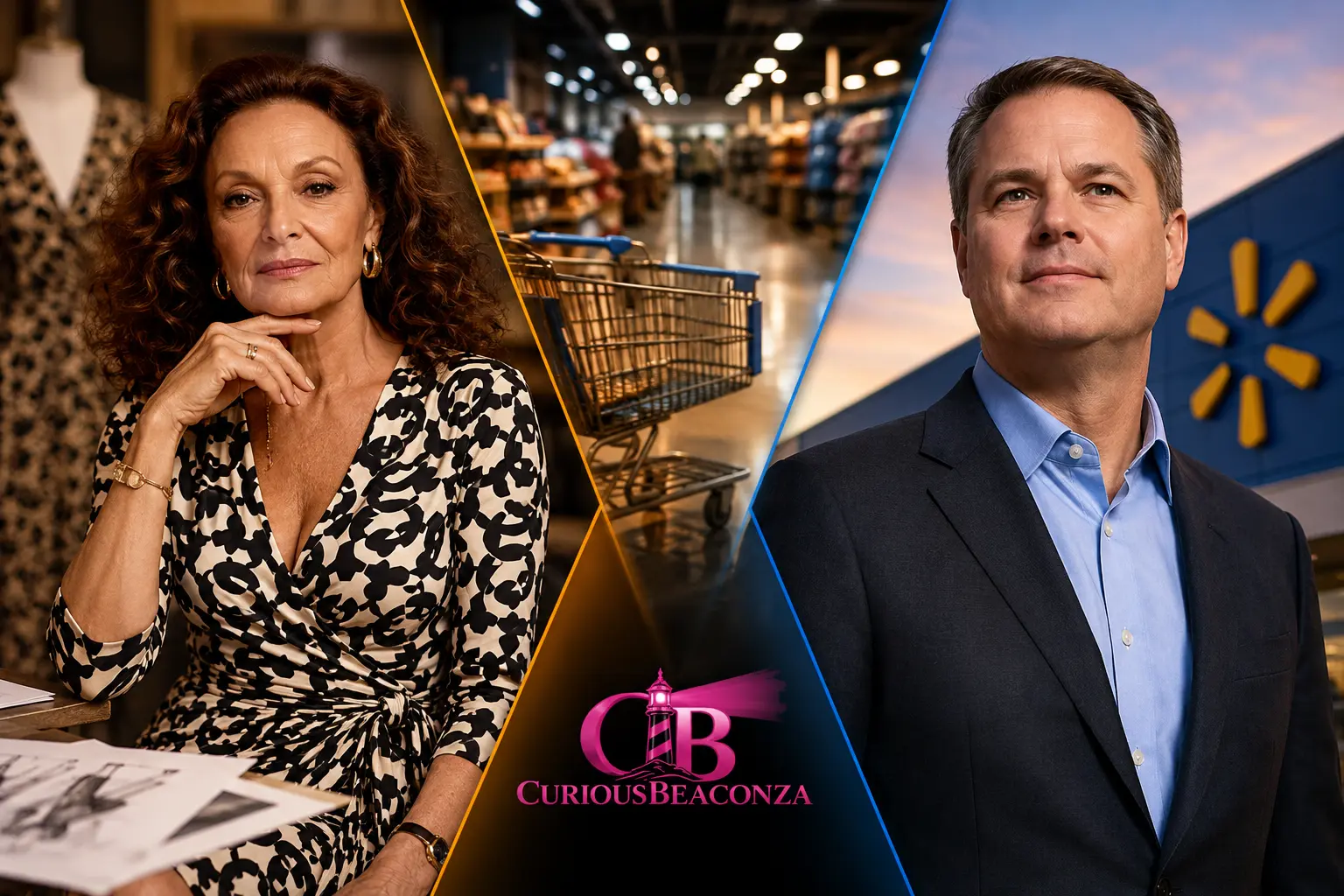
If you’ve searched for Diane von Furstenberg and Doug McMillon expecting to find a business partnership, a joint venture, or some secret collaboration between a Belgian-American fashion designer and the former CEO of the world’s largest retailer, I want to be upfront with you: that partnership doesn’t exist. No merger, no co-branded collection, no boardroom handshake. What you will find instead is a fascinating intersection of two distinct worlds one defined by high fashion and the other by retail innovation that offers insights into how disparate industries can influence one another.
While von Furstenberg has made her mark with iconic wrap dresses and powerful statements about female empowerment, McMillon’s influence can be observed in the way retail adapts to contemporary consumer needs and technological advancements. Their paths may never have crossed in a corporate sense, but the ideologies they represent invite us to consider the broader implications of design and commerce in our rapidly changing society.
What does exist is something more interesting, at least to me. These two names keep showing up together in search results because they represent the two farthest points on the same map the map of how Americans buy, wear, and think about clothing and consumer goods. One built a fashion label on a single, revolutionary dress. The other spent forty-two years climbing from a warehouse floor to the executive suite of a $600-billion-a-year company. Neither needed the other to become who they are, but understanding both tells you almost everything about modern retail.
That’s the honest angle I want to take in this article not manufacturing a connection that isn’t there, but genuinely comparing the two, correcting the myths floating around the internet, and explaining why people keep pairing these names in the first place. To understand the roots of these comparisons, we need to delve into the characteristics that people often attribute to each name. Whether it’s the cultural significance, historical context, or even the personalities associated with them, these factors play a crucial role in shaping perceptions. By examining the nuances behind these associations, we can shed light on the reasons they persist in popular discourse, and ultimately, foster a more informed conversation that transcends mere surface-level comparisons.
Who Is Diane von Furstenberg?
Diane von Furstenberg was born on December 31, 1946, in Belgium, to a family with Greek-Jewish and Eastern European Jewish heritage. She didn’t come up through a fashion school or a traditional design apprenticeship. She built her name through sheer instinct and hustle, entering the fashion world in the early 1970s with a confidence that had little to do with formal credentials.
Her breakthrough came in 1974 with the wrap dress a single-piece jersey garment that could be tied at the waist, flattered nearly every body type, and could take a woman from a workday into an evening out without a costume change. It wasn’t just a clothing item; it was a small act of liberation. Millions of units later, the wrap dress had become shorthand for a certain kind of confident, no-nonsense femininity, and Diane von Furstenberg had become a permanent fixture in American fashion.
Her early public visibility was helped by her marriage to Prince Egon von Furstenberg, but the business she built afterward was entirely her own. Decades later, she remains closely tied to the DVF brand, to philanthropy, and to mentorship programs supporting women in business. She’s active on Instagram under the handle @therealdvf, where she mixes archival fashion photography with reflections on aging, resilience, and reinvention.
One detail worth clearing up: in 2024, DVF launched a widely covered mass-market collection but it was with Target, not Walmart. That single mix-up is probably responsible for a good chunk of the confused searches pairing her name with Doug McMillon’s.
Who Is Doug McMillon?
Carl Douglas McMillon was born on October 17, 1966, in Memphis, Tennessee, and grew up in Jonesboro, Arkansas. His story is the closest thing corporate America has to a Cinderella arc, except it took place over four decades instead of one night.
In the summer of 1984, at 17 years old, McMillon took a seasonal job unloading trailers and picking orders at a Walmart distribution center, earning $6.50 an hour. He wasn’t chasing a career he was a teenager with a summer job. But he kept coming back. After finishing his business degree at the University of Arkansas and an MBA from the University of Tulsa, he joined Walmart’s management ranks in 1990, starting out, notably, as a fishing tackle buyer at company headquarters.
From there, the climb was steady and, by his own account, built on a simple habit: volunteering to cover for his manager whenever there was an opening, and showing up prepared even when he wasn’t fully ready. He led Walmart’s Sam’s Club division, then its international business, before being named President and CEO of Walmart Inc. in 2014 at the time, the youngest person to hold that role since founder Sam Walton.
Over his nearly twelve years as CEO, Walmart’s workforce grew to roughly 2.1 million associates, annual revenue climbed past $630 billion, and the company’s market value rose from around $250 billion to more than $800 billion. He also became known for raising associate wages, expanding parental leave benefits, and pushing Walmart’s transformation into a genuine e-commerce competitor to Amazon. McMillon retired from the CEO role on January 31, 2026, with John Furner stepping in as Walmart’s president and CEO the following day.
So Why Do People Pair Diane von Furstenberg and Doug McMillon?
There are three real reasons this pairing keeps popping up online, and none of them involve a formal relationship.
1. They’ve both appeared at the same elite gatherings. Both Diane von Furstenberg and Doug McMillon have been guests at the Allen & Company Sun Valley Conference the invite-only retreat in Idaho that brings together heavyweight names from media, tech, finance, and retail every July. Their documented attendance in 2019 is often cited as “proof” of a connection, but conference attendance isn’t a business relationship. Hundreds of executives and public figures attend the same event without ever exchanging a word.
2. They’ve been profiled by the same outlets. Trade publications like WWD, along with general business and culture media, have covered both figures extensively sometimes in the same roundups about influential figures in American commerce. Appearing in adjacent articles isn’t the same as appearing in the same room, but it’s enough to confuse a casual reader (or a search algorithm).
3. Search engines reward the pairing, even without a real story. This is the less glamorous truth. Once a handful of websites start publishing “Diane von Furstenberg and Doug McMillon” content, Google’s autosuggest and “people also search for” features start surfacing the phrase to more users, which in turn generates more searches, which in turn generates more articles. It becomes a bit of a feedback loop rather than a reflection of an actual relationship. I think it’s worth naming that dynamic honestly rather than pretending there’s a secret story to uncover.
A Side-by-Side Comparison
Since the honest answer is “they’re not connected, but they’re comparable,” here’s a table that lays out how these two retail-adjacent figures actually stack up.
| Category | Diane von Furstenberg | Doug McMillon |
|---|---|---|
| Born | December 31, 1946 (Belgium) | October 17, 1966 (Memphis, TN) |
| Industry | Fashion design, luxury and mass-market apparel | Mass retail, e-commerce, supply chain |
| Breakthrough | The wrap dress (1974) | Rising from warehouse associate to Walmart CEO (2014) |
| Signature achievement | Building the DVF brand into a lasting fashion label | Growing Walmart’s revenue past $630 billion and expanding its digital business |
| Recent milestone | 2024 mass-market collection with Target | Retired as Walmart CEO on January 31, 2026 |
| Public role today | Brand ambassador, philanthropist, mentor to women in business | Recently retired; long-serving Walmart and Business Roundtable figure |
| Documented shared appearance | Allen & Company Sun Valley Conference, July 2019 | Allen & Company Sun Valley Conference, July 2019 |
What Their Contrast Actually Teaches Us
Here’s my honest take: the real value in comparing Diane von Furstenberg and Doug McMillon isn’t in pretending they collaborated. It’s in what their opposite paths say about how consumer goods reach people.
Von Furstenberg represents the top-down model of fashion a single creative vision, filtered through a personal brand, eventually made accessible to wider audiences through collaborations like the one with Target. Her influence spreads through design language, cultural symbolism, and a decades-long relationship with the idea of “wearable confidence.”
McMillon represents the opposite direction a bottom-up operational model, where scale, logistics, pricing, and workforce management determine what shows up on shelves and how affordably it gets there. His entire career is proof that retail’s biggest transformations often come from inside the supply chain, not from a runway.
Put those two forces together design-driven brand equity and operations-driven scale and you basically get the modern retail economy. Designers need distribution. Retailers need differentiation. Neither Diane von Furstenberg nor Doug McMillon needed the other personally, but the industries they represent absolutely depend on each other constantly, even when the individuals never meet.
I’d also push back gently on any article that tries to dress this up as some kind of behind-the-scenes alliance. Readers deserve accuracy over intrigue. The far more useful and honestly more fascinating story is that two people from wildly different starting points a European-born designer with an aristocratic first marriage, and an Arkansas teenager unloading trucks for summer cash both ended up shaping how tens of millions of people shop, dress, and spend money, without ever needing to work together to do it.
Common Questions About Diane von Furstenberg and Doug McMillon
Did Diane von Furstenberg and Doug McMillon ever work together?
No. There’s no publicly confirmed business collaboration, joint venture, or formal partnership between them. Their names are frequently searched together mainly because of shared conference appearances and overlapping media coverage, not a documented working relationship.
Was DVF’s mass-market fashion line sold through Walmart?
No. Her widely reported 2024 mass-market collection launched through Target, not Walmart. This mix-up is one of the biggest sources of confusion behind this search pairing.
Is Doug McMillon still Walmart’s CEO?
No. McMillon retired as Walmart’s president and CEO on January 31, 2026. John Furner succeeded him, becoming Walmart’s president and CEO the next day.
What do Diane von Furstenberg and Doug McMillon have in common?
Both are widely recognized figures in the broader retail and consumer goods world, both have attended the Allen & Company Sun Valley Conference, and both have been profiled extensively by business and trade media but their day-to-day careers never intersected.
Final Thoughts
If you came here hoping for a hidden business story linking Diane von Furstenberg and Doug McMillon, I hope this cleared things up honestly rather than stringing you along. What’s really here is a useful comparison: a fashion visionary who reshaped how women dress, and a retail operator who reshaped how the world shops, told side by side. Sometimes the most useful article isn’t the one that invents a connection it’s the one that tells you clearly there isn’t one, and then shows you why the comparison is still worth making. Both Diane von Furstenberg and Doug McMillon stand as titans in their respective fields, each embodying an ethos that transcends mere business acumen.
Von Furstenberg’s wrap dress revolutionized women’s fashion, symbolizing empowerment and independence, while McMillon’s leadership at Walmart has redefined consumer accessibility and convenience, making shopping a seamless experience for millions. Yet, their journeys highlight a deeper narrative about innovation in the face of changing societal needs. By examining the strategies employed by these leaders, we can glean insights into how personal vision and adaptability drive success, regardless of industry. The juxtaposition of their legacies prompts us to consider not just what they accomplished, but how their approaches to problem-solving and market engagement resonate in today’s rapidly evolving landscape.
[…] Read Also: Diane von Furstenberg and Doug McMillon: The Powerful Truth Behind Two Retail Icons […]
[…] personal, business, or family connection between them. Diane von Furstenberg is a Belgian-American fashion designer best known for inventing the wrap dress in 1974. Sean Connolly is a Yorkshire-born chef and […]