
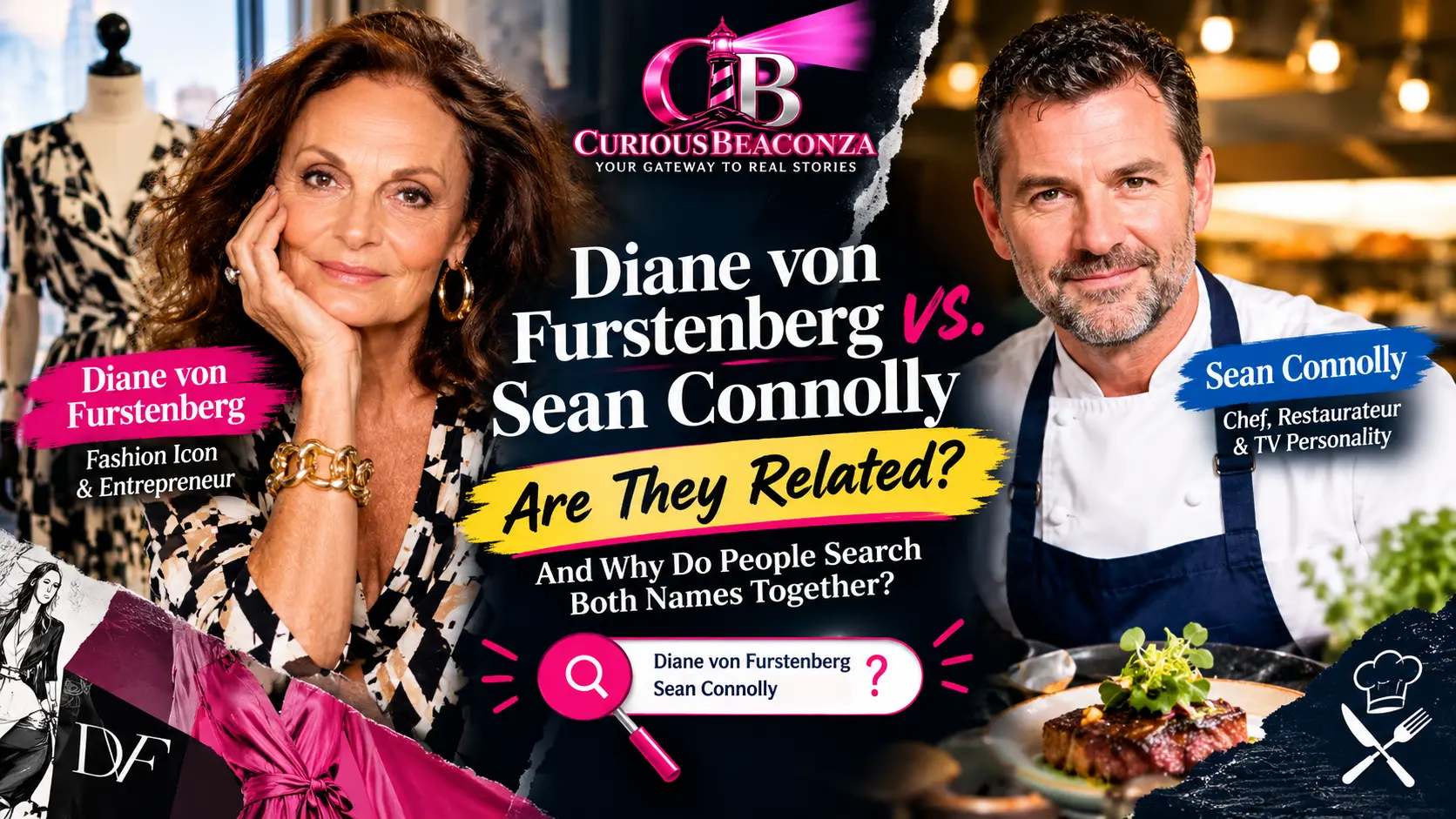
No, Diane von Furstenberg and Sean Connolly are not related, and there is no documented personal, business, or family connection between them. Diane von Furstenberg is a Belgian-American fashion designer best known for inventing the wrap dress in 1974. Sean Connolly is a Yorkshire-born chef and restaurateur based in Australia and New Zealand, known for restaurants like Esther, Steak & Oyster Co., and Pavilion Bar & Kitchens. They work in different industries, on different continents, and there is no reporting, interview, or public record connecting the two of them to each other.
While both individuals have made significant contributions to their respective fields, their paths have diverged entirely, reflecting the diverse tapestry of talent found in the global creative landscape. Von Furstenberg’s impact on fashion has been felt through her bold designs and empowering messages, while Connolly has become a celebrated figure in the culinary world, known for his innovative dishes and commitment to sustainable practices. Despite their lack of connection, both embody a spirit of entrepreneurship and creativity that inspires many across the globe.
If you landed here because a search engine, an autocomplete suggestion, or an AI tool paired these two names together, it’s worth being upfront: that pairing doesn’t reflect a real relationship. It’s most likely the result of two unrelated names showing up near each other in search data, or a mismatched keyword pairing generated for content purposes. Rather than invent a connection that doesn’t exist, here’s a genuinely useful alternative a side-by-side look at two self-made entrepreneurs who, despite having nothing to do with each other, followed surprisingly similar career patterns in completely different industries. First, we’ll delve into the journeys of Sara Blakely, the founder of Spanx, and Elon Musk, the visionary behind companies like Tesla and SpaceX.
Both have demonstrated remarkable resilience and innovation in their respective fields, navigating challenges and setbacks with a tenacity that has redefined their industries. Blakely, who started with just $5,000, revolutionized the shapewear market by identifying a gap in women’s apparel and leveraging her own experiences as a consumer. Meanwhile, Musk’s path began with a passion for technology and sustainability, leading him to create groundbreaking products that push the boundaries of electric vehicles and space exploration. Despite their different arenas, the common threads of determination, creativity, and an unwavering belief in their visions connect their stories in inspiring ways.
Who Is Diane von Furstenberg?
Diane von Furstenberg is a Belgian-American fashion designer, born Diane Simone Michele Halfin on December 31, 1946, in Brussels, best known for inventing the jersey wrap dress in 1974 a single design that sold more than a million units by 1976 and turned her into one of the most influential entrepreneurs in modern fashion. Today she is chairman of her own global lifestyle brand, DVF, chairman emerita of the Council of Fashion Designers of America (CFDA), and the wife of media executive Barry Diller.
That’s the one-line answer. But the more interesting story is how a young immigrant with a suitcase full of jersey dresses became a symbol of female independence and why, fifty years later, her name still means something in an industry that forgets most designers within a decade.
Early Life: The Daughter of a Survivor
Diane von Furstenberg was born in Brussels to Lily Nahmias Halfin, who survived Auschwitz and was released weighing barely 59 pounds, just over a year before Diane’s birth. Von Furstenberg has said publicly, including in interviews and her 2024 documentary, that her mother told her she was “the proof of life after death” a phrase that has become central to how she describes her own resilience. She studied economics at the University of Geneva before beginning her career in the textile industry in Italy, where she first learned to work with jersey fabric, the material that would define her signature look.
In 1969 she married Prince Egon von Furstenberg, a member of the German princely House of Fürstenberg, and briefly held the title of Princess. The couple moved to New York, had two children Alexander and Tatiana and separated in 1972, divorcing in 1983. Von Furstenberg kept the Furstenberg name professionally even after the marriage ended, and it became the brand identity she built her empire on.
The Wrap Dress
In 1974, von Furstenberg introduced a jersey wrap dress: a single piece of printed fabric that tied at the waist, flattered a range of body types without tailoring, and could go from office to evening in one outfit. It arrived at exactly the right cultural moment the early years of the women’s liberation movement, when more women were entering the workforce and wanted clothing that reflected independence rather than restriction.
The dress became a genuine phenomenon. By 1976, over a million had been sold, and von Furstenberg appeared on the cover of Newsweek under the headline “the most marketable woman since Coco Chanel” a comparison that has followed her ever since. The wrap dress is now held in the permanent collections of institutions including the Smithsonian’s National Museum of American History and the Costume Institute at New York’s Metropolitan Museum of Art, which is a strong signal of its lasting design significance rather than just a passing trend.
Who Is Chef Sean Connolly?
Sean Connolly is a UK-born chef and restaurateur, raised in Yorkshire, England, who moved to Australia in the late 1980s and became one of the country’s most recognizable hospitality figures. Over a career spanning more than four decades, he has created and led restaurant concepts across Australia, New Zealand, and the Middle East including Esther at QT Auckland, Steak & Oyster Co. in Sydney, and his own Pavilion Bar & Kitchens in Queenstown while also releasing a cookbook, a line of gourmet products, and starring in multiple television series.
If you’ve eaten at a QT Hotel restaurant in Australia or New Zealand, there’s a decent chance you’ve eaten Sean Connolly’s food without necessarily knowing his name. He’s less of a household celebrity-chef brand than someone like Gordon Ramsay, but within the Australian and New Zealand hospitality industry, he’s considered one of the most consistently working and well-respected operators of his generation.
From Yorkshire Kitchens to Sydney
Connolly began his career as an apprentice chef at the Pennine Hilton in Ainley Top, near Huddersfield in Yorkshire, England, before working through a series of UK restaurant kitchens. In 1988, he arrived in Australia on a working holiday visa — a common path for young British chefs at the time and, according to his own account, fell for the country’s produce, climate, and fast-growing restaurant scene enough to stay for good.
After several years working his way up through sous chef roles, he landed the head chef position at Sydney’s Astral restaurant in 1995, a high-profile posting that put him on the radar of the city’s dining press. By 2008, the Sydney Morning Herald had named him its Chef of the Year, and that same year he opened his second restaurant, Sean’s Kitchen a milestone that marked his shift from working chef to restaurant owner and brand.
Building a Multi-Venue Empire
What sets Connolly apart from many chefs of his generation is the sheer number of concepts he’s created, rather than owned outright. Much of his career has involved partnering with major hospitality groups including QT Hotels & Resorts, SkyCity, and West HQ to design and run signature restaurants inside their properties, rather than solely operating independent venues under his own name.
Quick Comparison Table
| Diane von Furstenberg | Sean Connolly | |
|---|---|---|
| Industry | Fashion design | Hospitality / restaurants |
| Born | December 31, 1946, Brussels, Belgium | Yorkshire, England (exact date not publicly disclosed) |
| Breakout moment | The 1974 wrap dress, which sold over 1 million units by 1976 | Head chef at Sydney’s Astral (1995); Sydney Morning Herald Chef of the Year (2008) |
| Signature achievement | Created a garment now held in the Smithsonian and the Met’s Costume Institute | Built and led restaurant concepts across Australia, New Zealand, Singapore, and the Middle East |
| Business model | Owns and chairs her namesake global brand, DVF | Mostly partners with hotel groups (QT, SkyCity, West HQ) to design and run venues |
| Career reinvention | Left fashion in 1985 to run a Paris publishing house; returned in 1997 | Moved from UK kitchens to Australia in 1988; shifted from chef-for-hire to restaurant owner in 2008 |
| Media presence | Subject of the 2024 Hulu documentary Woman in Charge | Hosted TV series My Family Feast and Sean’s Kitchen with Chef Sean Connolly |
| Recent milestone | DVF returned to profitability in 2026 under new CEO Gabby Hirata | Opened his first fully self-owned venue, Pavilion Bar & Kitchens, in Queenstown, NZ, in 2025 |
| Personal philosophy | “Own it” — self-possession and independence, as expressed in her books | “What we don’t do to a dish” — minimalism and letting ingredients speak, as described in interviews |
Where Their Stories Actually Overlap: The Pattern, Not the People
Even though von Furstenberg and Connolly have never worked together or been publicly linked, their career arcs share a structural pattern that’s worth pulling apart because it’s genuinely instructive, not because they’re connected. Both have navigated the complexities of their respective industries with a blend of innovation and resilience, often redefining expectations in pursuit of their creative visions. von Furstenberg’s iconic wrap dress revolutionized women’s fashion, symbolizing empowerment and independence, while Connolly’s craftsmanship in leather goods redefined luxury, emphasizing timeless quality over fleeting trends. Their distinct journeys illustrate how personal narratives and cultural contexts can shape artistic output, reflecting broader societal changes.
For von Furstenberg, the wrap dress emerged not just as a fashion statement but as a response to the evolving roles of women in the 1970s, offering a versatile silhouette that celebrated individuality and freedom. Meanwhile, Connolly’s approach to leather goods evokes a reverence for craftsmanship and sustainability, positioning his brand as a counter-narrative to the fast fashion cycle that often prioritizes quantity over quality. In this way, both designers not only create products but also engage in a dialogue with their audiences, encouraging them to consider the underlying values of their purchases and the stories behind them.
Their journeys illuminate how distinctive approaches to design and branding can resonate deeply with audiences, fostering a loyal following that transcends mere consumerism. By examining the nuances of their successes, we can glean insights into the broader dynamics of creativity and entrepreneurship in an ever-evolving marketplace. These insights reveal not only the importance of authenticity and storytelling in building brand identity, but also highlight the role of adaptability in responding to shifting consumer preferences.
As these brands navigate the complexities of modern commerce, they demonstrate that true innovation often stems from a keen understanding of cultural currents and a willingness to engage with their audience on a personal level. This dynamic interplay between creativity and market awareness challenges conventional notions of success, urging entrepreneurs to rethink their strategies and redefine what it means to thrive in a competitive landscape.
1. Both built their names on one breakout product
Von Furstenberg’s entire empire traces back to a single garment: the wrap dress. It wasn’t her only design, but it’s the one the brand still leans on for its identity fifty years later. Connolly’s career similarly turns on a signature concept he’s repeated and refined across venues the steak-and-seafood format he first built as Steak & Oyster Co. in Sydney, which he has since exported to Queenstown and other properties under slightly different names. In both cases, one strong, repeatable idea did more for the long-term brand than any single year of output.
2. Both stepped away and came back stronger
Von Furstenberg’s decade-long departure from ready-to-wear fashion, when she ran a publishing house in Paris, is often framed in her own interviews and her Hulu documentary as a deliberate reinvention rather than a retreat. Connolly’s career shows a quieter version of the same instinct: after more than 25 years designing restaurants for other companies, he chose in 2025 to finally open something under his sole ownership. Neither took the straightforward, linear path to their most recognizable achievement both built in phases.
3. Both eventually chose ownership over hired talent
Early in her career, von Furstenberg partnered on the business side, but her long-term strategy was always to own her name outright she is chairman of her own studio, with her husband Barry Diller and her children sharing ownership, according to Forbes’ profile of the designer. Connolly took longer to make that shift. For most of his career, he has designed restaurant concepts inside larger hotel groups’ properties QT Hotels, SkyCity, West HQ rather than owning them outright. Pavilion Bar & Kitchens, which he opened in Queenstown in 2025, marks his own version of that same move toward full ownership after decades of building brand equity for other companies first.
4. Both use media to extend their brand beyond their core product
Von Furstenberg has published two books and sat for a feature-length Hulu documentary, all built around the same message of self-determination that underpins her fashion brand. Connolly has starred in multiple television series, including a show that followed him researching New York City’s food scene before opening a new restaurant back home using television not just for exposure, but to actively shape and preview new concepts before they launch.
So Why These Two Names Paired in Search?
This is worth answering plainly, because it’s the actual reason you may have landed on this article. There’s no red carpet appearance, business deal, interview, or family tie linking Diane von Furstenberg and Sean Connolly in any reputable source not Forbes, not Wikipedia, not IMDb, not any major newspaper. Searches or AI-generated content pairing unrelated names like this typically come from one of a few sources
If you were actually looking for information on how DVF’s fashion brand and hospitality more broadly intersect for example, DVF’s retail partnerships or hospitality collaborations that’s a legitimate and different question, but as of this writing there’s no indication that connection involves Sean Connolly specifically.
When two names get algorithmically paired without a real-world reason, the honest and more useful move is to say so clearly rather than manufacture a story. What’s genuinely interesting here isn’t a nonexistent relationship it’s that two people in completely unrelated industries, on opposite sides of the world, both built lasting personal brands using nearly identical playbooks: one signature product, a mid-career reinvention, and a deliberate late-career move toward full ownership.
FAQs
1. Are Diane von Furstenberg and Sean Connolly related or connected in any way?
No. There is no documented family, business, or personal connection between them in any reputable source they work in different industries, live on different continents, and have never been publicly linked.
2. Who is Diane von Furstenberg?
She’s a Belgian-American fashion designer, born December 31, 1946, in Brussels, best known for inventing the jersey wrap dress in 1974 and building it into a global lifestyle brand, DVF.
3. Who is Sean Connolly?
He’s a Yorkshire-born chef and restaurateur who moved to Australia in 1988 and went on to build restaurant concepts across Australia, New Zealand, and Singapore, including Esther, Steak & Oyster Co., and Pavilion Bar & Kitchens.
4. What is Diane von Furstenberg most famous for?
The wrap dress a single jersey design that sold over a million units by 1976 and is now held in the permanent collections of the Smithsonian and the Met’s Costume Institute.
5. What is Sean Connolly most famous for?
Designing and running signature restaurant concepts inside major hotel groups like QT Hotels and SkyCity, plus hosting TV series including My Family Feast and Sean’s Kitchen with Chef Sean Connolly.
6. Is Diane von Furstenberg still involved with her brand today?
Yes. She remains chairman of DVF, and as of 2026 the company had returned to profitability under CEO Gabby Hirata after a period of cutbacks, according to reporting from The Business of Fashion.
7. What is Sean Connolly’s most recent restaurant venture?
Pavilion Bar & Kitchens, an 860-square-metre dining precinct in Queenstown, New Zealand, which opened in 2025 as his first fully self-owned venue after decades of building concepts for other hospitality groups.
8. Who is Diane von Furstenberg married to?
Media executive Barry Diller, chairman of IAC and Expedia Group; they married in 2001 after being linked for years prior. She was previously married to Prince Egon von Furstenberg from 1969 to 1983.
9. Has either of them been the subject of a documentary or TV series?
Yes, both. Von Furstenberg is the subject of Hulu’s 2024 documentary Diane von Furstenberg: Woman in Charge; Connolly has starred in TV series including My Family Feast on SBS and a six-episode series following his research trip to New York City.
10. Why do “Diane von Furstenberg” and “Sean Connolly” show up together in some searches?
Most likely due to autocomplete artifacts or automated keyword-pairing tools that group two individually popular names together without verifying whether an actual real-world connection exists not because of any genuine link between them.
Final Verdict
There’s no real contest between Diane von Furstenberg and Sean Connolly since they’ve never been connected and work in entirely different industries, but judged purely as entrepreneurs, von Furstenberg wins on legacy a single 1974 design that’s now in the Smithsonian and the Met, plus a brand that clawed back to profitability in 2026 while Connolly wins on business durability, having spread his risk across hotel-group partnerships for over 30 years before finally opening his first fully self-owned venue in 2025, meaning the honest final call isn’t “who’s better” but “better at what”: von Furstenberg built something more likely to be remembered, and Connolly built something more likely to be repeated.
This distinction highlights the varying definitions of success within entrepreneurship; while von Furstenberg’s impact is rooted in cultural significance and iconic status, Connolly’s approach reflects a pragmatic understanding of market demands and sustainability. Both paths have their merits, revealing that the entrepreneurial landscape is vast and multifaceted, accommodating diverse visions of achievement. Von Furstenberg’s legacy, encapsulated in her wrap dress, speaks to a timeless appeal that transcends generations, whereas Connolly’s strategic diversification demonstrates a keen awareness of the ever-evolving hospitality industry. Ultimately, their journeys exemplify how innovation and resilience can manifest in different forms, inviting aspiring entrepreneurs to consider what kind of legacy they wish to create in their respective fields.
You may also read: Willie Nelson and Angelina Jolie: The Unexpected Connection