
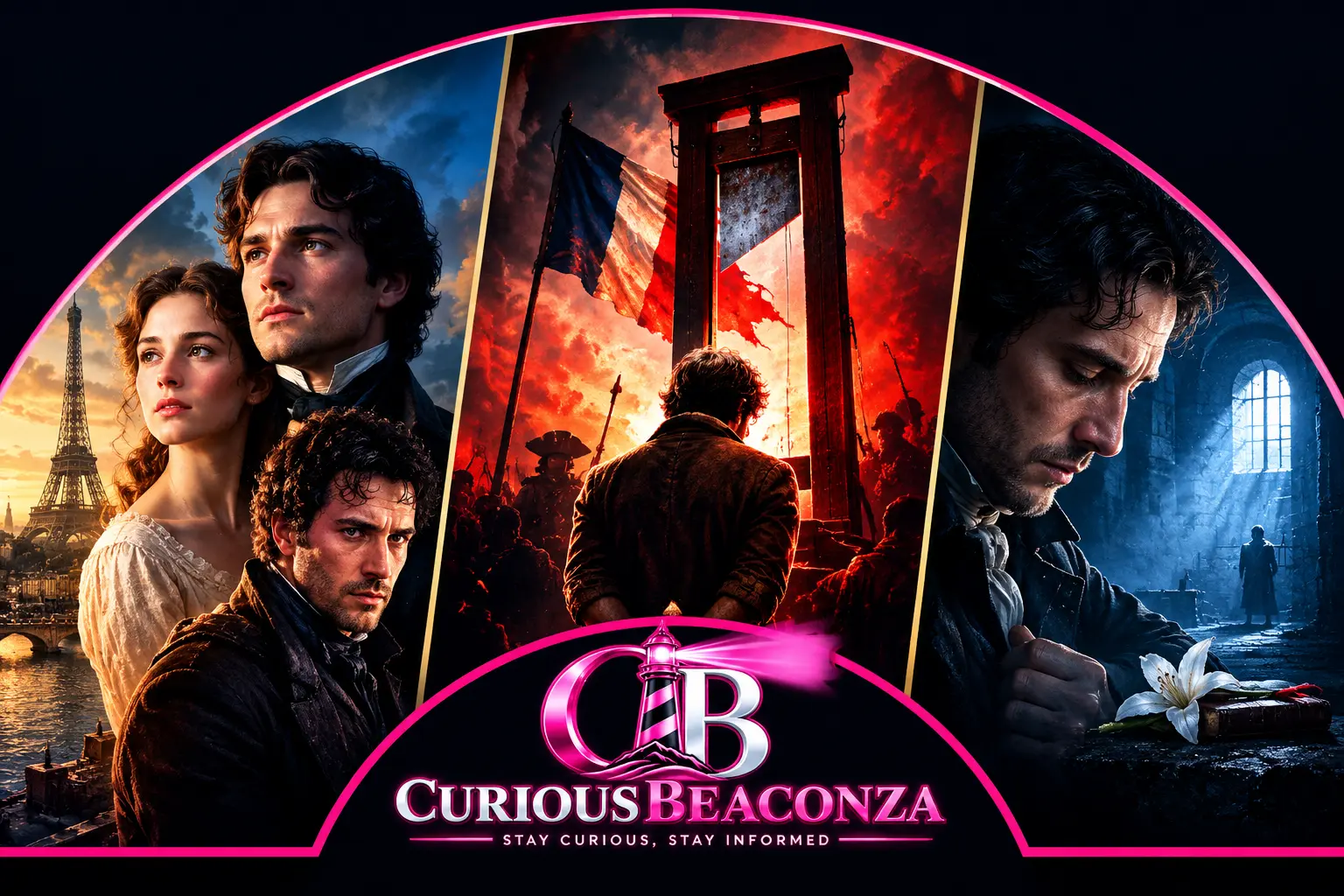
A Tale of Two Cities: The Novel That Asked “Who Is the Real Monster?” And Answered With a Guillotine
A Tale of Two Cities is Charles Dickens’ historical novel set in London and Paris before and during the French Revolution, following Dr. Alexandre Manette’s release from 18 years in the Bastille, his daughter Lucie’s love for the exiled French aristocrat Charles Darnay, and the sacrificial redemption of the dissolute lawyer Sydney Carton. Published in 1859, it remains one of the best-selling novels of all time and the definitive fictional account of the Reign of Terror.
But here’s what most summaries miss: this is not really a book about revolution. It’s a book about resurrection, of a man buried alive, of a city drowning in blood, of a soul that finds meaning only in death.
Who is the protagonist of A Tale of Two Cities? The novel has two: Charles Darnay, the French nobleman who renounces his title and is dragged back to Paris to die for his family’s crimes, and Sydney Carton, the brilliant, self-loathing English barrister who looks almost identical to Darnay, and who ultimately takes his place at the guillotine. Dickens called it “the best story I have written”.
Let’s explore why this 167-year-old novel still cuts as deep as Madame Defarge’s knitting needles.
Who Was Charles Dickens When He Wrote This?
Charles Dickens was born on February 7, 1812, in Portsmouth, England, the second of eight children in a family perpetually on the edge of financial ruin. When he was eleven, his father was thrown into the Marshalsea debtors’ prison, and young Charles was sent to work pasting labels on bottles in a London warehouse for six shillings a week.
That experience, a child alone in a vast, cold city, hungry and forgotten, haunted him for the rest of his life. It also explains everything about his fiction. Dickens didn’t write about aristocrats and ballrooms. He wrote about prisons, orphans, debt, and the poor.
By 1859, when A Tale of Two Cities began serialization, Dickens was the most famous novelist in the English-speaking world. He had published Oliver Twist, David Copperfield, Bleak House, and A Christmas Carol. He was also in the middle of a painful public scandal: his marriage to Catherine Hogarth had collapsed, and he had begun a secret affair with a young actress named Ellen Ternan. The separation, brutal by Victorian standards, was fresh when he sat down to write a novel about sacrifice and resurrection.
What Dickens never publicly admitted was that the core plot of A Tale of Two Cities, a man sacrificing himself on the guillotine to save his romantic rival, was not entirely his invention. It was lifted, almost beat for beat, from a play called The Frozen Deep, written by his friend Wilkie Collins.
Dickens had performed the lead role in 1857, opposite a young actress named Ellen Ternan, the same woman he was secretly involved with when his marriage collapsed. In the play, Dickens played the frustrated lover who sacrifices himself for the man who wins the woman. The parallels to his own life were not subtle. Literary critics have noted that the “Carton-Darnay-Lucie triangle” repeats the plot of The Frozen Deep, and that Dickens’s private emotional turmoil became the raw material for his most famous fictional sacrifice
Publication: The Experiment That Changed Victorian Fiction
A Tale of Two Cities was not published the way most Victorian novels were. Dickens owned his own literary magazine, All the Year Round, and he used it to do something innovative: he serialized the novel in weekly instalments while simultaneously releasing monthly sections in green covers.
The first weekly instalment appeared on April 30, 1859, the very first issue of All the Year Round, and the final chapter ran thirty weeks later, on November 26, 1859. Dickens later said the story “opens out before me” so vividly that he could see the whole serial revolving in his mind.
This dual-publication strategy was commercially brilliant and artistically risky. Weekly readers got cliffhangers; monthly readers got a more novel-like experience. It worked. The novel became a sensation on both sides of the Atlantic.
The Plot: What Actually Happens
The story begins in 1775. Mr. Jarvis Lorry, a clerk at Tellson’s Bank, travels to Dover to meet a young woman named Lucie Manette. He tells her something she has never known: her father, Dr. Alexandre Manette, is not dead. He has just been released from the Bastille, where he was imprisoned for eighteen years as a political prisoner.
Lucie and Lorry travel to Paris, where they find Dr. Manette living above a wine-shop run by Ernest and Thérèse Defarge. The doctor has lost his mind; he spends his days cobbling shoes in a fugue state. Lucie’s love slowly “recalls him to life.”
Five years later, in London, a Frenchman named Charles Darnay is tried for treason, accused of passing English secrets to the French and Americans. The case collapses when Sydney Carton, a brilliant but dissolute barrister who looks strikingly like Darnay, points out that the witnesses cannot possibly identify the accused because the two men are nearly identical.
Darnay, Carton, and a lawyer named Stryver all fall for Lucie. She chooses Darnay. They marry. Carton, in a moment of raw honesty, tells Lucie he expects nothing in return for his love but would do anything for her or anyone she loves.
Darnay, we learn, is actually Charles St. Evrémonde, nephew of a cruel French marquis who was murdered in his bed by revolutionaries. Darnay renounced his title and left France in disgust. But in 1792, as the Revolution consumes Paris, he receives a desperate letter from his old servant Gabelle, imprisoned by the revolutionaries. Darnay returns to Paris to save him, and is immediately arrested as an aristocrat and emigrant.
Dr. Manette, Lucie, and their daughter follow. Dr. Manette, once a prisoner of the Bastille, is hailed as a hero by the revolutionaries and manages to get Darnay acquitted. But then the Defarges denounce Darnay again, and produce a document hidden in Dr. Manette’s old Bastille cell. It is Manette’s own account, written during his imprisonment, revealing that he was jailed by the Evrémonde brothers after witnessing their rape of a peasant girl and the murder of her brother. Darnay, as the last Evrémonde, is sentenced to death.
Sydney Carton, who has traveled to Paris out of love for Lucie, overhears the Defarges plotting to kill Lucie and her child. He arranges for the Manettes to escape, then gains access to Darnay’s cell through a spy named John Barsad. Carton drugs Darnay, swaps clothes with him, and has him carried out unconscious. Carton remains to die in Darnay’s place.
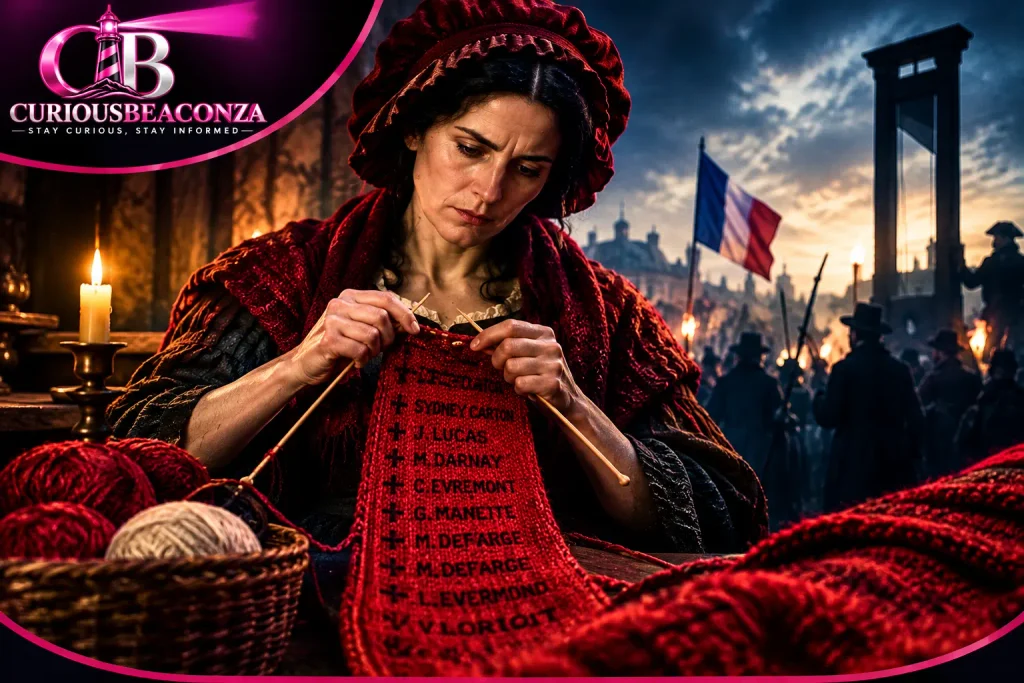
Madame Defarge comes to kill Lucie and her daughter but finds only Miss Pross, Lucie’s fierce protector. The two women struggle; Madame Defarge is shot dead with her own gun.
Carton goes to the guillotine. His final words, “It is a far, far better thing that I do, than I have ever done; it is a far, far better rest that I go to, than I have ever known”, are among the most famous in English literature.
The Characters: Who They Really Are
| Character | Role | The Deep Truth |
|---|---|---|
| Sydney Carton | English barrister, alcoholic, self-loathing | The novel’s true hero. He is the “resurrection” of the title, a wasted life redeemed by one selfless act. |
| Charles Darnay | French aristocrat who renounced his title | He is not the hero. He is the object of the sacrifice, the man who cannot save himself. |
| Dr. Alexandre Manette | Lucie’s father, 18 years in the Bastille | The living embodiment of the Ancien Régime’s cruelty. His private trauma becomes public evidence. |
| Lucie Manette | Dr. Manette’s daughter, Darnay’s wife | She is the “golden thread” that binds the men together, but she is also largely passive, a Victorian ideal rather than a fully realized person. |
| Madame Defarge | Revolutionary, wine-shop owner, knitting fanatic | The novel’s most terrifying force. She is not a villain in the conventional sense. She is what happens when a victim is given absolute power. |
| Miss Pross | Lucie’s devoted servant | A minor character who kills Madame Defarge in one of the novel’s most brutal scenes. She loses her hearing in the struggle, a detail Dickens uses to show the physical cost of survival. |
Who Is Sydney Carton?
If you ask most readers who the protagonist of A Tale of Two Cities is, they’ll say Charles Darnay. They are wrong.
Sydney Carton is the emotional center of the novel. He is the character Dickens cares most about, the one whose arc matters. Darnay is a decent man, but he is also a bit of a bore, a man of honor without much interiority. Carton is a wreck: brilliant, drunk, self-destructive, convinced he is worthless.
His love for Lucie is not romantic in the conventional sense. It is redemptive. He knows he cannot have her. He knows he is not the man she would choose. But he also knows and tells her that she has made him believe he could be better than he is.
His sacrifice at the end is not a sudden conversion. It is the logical conclusion of a life that finally finds something worth dying for. Dickens frames it explicitly as a resurrection: Carton tells Lucie, earlier in the novel, that he would gladly give his life for her or anyone she loves. He means it. He does it. This is why the novel has endured. Carton is not a hero in the traditional sense. He is a failure who performs one perfect action. And in a world where most of us suspect we might be failures too, that story still resonates.
The resurrection theme isn’t just a nice phrase. It is the novel’s structural engine. Dr. Manette is literally “recalled to life” from the Bastille. Charles Darnay is resurrected twice first from the treason trial, then from his death sentence. Jerry Cruncher, the “Resurrection Man,” digs up bodies for a living. Even the opening line’s contradictory pairs “best of times, worst of times,” “spring of hope, winter of despair” create a world where death and rebirth are constantly interchanging.
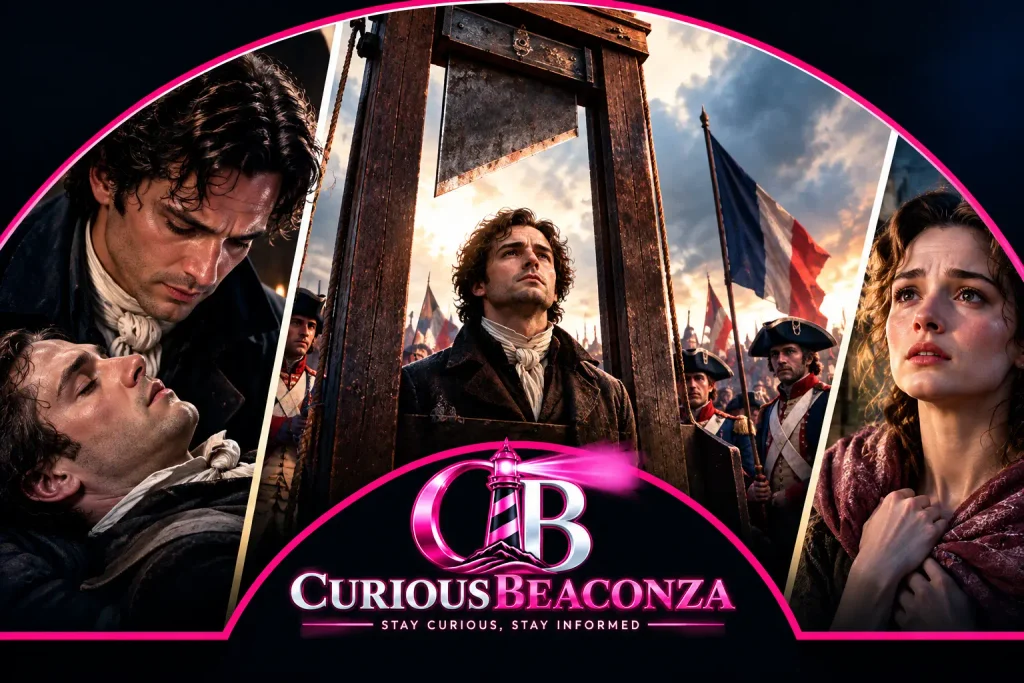
Sydney Carton’s sacrifice is the final resurrection in a chain of resurrections. But it is also the most paradoxical: he dies so that Darnay can live, but he also dies so that he can live finally, fully, as the man he always believed he could be. His famous final words are not a farewell. They are a birth.
Historical Accuracy: How Dickens Got the Revolution Right (And Wrong)
Dickens was not a historian. He was a novelist who read widely, Thomas Carlyle’s The French Revolution was a major source, and then wrote a story that “views the causes and effects of the Revolution from an essentially private point of view”.
Dickens’s preface openly acknowledges his debt to Carlyle, but the novel’s relationship to history is more complicated than simple borrowing. Carlyle’s The French Revolution was a transcendental, almost mystical interpretation of history, not a factual chronicle. Dickens absorbed Carlyle’s method as much as his material: the idea that historical events operate on two levels, the political and the spiritual, and that the visible revolution is merely a symptom of a deeper moral reckoning .
The conservative English press of the 1790s had already created a powerful image of the Revolution as orgiastic bloodletting, a guillotine dripping with gore, sansculottes feasting on dismembered bodies. This imagery passed directly into Dickens’s novel. The grindstone scene, where the revolutionaries sharpen their weapons until “the eye could not detect one creature in the group free from the smear of blood,” is pure Burkean propaganda rendered as literature .
What Dickens added, and what makes the novel endure, is complexity. He refuses to make the revolutionaries simple monsters. Madame Defarge is terrifying, but she is also a victim. The Evrémonde brothers are monsters, but Darnay is innocent. Dickens holds both truths simultaneously: the aristocracy deserved to fall, and the revolution became a nightmare. That moral double vision is why the novel still feels honest.
What he got right:
- The Reign of Terror (1793–94) was indeed a period of mass executions, revolutionary tribunals, and paranoia.
- The Bastille was a real prison, and political prisoners were held there without trial.
- The aristocracy was genuinely brutal. The Evrémonde brothers’ crimes, rape, murder, abuse of power, were based on real incidents.
- The revolutionaries’ fury was fueled by centuries of oppression. Dickens shows this without excusing the violence.
What he got wrong or simplified:
- Dickens never visited Paris during the Revolution, obviously, but he also had limited firsthand experience of France. One critic noted that he “described the city he did not know or understand better than the city he did know”.
- The novel suggests the Revolution was largely a matter of personal revenge (the Defarges’ vendetta against the Evrémondes) rather than a complex political and economic upheaval.
- Madame Defarge is a fictional invention. She represents the revolutionary rage, but she is not a historical figure.
Still, the novel captures something true: the Revolution was personal. Dickens’s core political argument is deceptively simple: extreme inequality makes revolution inevitable, and the aristocrats brought the catastrophe on themselves. The Marquis who runs over a peasant child and tosses a gold coin to the valet is not a cartoon villain. He is a precise portrait of a class that has lost the ability to see the poor as human .
This is why the novel still speaks to 2026. The specific mechanisms differ, guillotines have been replaced by systems, aristocrats by billionaires, but the moral logic Dickens describes remains intact. When the gap between rich and poor becomes unbridgeable, the violence that follows is not a surprise. It is a consequence. It was not just about ideas. It was about people who had been starved, beaten, and ignored for generations finally getting their hands on power, and what they did with it.
2026: Why This Story Is Being Retold Now
In September 2026, a new four-part adaptation of A Tale of Two Cities premieres on BBC One and MGM+, starring Kit Harington (Jon Snow from Game of Thrones) as Sydney Carton, François Civil as Charles Darnay, and Mirren Mack as Lucie Manette.
The creative team has been explicit about why they’re making it now. Executive producer Polly Williams said: “In an era of worldwide turbulence, confusion and uncertainty, A Tale of Two Cities is a very timely story”. Kit Harington and screenwriter Daniel West called it “the original historical blockbuster, a heartbreaking romance and a brutal revenge mystery”.
The adaptation is being framed as a “modern psychological thriller” rather than a traditional period drama. Early reviews of the four-part series suggest the adaptation makes some deliberate departures from Dickens. The Paris scenes are performed in French, lending an authenticity the novel never had. Lucie Manette, traditionally criticized as a passive Victorian ideal, is given a substantive arc: she studies medicine, performs procedures on corpses since women cannot be doctors, and helps rescue Darnay herself .
Kit Harington has acknowledged that the language has been modernized, “trading Dickens’ Victorian-period phrasing for more emotionally charged, straightforward prose”, and that the love triangle receives greater emphasis than the historical backdrop . For purists, this may rankle. But it is a defensible choice: the novel’s emotional core has always been the Carton-Darnay-Lucie dynamic, and the Revolution is the stage, not the play. That’s a telling choice. Dickens’ novel is, at its core, a thriller: a man is imprisoned unjustly, a woman is hunted by a revolutionary, a sacrifice is planned in secret.
But the timing matters too. In a world of political polarization, refugee crises, and debates about who deserves mercy and who deserves punishment, A Tale of Two Cities asks questions we are still answering:
- When is violence justified?
- Can a person be guilty of their ancestors’ crimes?
- What does redemption actually look like?
The Opening Line: Why It Still Matters
“It was the best of times, it was the worst of times, it was the age of wisdom, it was the age of foolishness, it was the epoch of belief, it was the epoch of incredulity, it was the season of Light, it was the season of Darkness, it was the spring of hope, it was the winter of despair.” This is the most famous opening in English fiction. It has been parodied, quoted, and memed. But what makes it work is not its rhythm. It’s its accuracy.
Dickens is not just describing 1775. He is describing every moment of historical crisis. He is describing 2026. The novel insists that revolution, political, personal, emotional, happens in a world where everything is simultaneously true. Hope and despair coexist. Wisdom and foolishness share the same room.
That is why the book survives. It does not offer easy answers. It offers a mirror.
A Tale of Two Cities Quotes: The Lines That Still Cut Deep
Dickens didn’t just write a novel. He wrote a collection of sentences that have outlived every empire that rose and fell since 1859. Some are famous. Some are hidden. All of them are weapons.
“It was the best of times, it was the worst of times…”
Where it appears: Book 1, Chapter 1, Page 5
This is the most quoted opening in English fiction. It has been parodied, memed, and reduced to a greeting card. But the line’s power isn’t in its rhythm. It’s in its accuracy. Dickens is using a literary technique called antithesis placing opposite ideas side by side with equal weight . “Best” and “worst” aren’t alternatives. They are simultaneous truths. The sentence insists that a single moment can contain everything: hope and despair, wisdom and foolishness, light and darkness.
The deep cut: The full sentence ends with “we were all going direct to Heaven, we were all going direct the other way” . Most people forget that part. It’s the punchline. Everyone thinks they’re the good guys. Everyone is wrong.
“It is a far, far better thing that I do, than I have ever done…”
Where it appears: Book 3, Chapter 15, Sydney Carton’s final words on the guillotine
This is the other most famous line in the novel. Sydney Carton, the alcoholic failure who wasted his life, speaks these words moments before his death. He is dying in Charles Darnay’s place. He is dying so Lucie can live.
The line works because of everything that came before it. Carton spent the entire novel believing he was worthless. He told Lucie he was “a heap of ashes”, a man who could never be anything but a disappointment . His sacrifice isn’t a sudden conversion. It’s the logical conclusion of a life that finally found something worth dying for.
What most readers miss: Carton also says “it is a far, far better rest that I go to.” He isn’t just talking about death. He’s talking about peace. For the first time in his life, Carton is at rest. He has done something that matters. He has become the man he always suspected he could be.
“Recalled to life.”
Where it appears: Book 1, Chapter 2, Page 12
Jarvis Lorry, the Tellson’s Bank clerk, delivers this cryptic message about Dr. Manette’s release from the Bastille. It’s only three words. It’s also the entire novel in miniature.
Dr. Manette spent eighteen years buried alive in a French prison. When he emerges, he isn’t a man. He’s a ghost. He cobbles shoes in a fugue state. He doesn’t know his own name. Lucie’s love, and only Lucie’s love, slowly pulls him back from the dead . This phrase introduces the novel’s central theme: resurrection. Manette is resurrected. Darnay is resurrected twice. Carton resurrects himself through sacrifice. The novel is a chain of people being pulled back from death, one after another.
“Liberty, Equality, Fraternity, or Death; the last, much the easiest to bestow, O Guillotine!”
Where it appears: Book 3, Chapter 4
This is Dickens at his most savage. The revolutionary slogan “Liberty, Equality, Fraternity” is stripped of its romance. The final word is the only one the guillotine can actually deliver .
Dickens isn’t mocking the ideals of the Revolution. He’s mourning them. Liberty and equality were real hopes. Fraternity was a real dream. But the blade turned them into a death sentence. The line captures the novel’s central political argument: revolution devours its own children.
“Then tell Wind and Fire where to stop, but don’t tell me.”
Where it appears: Book 3, Chapter 12, Madame Defarge speaking to her husband
Madame Defarge is the most terrifying character in the novel. She sits in her wine-shop, knitting names into a death list. She never raises her voice. She never hesitates. When her husband suggests that maybe, perhaps, they should spare Lucie and her child, this is her answer. The line is a warning. Once the machinery of revenge is set in motion, it cannot be stopped. Wind and fire can be reasoned with. Madame Defarge cannot. She is what happens when a victim is given absolute power. She is not a villain in the conventional sense. She is a consequence.
“I have had the weakness, and have still the weakness, to wish you to know with what a sudden mastery you kindled me, heap of ashes that I am, into fire.”
Where it appears: Book 2, Chapter 13, Sydney Carton confessing his love to Lucie
This is Sydney Carton’s most honest moment. He knows Lucie will never love him. He knows he is telling her something that can only cause pain. And he tells her anyway. The metaphor matters: “heap of ashes” and “kindled into fire.” Carton sees himself as dead, already burned out, already worthless. Lucie didn’t just make him love her. She made him alive . She showed him that there was something in him worth saving. The tragedy is that he only realizes it fully when he decides to die.
“I am the Resurrection and the Life.”
Where it appears: Book 3, Chapter 15, Carton’s vision before his death
These words are not Dickens’s invention. They come from the Gospel of John, spoken by Jesus before he raises Lazarus from the dead . Carton hears them, sees them written “on land and on water, on earth and on sky”, as he prepares to die.
The quote is doing something radical. Carton is not a Christ figure in any traditional sense. He’s a drunk. He’s a failure. He’s a man who spent his life convincing himself he was worthless. But in the final moments, he claims the language of resurrection for himself. He is not just dying for Darnay. He is dying to be reborn.
“A multitude of people, and yet a solitude!”
Where it appears: Book 2, Chapter 7 Darnay in London
This is the novel’s quietest line. It’s also one of its most important. Darnay speaks it during a thunderstorm, standing with Carton and Lucie, listening to the echoes of footsteps in the street . Dickens uses the image to suggest something about modern life: we are surrounded by people and completely alone. The footsteps belong to people who will enter their lives some as friends, some as enemies. The coming crowd is history. It is the Revolution. It is death.
The line captures the loneliness at the heart of the novel. Everyone in A Tale of Two Cities is isolated, even when they are together. Dr. Manette is isolated in his trauma. Carton is isolated in his self-loathing. Madame Defarge is isolated in her vengeance. The crowd is always coming. But it never brings connection.
“Madame Defarge knitted steadily, but the intelligence had a palpable effect upon her husband.”
Where it appears: Book 2, Chapter 15
This is not a famous line. It should be. It captures the novel’s most chilling symbol in a single sentence.
Madame Defarge knits. She knits the names of people who will die. She knits while her husband watches. She knits while the Revolution builds. The knitting is mechanical, relentless, emotionless. It is a substitute for eating and drinking, a way to keep the hands busy while the mind plans murder. The line is a masterclass in understatement. “A palpable effect” is the gentlest possible way to describe the terror Defarge feels. His wife has just told him she is keeping a list of people to kill. He is not horrified. He is afraid of her.
Conclusion: The Resurrection That Never Ends
A Tale of Two Cities is a novel about being buried alive, in a prison, in grief, in addiction, in history, and coming back. Dr. Manette is “recalled to life.” Charles Darnay escapes death twice. Sydney Carton finds meaning in dying. But the resurrection that matters most is the one Dickens performs on his readers. He takes a historical event, the French Revolution, that most English readers in 1859 knew only as a distant horror, and he makes it personal. He shows that revolutions are not just mobs and guillotines. They are fathers and daughters, husbands and wives, ordinary people caught in forces they cannot control.
Sydney Carton’s final words are often read as a statement of selflessness. They are also a statement of belief: that a life can be redeemed, that a sacrifice can matter, that the future can be better than the past.
That is the “far, far better thing.” Not the death. The hope.
You may read also: Friends, Lovers, and the Big Terrible Thing: A Memoir, The Book Matthew Perry Wrote So His Pain Would Mean Something