
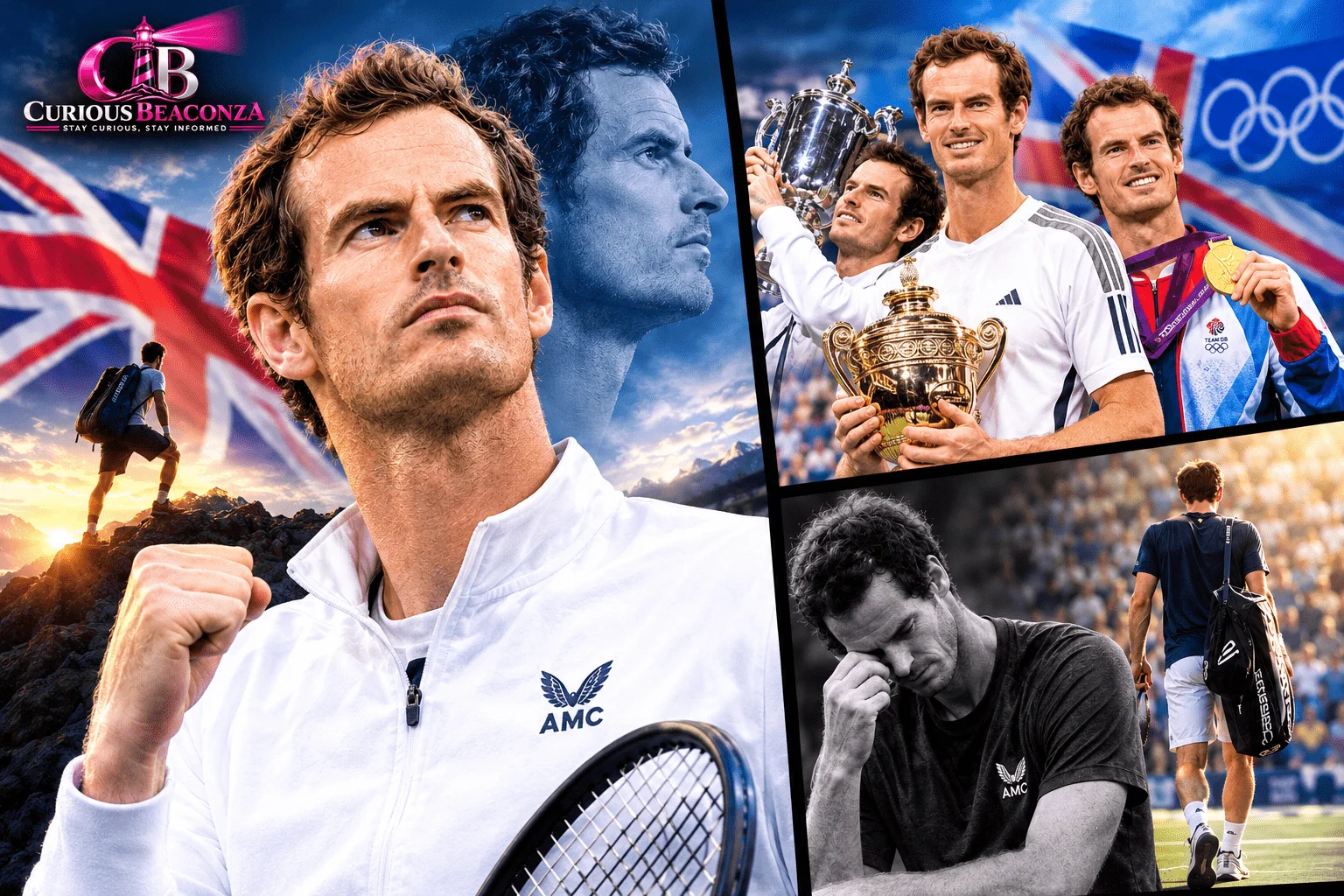
Sir Andy Murray is a three-time Grand Slam champion, two-time Olympic gold medalist, and former world No. 1 who retired from professional tennis in 2024 as one of the greatest British athletes of all time. Yet his true legacy extends far beyond trophies. Murray’s career represents something increasingly rare in modern sport: a champion who won not by natural dominance, but by sheer force of will, tactical intelligence, and an almost stubborn refusal to accept limitations placed upon him. He competed in the most brutal era of men’s tennis history alongside Roger Federer, Rafael Nadal, and Novak Djokovic, and he didn’t just survive. He won. He reached No. 1. He made history.
Murray’s resilience was evident not only in his grueling matches but also in his personal battles, including injuries that threatened to derail his career. Each setback became a testament to his dedication, as he meticulously rehabilitated and returned to the court with renewed vigor, often surpassing the expectations of both fans and critics alike. His evolution from a talented but inconsistent player to a formidable competitor reflected an unwavering commitment to self-improvement, embodying the spirit of perseverance.
Off the court, his role as a father has also become an important part of his life, with his Andy Murray children remaining central to his family life, using his platform to discuss the pressures athletes face, thereby further solidifying his role as a pioneer for future generations. As he transitions from player to mentor, Murray’s impact on tennis and society continues to resonate, inspiring countless individuals to challenge their own limitations and redefine what it means to be a champion.
The Numbers Behind a Legendary Career
Before exploring the deeper story, here are the essential statistics that define Sir Andy Murray’s professional tennis career:
| Achievement | Detail |
|---|---|
| Grand Slam Titles | 3 (US Open 2012, Wimbledon 2013, 2016) |
| Olympic Gold Medals | 2 (London 2012, Rio 2016) |
| ATP World No. 1 | November 7, 2016 – 41 consecutive weeks |
| Career Singles Titles | 46 |
| Davis Cup | 2015 champion with Great Britain |
| Career Prize Money | $64.7 million (approx.) |
| Wins vs. Big Three | 29 combined victories |
| Knighthood | 2019 (for services to tennis and charity) |
Source: ATP Tour, Yahoo Sports
The Dunblane Beginning
Andy Murray was born on May 15, 1987, in Glasgow, Scotland, and grew up in the small town of Dunblane. His introduction to tennis came through his mother, Judy Murray, a former Scottish champion who recognized early that her younger son possessed something unusual not just talent, but an almost obsessive relationship with competition.
What often goes unmentioned in discussions of Murray’s development is the shadow that hung over his childhood. In 1996, when Murray was just eight years old, the Dunblane school massacre occurred. Murray and his brother Jamie were both present at the school that day, taking cover in a classroom. He has generally been reluctant to discuss the trauma publicly, but those who know him well suggest it shaped his perspective on life and sport in ways that words cannot fully capture. Tennis became not just a career path but a form of expression, a way to channel intensity and emotion into something constructive.
The financial sacrifice his family made was substantial. At fifteen, Murray moved to Barcelona to train at the Sánchez-Casal Academy. His mother took out a £30,000 bank loan to fund the move. Murray has since spoken openly about the pressure he felt to justify that investment, and about the regret he carries for leaving school without formal qualifications. It’s a candid admission from someone who would go on to become one of the most articulate and thoughtful voices in British sport.
Climbing the Mountain in the Shadow of Giants

Murray turned professional in 2005 and won his first ATP title in 2006 at the SAP Open, defeating Lleyton Hewitt in the final. He became British No. 1 that same year, ending Tim Henman’s seven-year reign. The early promise was obvious. What wasn’t yet clear was whether he could translate that promise into major titles, because standing in his way were three players who would become the most dominant trio in tennis history.
Roger Federer, Rafael Nadal, and Novak Djokovic were not just formidable opponents; they represented a new era of tennis that would redefine the sport. Each possessed a unique blend of skill, determination, and mental fortitude, making them a daunting challenge for any aspiring champion. As Murray continued to hone his game, it became increasingly clear that his path to greatness would require not only talent but also resilience and strategic evolution, especially as he faced these titans in crucial matches. The question lingered: could his relentless work ethic and tactical acumen allow him to break through and claim the prestigious Grand Slam titles that had thus far eluded him?
Between 2004 and 2024, Federer, Nadal, and Djokovic combined to win an almost incomprehensible number of Grand Slam titles. Murray reached eleven Grand Slam finals and lost eight of them. That statistic could be read as failure. A more honest reading is that Murray consistently placed himself in the final weekend of the sport’s biggest events, against opponents who were, at their peaks, virtually unbeatable.
Patrick Mouratoglou, the renowned coach who has worked with champions including Serena Williams, offered this assessment: “What Andy Murray has shown most in his career are mental virtues and values. He is one of the ultimate champions in terms of mentality. When he became world number 1, he fought like hell… He put himself in impossible states, but he had that resilience and he never gave up”.
Breaking Through: The Major Victories
The breakthrough came in 2012 at the US Open, where Murray defeated Novak Djokovic in a five-set final. It was Britain’s first male Grand Slam singles title since Fred Perry in 1936, a 76-year wait that had become an almost mythological burden for British tennis. The following year, Murray won Wimbledon, becoming the first British man to lift the trophy since Perry. The 77-year gap made the victory feel less like a tennis match and more like a national exorcism. He won it again in 2016, defeating Milos Raonic in straight sets.
But perhaps Murray’s most remarkable achievement came in 2016. That season, he won nine titles including five in a row to end the year, captured Olympic gold in Rio (becoming the only player, male or female, to win two Olympic singles gold medals), and claimed the ATP Finals title over Djokovic to secure the year-end No. 1 ranking. For a brief moment, he stood alone at the top of a sport dominated by three of the greatest players who ever lived.
A Legacy Beyond Trophies
Murray’s influence extends far beyond his win-loss record. He hired Amélie Mauresmo as his coach in 2014, becoming only the second top-10 player in ATP history to have a female coach. The decision was mocked by some at the time. Murray’s response was characteristically direct: he didn’t care. He believed Mauresmo was the right person for the job, and the gender of his coach was irrelevant.
He has been an outspoken advocate for gender equality, women’s sport, and various charitable causes. His knighthood in 2019 recognized not just his tennis achievements but his willingness to use his platform for purposes larger than himself.
The Body Breaks
After 2016, Murray’s body began to betray him. A hip injury that had been worsening for years eventually required major surgery in 2019, hip resurfacing, a procedure that had ended the careers of other athletes. Murray’s tearful press conference before the 2019 Australian Open, where he suggested he might never play again, was one of the most raw moments in modern sports.
Yet he returned. He won the European Open in 2019. He climbed back inside the top 50. He played on, through metal plates in his hip and various other physical ailments, because he simply didn’t know how to stop. His final professional tournament was the 2024 Paris Olympics, where he partnered with Daniel Evans in doubles before calling time on his career.
What Comes After
Since retiring, Murray has kept himself busy. He has become an avid golfer, playing in pro-am events and joking about his own limitations on Instagram. He has expanded his business interests, including the Cromlix House hotel, a tennis apparel brand with Castore, and various investments. The Sunday Times Rich List estimated his wealth at £110 million in 2026.
But tennis hasn’t fully let him go. In 2026, Murray returned to the sport as a coaching consultant for British player Jack Draper during the grass-court season. It’s a role that suits him—not full-time coaching, which would require the travel and time away from his family that he no longer wants, but something more flexible. Something that allows him to give back to the sport that gave him everything.
Frequently Asked Questions
How many Grand Slam titles did Sir Andy Murray win?
Murray won three Grand Slam singles titles: the 2012 US Open and Wimbledon in 2013 and 2016.
Was Andy Murray ever ranked world No. 1?
Yes. Murray became world No. 1 on November 7, 2016, and held the ranking for 41 consecutive weeks.
How many Olympic gold medals did Andy Murray win?
Two. He won men’s singles gold at London 2012 and Rio 2016, becoming the only player to win two Olympic singles gold medals.
When did Sir Andy Murray retire?
Murray played his final professional tournament at the 2024 Paris Olympics.
Why was Andy Murray knighted?
Murray was knighted in 2019 for his services to tennis and charity.
The True Measure of a Champion
Sir Andy Murray’s career will always be discussed in relation to the Big Three. He won three majors; they won dozens. He spent 41 weeks at No. 1; they spent years. But those comparisons miss the point entirely. Murray’s journey is defined not merely by the numbers but by his relentless spirit and resilience in the face of adversity. His battles on the court were often as much against his own body as they were against formidable opponents.
Injuries plagued his career, yet he consistently returned to the top level, demonstrating an unwavering commitment to his craft that resonates deeply with fans and aspiring athletes alike. It is this tenacity, coupled with his tactical brilliance and sportsmanship, that sets him apart and ensures his legacy transcends mere statistics.
Murray competed in an era that demanded perfection, and he refused to be reduced to a footnote. He clawed his way to the top of a sport that had three of its greatest practitioners competing simultaneously. He did it with a game built on intelligence, defense, and an almost pathological refusal to accept defeat, not with the divine gifts of Federer, the brute force of Nadal, or the elasticity of Djokovic.
His legacy is not just the trophies, though they matter. It’s the example he set: that excellence can be earned, that limitations can be challenged, and that a champion can be measured by something more than the number of times he lifted a trophy. Murray’s story is one of perseverance, and in an era obsessed with greatness, it may be the most human story of them all.
You may read also: Who Is Kim Sears Husband? Andy Murray’s Love Story and Life Together
[…] Sears brought a unique understanding to her relationship with Andy Murray. As the daughter of a professional tennis coach who worked with players like Ana Ivanovic and […]
[…] Sir Andy Murray has become known not only for his remarkable tennis career but also for the important role his family plays in his life. The three-time Grand Slam winner and his wife, Kim Sears, are proud parents to four children: Sophia, born in 2016; Edie, born in 2017; Teddy, born in 2019; and Lola, born in 2021. Together, Andy Murray children have brought new meaning and balance to his world both on and off the court. As he navigates the challenges of professional tennis, Andy often speaks about how fatherhood has reshaped his priorities, instilling in him a deeper sense of purpose. […]