

What Is This Book, Really?
Friends, Lovers, and the Big Terrible Thing: A Memoir is Matthew Perry’s powerful and heart-breaking story of fame, addiction, and survival. Beyond his success on Friends, he reveals the painful truth about getting everything he ever wanted yet still struggling to find happiness. Through candid reflections and raw honesty, Perry takes readers on a journey that exposes the inner demons he battled while navigating the highs and lows of Hollywood life. As he recounts his experiences, he shines a light on the often-overlooked realities of addiction, the pressures of fame, and the profound impact these challenges had on his relationships with those he cherished most.
Perry wrote it because he believed his suffering might serve a purpose beyond himself. “When I die, I don’t want Friends to be the first thing that’s mentioned,” he said in a November 2022 interview with CBC’s Q with Tom Power. “I want helping people struggling with addiction to be the first thing that’s mentioned. And I’m gonna live the rest of my life proving that.” His determination to shift the narrative surrounding his life was palpable, and it drove him to share his journey with raw honesty. Perry understood that the path to recovery was fraught with challenges, yet he was committed to using his platform to inspire others who felt lost in the depths of addiction.
“Every story matters,” he stated, emphasizing that vulnerability could be a source of strength. Through his advocacy, he aimed to foster a sense of community among those battling similar demons, reminding them that they were not alone in their struggles.
He died less than a year later. The book became his proof.
Who Was Matthew Perry? The Man Behind Chandler Bing
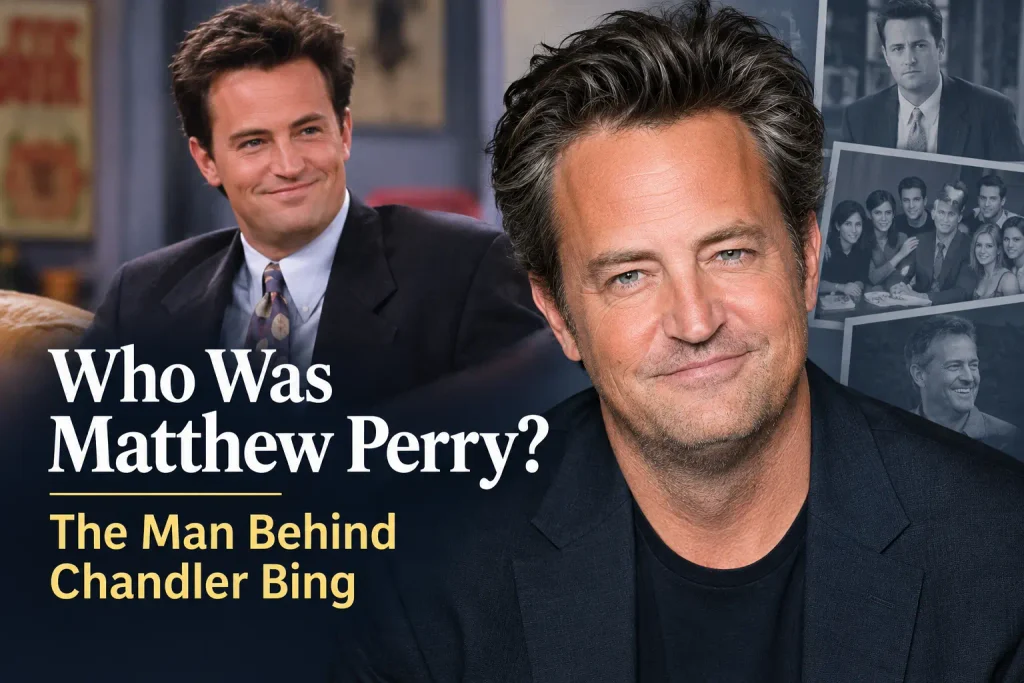
Matthew Langford Perry was born August 19, 1969, in Williamstown, Massachusetts, and raised primarily in Ottawa, Canada, after his parents separated. He became a nationally ranked junior tennis player in Canada before pivoting to acting at 15, moving to Los Angeles to pursue the career that would make him a household name.
From 1994 to 2004, he played Chandler Bing on Friends, a role that earned him global recognition and an estimated $1 million per episode at the show’s peak. But the fame he had actively prayed for, literally, as a young man, he prayed, “Please, God, make me famous” proved to be no shield against the disease that would define his life.
Perry died October 28, 2023, at age 54. The Los Angeles County Medical Examiner ruled his death an accident caused by “acute effects of ketamine,” with drowning, coronary artery disease, and buprenorphine effects as contributing factors. He had reportedly been clean for 19 months.
Why this matters for understanding the book: Perry wrote Friends, Lovers, and the Big Terrible Thing as a living man looking backward, not as a dead man being memorialized. That distinction shapes every page.
The Big Terrible Thing: What Perry Was Actually Writing About
The “big terrible thing” is not Friends. It is not a breakup. It is not even fame itself.
It is addiction, specifically, Perry’s decades-long relationship with alcohol and opioids that began, by his own account, when he was prescribed a barbiturate for colic at just 30 days old. He had his first drink at 14. By 18, he was drinking nightly. By his mid-20s, he was taking as many as 55 Vicodin a day.
At his lowest, in 2018, his colon burst from opioid overuse. He was placed on ECMO life support. Doctors gave him a 2% chance of survival. “Five people had an ECMO machine that night and the other four died,” Perry recalled. “And I survived.”
He spent an estimated $7 to $9 million on rehab and recovery attempts over his lifetime.
Perry’s Acting Career Beyond Chandler Bing
Perry’s professional legacy extends far beyond Friends. The Television Academy records that he received Primetime Emmy Award nominations for his performances in The West Wing (2003) and The Ron Clark Story (2006). He also starred in Studio 60 on the Sunset Strip, co-created and starred in Mr. Sunshine and Go On, and appeared in films including Fools Rush In, The Whole Nine Yards, and 17 Again. His ability to transition between comedy and drama demonstrated a range that his most famous role sometimes overshadowed
The critical insight: Perry’s addiction was not a response to fame. It was a pre-existing condition that fame could not touch. “Alcoholism did not care that I was on Friends,” he said. “Alcoholism wants you alone; it wants you sick; and then it wants to kill you.”
What the Memoir Actually Reveals: Key Themes and Revelations
The Book’s Structure
Perry organized the memoir in a deliberately non-linear fashion, looping between his childhood in Canada, his early audition days, the Friends years, his romantic relationships, and the endless cycle of rehab, relapse, and near-death experiences. The effect is disorienting by design, it mirrors how addiction fractures a life into disconnected moments of crisis and fleeting peace.
The narrative opens with perhaps the most arresting first line in modern celebrity memoir: “Hi, my name is Matthew, although you may know me by another name. My friends call me Matty. And I should be dead.”
The Friends Connection
Perry worked on the show under a personal rule: never drink or use drugs on set. But he often arrived severely hungover, and he avoided watching the show later because his changing weight and appearance served as a visible timeline of his addiction’s progression.
He wrote about his castmates with genuine warmth, though he did not spare himself in describing how his struggles affected those around him.
Jennifer Aniston’s Perspective: What the Cast Knew
In August 2025, Jennifer Aniston spoke to Vanity Fair about Perry’s long struggle with addiction and the cast’s response. “We did everything we could when we could,” Aniston said. “It almost felt like we’d been mourning Matthew for a long time because his battle with that disease was a really hard one for him to fight. As hard as it was for all of us and for the fans, there’s a part of me that thinks this is better. I’m glad he’s out of that pain”.
Aniston revealed that Perry sent her a text message with a photo of them laughing on the Friends set, writing: “Making you laugh just made my day. It made my day”. She also disclosed that she had texted Perry on the day he died and noted he was “happy” and “healthy” at that time
The Love Story (or Lack Thereof)
Despite the “lovers” in the title, the book is not a romantic memoir. It is a chronicle of Perry’s repeated attempts to find in relationships what he could not find in himself. He writes candidly about a pattern of pursuing women, including notable relationships with Julia Roberts and Lizzy Caplan, and then sabotaging the connection before it could deepen.
The most painful passages concern what he describes as a fundamental belief that he was unlovable, a conviction that no external validation could dislodge.
The Legacy He Wanted
Perry was explicit about how he wanted to be remembered. He created the Perry House in Malibu, a sober-living facility for men. He wrote a play, The End of Longing, drawing on his experiences. And he wrote this book.
The Matthew Perry Foundation: Continuing His Mission
After Perry’s death, the Matthew Perry Foundation was established to carry forward his vision. The organization is “dedicated to challenging the stigma surrounding addiction that keeps people from getting the help they need”. Its mission statement quotes Perry directly: “When I die, I want helping others to be the first thing that’s mentioned. Addiction is far too powerful for anyone to defeat alone. But together, one day at a time, we can beat it down”.
The Foundation operates on four strategic pillars: Care (championing compassionate, evidence-based treatment), Stigma (changing the narrative through storytelling and education), Philanthropy (investing in solutions), and Community (building a network of supporters). Its inaugural program, Grassroots Recovery Grants, provides financial assistance to local organizations combating substance use disorders.
“We’ve already heard about five different people that have read it and then checked into rehab the next day,” Perry said shortly after publication. “There’s been some real ups and downs in my life and this is a lot about the downs, but the further down you go the more people you can help.”
The Memoir in Context: Reception and Legacy
What Readers Actually Say: The Book’s Emotional Impact
Reader response to Friends, Lovers, and the Big Terrible Thing reveals its dual nature as both a celebrity memoir and a cautionary tale. On library review platforms, readers describe it as “uncomfortably honest in the best possible way,” with many noting that Perry “does not structure his story as a rise, fall, and redemption arc”.
Some readers found the non-linear structure disorienting, with one reviewer noting “it’s hard to determine at times who Perry is talking about, what time period, what movie or TV show, or what stint in rehab he’s [referring to]”. Others found profound meaning in his struggle: “To truly understand addiction you need to read a personal story like this one. It is difficult to understand how someone with great wealth, and fame cannot escape their demon”.
A particularly poignant review published after Perry’s death observed: “Reading it now that Matthew is gone made it so much sadder and harder to process
Why This Book Matters
Friends, Lovers, and the Big Terrible Thing is not a great work of literature. It is repetitive, sometimes self-indulgent, and structurally uneven. Perry was not a professional writer, and the book bears the marks of someone who found honesty easier than craft.
But it is an important book. It documents, with unusual specificity, what addiction actually looks like from the inside, not the glamorized version, not the moralistic version, but the mundane, grinding, humiliating reality of a man who could afford every treatment in the world and still could not stay well.
Perry’s death eight months after publication gives the book an uncomfortable weight. It reads now as both testimony and warning. The final chapters, which strike a note of cautious hope, land differently when you know the ending.
The book’s lasting value lies in its refusal to offer a clean redemption arc. Perry did not get to be remembered the way he wanted, as the man who helped others before he was known as Chandler Bing. But he left behind a document that might do exactly what he hoped: let someone struggling see their own experience reflected, and perhaps decide to try again.
The Medical Reality Behind the “Big Terrible Thing”
Understanding Perry’s death requires understanding the medical complexities involved. The Los Angeles County Medical Examiner ruled his death an accident caused by “acute effects of ketamine,” with drowning, coronary artery disease, and buprenorphine effects as contributing factors.
Chief Medical Examiner Odey Ukpo explained the reasoning behind the ruling: “But for the ketamine, would he have been out of it and unable to rescue himself? That’s why ketamine is the cause of death primarily, and then the drowning contributed”. The examiner’s report noted that ketamine levels in Perry’s blood were comparable to higher-range levels used in general anesthesia, which would cause overstimulation of the heart and breathing problems.
This medical context is crucial because ketamine is increasingly used therapeutically for treatment-resistant depression, with research showing a single dose can ease depressive symptoms within hours. Perry was undergoing ketamine infusion therapy, but his most recent known treatment was more than a week before his death, meaning that dose would no longer have been in his system
Frequently Asked Questions
Is Friends, Lovers, and the Big Terrible Thing about the TV show Friends?
It is not a behind-the-scenes tell-all. Friends provides context and occasional anecdotes, but the book’s primary subject is Perry’s addiction and his attempts to understand why fame and success could not fix him.
When was the book published?
November 1, 2022, by Flatiron Books.
Did Matthew Perry narrate the audiobook?
Yes. Perry recorded the audiobook himself, which AudioFile noted added to the emotional impact.
What does “the big terrible thing” refer to?
It is Perry’s term for his addiction, the force that dominated his life, destroyed relationships, and nearly killed him multiple times.
Did the book help people?
Perry claimed within weeks of publication that at least five people had checked into rehab after reading it. Whether or not that number is precise, the book’s unflinching honesty about addiction’s daily realities gives it genuine utility for readers in similar struggles.
What was Matthew Perry’s cause of death?
Perry died October 28, 2023, at age 54. The Los Angeles County Medical Examiner determined the cause was “acute effects of ketamine,” with drowning, coronary artery disease, and buprenorphine effects listed as contributing factors. The manner of death was ruled an accident
Where can we learn more about the Matthew Perry Foundation?
The Matthew Perry Foundation continues Perry’s mission of helping those struggling with addiction. You can visit matthewperryfoundation.org for information about their programs, including Grassroots Recovery Grants, and to learn how to support their work
[…] You may read also: Friends, Lovers, and the Big Terrible Thing: A Memoir, The Book Matthew Perry Wrote So His Pain Woul… […]