

Buket Kömür is a Turkish-British actress born in Camden, London, known for her compelling performances in critically acclaimed television dramas including ITV’s Honour (2020), Our House (2022), and Channel 4‘s Generation Z (2024). While her name translates literally to “bouquet of coal” in Turkish, a striking contrast between floral beauty and industrial grit, her career has blossomed far beyond her evocative name. In an industry where many actors struggle for visibility, Kömür has carved a distinctive niche playing complex, often marginalized characters with remarkable authenticity.
To achieve this, consider incorporating vibrant colors that reflect the theme of curiosity and exploration, perhaps using a palette that includes shades of blue and green to evoke a sense of wonder. Additionally, the imagery should feature elements that symbolize discovery, such as magnifying glasses, compasses, or abstract representations of light and knowledge, seamlessly integrated within the three-part layout to maintain visual harmony and balance.
Who Is Buket Kömür? A Complete Biography
Buket Kömür represents a fascinating intersection of cultures. Born in Camden, North London, she carries both Turkish heritage and British nationality, a duality that has informed her acting career in subtle yet meaningful ways . While specific details about her early life and training remain limited, a reflection of her relatively private persona, her professional trajectory speaks volumes about her dedication to the craft.
Kömür was born on 19 December 1998 . She grew up between North London and Hertfordshire, and she has spoken about watching Turkish television during her formative years, an experience that likely shaped her understanding of performance and storytelling from a dual cultural perspective.

Standing at just five feet tall (approximately 152 cm), Kömür has jokingly noted that her petite stature would serve her well in a zombie apocalypse she’d rely on her childhood hide-and-seek skills to stay quiet and hidden.
Academically driven as well as artistically inclined, Kömür graduated from the University of East Anglia (UEA) in 2020 with a degree in Film Studies and English Literature . This formal education in film theory and literary analysis provides a foundation that distinguishes her approach to scripts and character work from actors who come to the profession through purely practical routes.
Buket Kömür’s Early Career and YouTube Background
Before entering television, Kömür built an audience as a YouTube content creator under the alias “Buket’s Blog” . She later deleted these videos in spring 2021, a decision that suggests a conscious pivot away from influencer culture toward traditional acting credibility. This background in digital content creation is increasingly common among younger performers, yet Kömür’s choice to distance herself from that identity indicates a serious commitment to the craft over personal branding.
The deletion of her YouTube archive is a telling detail. In an era when many performers maintain their online presence as a parallel career or safety net, Kömür’s choice to remove her content suggests a deliberate boundary between her past as a content creator and her present as an actress. The videos may have been deleted for practical reasons, perhaps they were amateurish or didn’t reflect her current artistic ambitions but the act itself signals a prioritization of professional identity over personal archive.
This decision also raises interesting questions about how actors from digital-native backgrounds navigate traditional industry structures. Casting directors and agents may view YouTube history with skepticism, associating it with influencer culture rather than trained performance. By deleting her videos, Kömür effectively erased a potential liability while retaining the skills she developed comfort in front of a camera, self-direction, and audience awareness, that serve her acting career.
Buket Kömür’s Acting Debut and Breakthrough in Honour
Her on-screen debut came in the 2019 concert film Roger Waters: Us + Them, where she appeared as a “Palestinian Girl” . This minor role easy to overlook in a filmography marked her transition from content creator to professional actress.
Kömür’s breakthrough came with the ITV drama Honour (2020), a two-part miniseries based on the real-life story of Banaz Mahmod, a young Kurdish woman murdered in an “honour killing.” The production, which starred Keeley Hawes, tackled sensitive themes of domestic violence, cultural pressure, and systemic failures within law enforcement . Kömür’s involvement in such a socially significant project early in her career demonstrated her willingness to engage with challenging material.
What the original article understates is the significance of Kömür’s role in Honour. She did not merely appear in a supporting capacity she portrayed Banaz Mahmod herself, the central victim whose story drives the entire narrative . Banaz was a 20-year-old Iraqi Kurd from Mitcham, south London, who was murdered by members of her own family in 2006 after leaving an abusive arranged marriage .
Taking on such a role as one’s television debut requires extraordinary emotional courage. The production required Kömür to embody a real woman whose life ended in state-sanctioned neglect and familial violence. Reviews of the drama noted that while the series focused heavily on DCI Caroline Goode (played by Keeley Hawes) and the police investigation, Banaz’s presence as rendered by Kömür anchored the story’s moral weight.
This casting choice also carried cultural significance. The British television industry has historically struggled to represent Kurdish and Turkish communities with authenticity. By placing a Turkish-British actress in the role of a Kurdish woman, the production implicitly acknowledged the shared cultural and linguistic terrain of these communities while still respecting their distinct identities.
| Year | Production | Role | Notes |
|---|---|---|---|
| 2019 | Roger Waters: Us + Them | Palestinian Girl | Concert film |
| 2019 | What Is Your Name | Girl | Short film |
| 2020 | Honour | Banaz Mahmod | ITV miniseries (2 episodes) |
| 2020 | Tin Luck | Demi | Short film |
| 2022 | Our House | Wendy | ITV miniseries (3 episodes) |
| 2022 | Signora Volpe | Rabia Yacoub | Episode: “An Anxious Aunt” |
| 2023 | See You in the Dark | Nora Aslan | Short film |
| 2023 | Ten Dates | Brandy | Video game |
| 2024 | Layla | Sara | Feature film |
| 2024 | Generation Z | Kelly | Channel 4 (6 episodes, main role) |
| 2025 | Bookish | Nora | Alibi crime drama (6 episodes) |
| 2026 | Blue Time | Zehra | Short film (completed) |
The Name That Tells a Story
The name “Buket Kömür” itself is a linguistic curiosity worth examining. “Buket” is a Turkish feminine name derived from the French word “bouquet,” meaning a bunch of flowers or flower arrangement . Major Turkish publications including Milliyet and Hürriyet confirm this etymology, noting that the name has been widely used for girls in Turkey for decades.
“Kömür,” by contrast, means “coal” in Turkish. The juxtaposition “flower bouquet” paired with “coal”, creates an almost poetic tension. In Turkish folk culture, coal has long been used as a metaphor for intense blackness, particularly in describing captivating dark eyes. Traditional folk songs and poems frequently employ the phrase “kömür gözlüm” (my coal-eyed one) to express admiration for a lover’s dark, mesmerizing gaze . Whether her parents intended this literary resonance remains unknown, but the name undeniably carries cultural weight.
The name’s duality floral delicacy paired with industrial darkness can be read as a metaphor for Kömür’s career itself. She operates in an industry that often demands conformity and commercial appeal (“bouquet”), yet she consistently gravitates toward projects dealing with violence, marginalization, and social failure (“coal”).
In Turkish naming conventions, compound meanings like this are not unusual. Names often carry aspirational, poetic, or familial significance. The pairing of “Buket” and “Kömür” is striking precisely because the two words occupy opposite ends of a sensory spectrum: lightness versus darkness, fragility versus endurance. Whether intentional or not, the name has proven oddly prophetic for an actress whose work engages with the uncomfortable spaces between beauty and brutality.
Breaking Through: Our House and Beyond
While Honour introduced Kömür to British audiences, it was Our House (2022) that showcased her range more fully. The four-part ITV thriller, based on Louise Candlish’s bestselling novel, starred Martin Compston and Tuppence Middleton as a couple whose lives unravel when their home is sold without their knowledge. Kömür played Wendy, a role that required navigating the tense, emotionally charged atmosphere of a family in crisis .
Her IMDb credits reveal a deliberate career strategy: she has consistently chosen projects with strong social themes and complex narratives rather than chasing mainstream blockbusters. The 2024 release Layla, in which she portrays Rabia Yacoub, and her role in Signora Volpe, an Italian-set detective series, demonstrate her versatility across genres and production scales. The 2024 release Layla, in which she portrays Sara, and her role as Rabia Yacoub in Signora Volpe, an Italian-set detective series, demonstrate her versatility across genres and production scales.
Layla, directed by Amrou Al-Kadhi, premiered to significant buzz on the festival circuit before its 2024 release . The film stars Bilal Hasna known for 3 Body Problem and Extraordinary as a struggling drag queen navigating romance and identity . Kömür’s role as Sara places her within a contemporary queer narrative that engages with themes of performance, authenticity, and cultural expectation territory that resonates with her own dual heritage.
Her appearance in Signora Volpe, meanwhile, represents a different kind of credit: a guest role in an established series with an international audience . Such roles function as both financial stability and networking opportunities within the industry. Her casting in Generation Z (2024), Channel 4’s horror-comedy about teenagers confronting a zombie apocalypse, represents an intriguing departure into genre territory. Created by Ben Wheatley, the series has attracted attention for its darkly satirical take on contemporary British life.
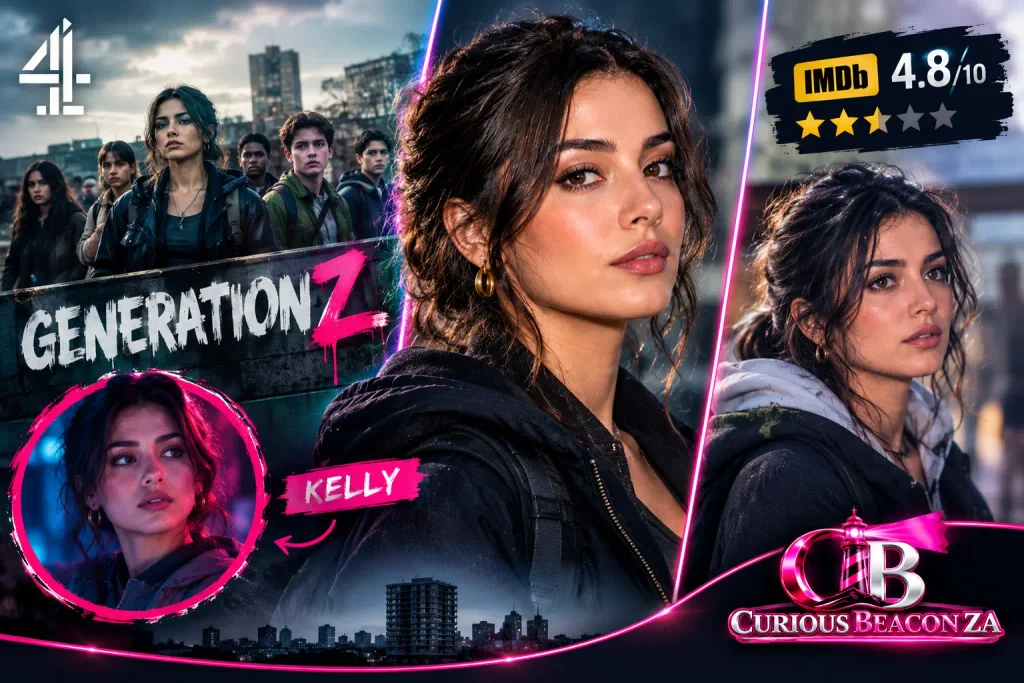
Kömür’s role as Kelly in Generation Z represents her most substantial television commitment to date she appears in all six episodes as a main cast member . The series, which premiered on Channel 4, has been divisive among critics: IMDb users rate it 4.8/10, suggesting significant audience polarization.
Ben Wheatley’s filmography including Kill List, High-Rise, and Free Fire is characterized by genre-blending, dark humor, and social commentary wrapped in visceral imagery. Generation Z applies this sensibility to the zombie genre, using the undead as metaphors for generational conflict, consumerism, and societal decay. For Kömür, working under a director known for extracting raw, unsettling performances from actors represents a significant artistic opportunity. The role also demonstrates her willingness to work in genre television, a sector that, while sometimes dismissed by critics, has become a major source of employment and visibility for British actors in the streaming era.
What Makes Kömür’s Career Trajectory Notable
Several factors distinguish Buket Kömür from the crowded field of emerging British actors:
Authentic representation. As a Turkish-British performer, Kömür contributes to the gradual diversification of British television. Her presence in productions like Honour, which dealt specifically with Kurdish and Turkish communities in London, suggests an authenticity that casting directors increasingly recognize as essential.
Selective project choices. Kömür has not rushed to capitalize on early momentum with quantity. Instead, her filmography reflects careful curation, each project appears to serve a purpose in building a coherent artistic identity.
Cross-cultural appeal. Her Turkish heritage and British upbringing position her uniquely to bridge audiences. In an era when streaming platforms seek global reach, performers who embody multiple cultural perspectives hold strategic value.
The Broader Context: Turkish Actors in British Television
Kömür’s emergence coincides with a broader wave of Turkish and Turkish-heritage talent making their mark in British entertainment. This phenomenon mirrors demographic realities: the UK’s Turkish-speaking population, concentrated largely in London, has grown substantially over recent decades, yet screen representation has lagged. Productions like Honour explicitly addressed this gap, telling stories from within communities that had previously been marginalized or stereotyped. Kömür’s participation in such projects positions her not merely as an actress but as part of a generational shift toward more authentic storytelling.
The scale of Turkish-speaking communities in the UK is often underestimated. According to census data, Turkish is among the most commonly spoken languages in London, yet representation of Turkish and Kurdish communities on British screens remains disproportionately low relative to population size. This gap has begun to close in recent years, with productions like Honour and Our House featuring actors from these communities in substantive roles. Kömür’s casting in Honour playing a Kurdish character despite her Turkish heritage reflects both the shared cultural space these communities occupy in Britain and the limited pool of actors from either background available to casting directors.
For audiences from Turkish and Kurdish backgrounds, seeing a performer like Kömür in mainstream British productions carries significance beyond entertainment. It signals that their stories, their faces, and their experiences have a place in the national narrative a small but meaningful form of recognition.
What’s Next for Buket Kömür?
With Generation Z generating conversation and Layla showcasing her film work, Kömür appears well-positioned for continued growth. The trajectory from supporting roles in prestige dramas to more prominent parts suggests a steady, sustainable ascent rather than a flash-in-the-pan rise.
Two projects on the horizon offer further evidence of Kömür’s upward trajectory.
Bookish (2025), an Alibi crime drama, casts her as Nora across six episodes . The series appears to position her as a recurring presence in a genre that has traditionally dominated British television viewership. Unlike a guest role, a six-episode commitment suggests the producers see her as integral to the show’s identity.
Additionally, Blue Time (2026), a short film in which she plays Zehra, has already completed production . Short films often serve as calling cards for actors and directors alike, and Kömür’s continued engagement with this format she has appeared in several shorts including What Is Your Name (2019), Tin Luck (2020), and See You in the Dark (2023) indicates an interest in supporting emerging filmmakers and experimenting with smaller-scale work.
For audiences encountering her work for the first time, the through-line in her performances is worth noting: an ability to convey inner life and vulnerability even in limited screen time. This quality, harder to teach than technique often distinguishes actors who endure from those who fade.
Conclusion: More Than a Name
Buket Kömür’s story is still being written. At this stage in her career, she represents something valuable: proof that distinctive voices can find space in mainstream British television without sacrificing authenticity. Her name, that curious “flower bouquet of coal”, has proven prophetic in its own way. Like coal under pressure, she has emerged hard and bright; like a bouquet, her work continues to unfold with care and intention.
Her journey is a testament to resilience, marked by a series of bold choices that challenge the status quo. Each project she embraces reflects not only her versatility but also her commitment to storytelling that resonates with diverse audiences. As she steps into new roles, Buket’s keen eye for nuance and emotional depth brings characters to life, offering viewers a fresh perspective that is often overlooked. Her presence is more than just a name on a cast list; it’s a movement toward representation that celebrates complexity in identity and experience.
In a landscape that can feel homogenized, Buket’s artistry serves as both a beacon and a bridge, inviting others to explore the rich tapestry of human experience through their own narratives.