
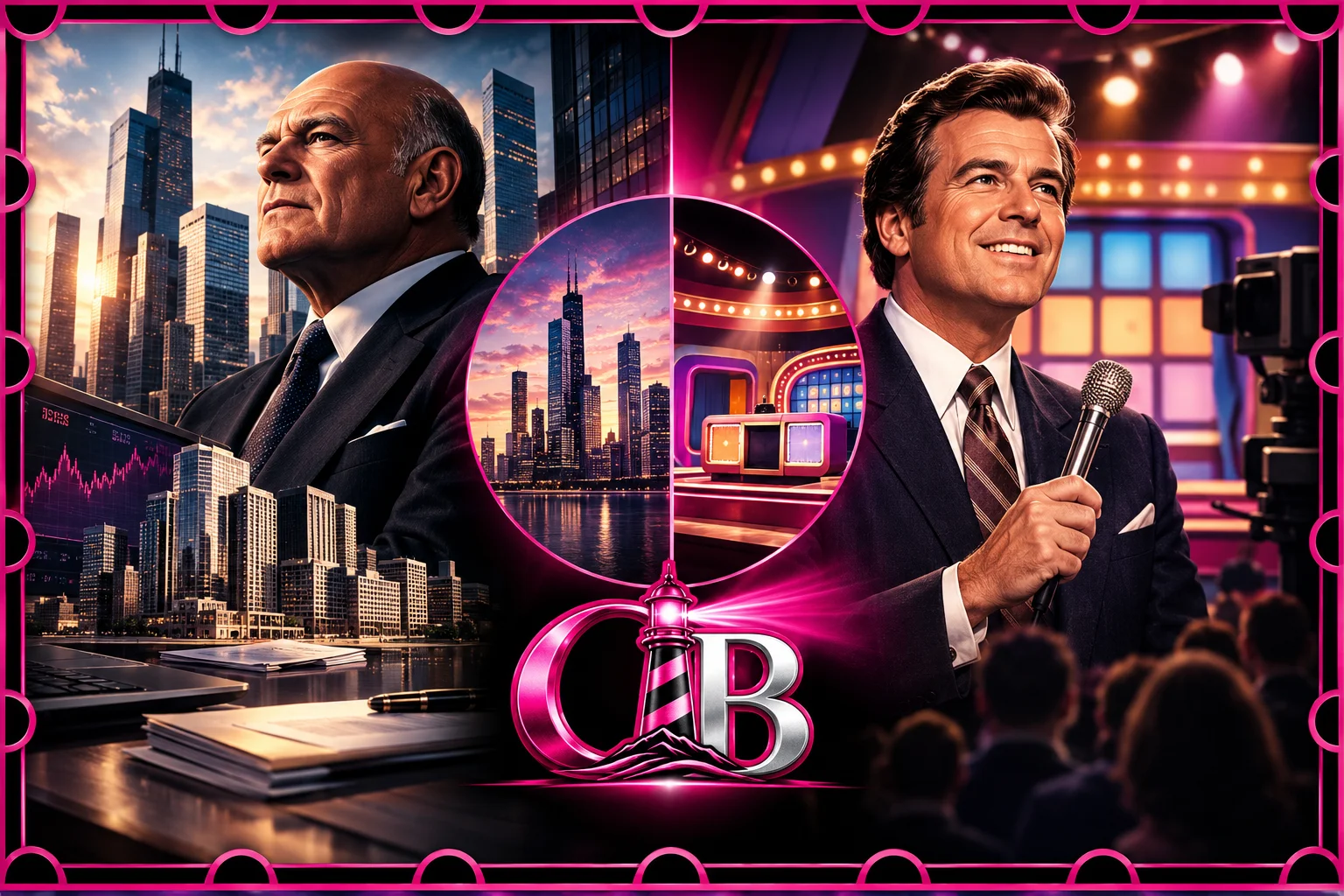
Sam Zell and Tom Kennedy were two entirely different American figures who never shared a Wikipedia page until now. Sam Zell was a Chicago real estate billionaire known as the “Grave Dancer,” who famously drove the Tribune Company into bankruptcy after a disastrous 2007 leveraged buyout. Tom Kennedy was a beloved television game show host, born Jim Narz, who entertained millions on Name That Tune, Split Second, and Password Plus. One made fortunes buying distressed assets; the other made audiences smile for three decades. Here’s why their legacies deserve a closer look.
Who Were Sam Zell and Tom Kennedy?
If you arrived here wondering who these two men were, here’s the direct answer.
Sam Zell (1941–2023) was an American billionaire real estate investor and entrepreneur. He founded Equity Group Investments and built a fortune by acquiring troubled properties, hence his self-given nickname, “The Grave Dancer.” In 2007, he orchestrated an $8.2 billion leveraged buyout of the Tribune Company, saddling the media giant with over $13 billion in debt. The company filed for Chapter 11 bankruptcy in December 2008, a debacle that stained Zell’s otherwise legendary career.
Tom Kennedy (1927–2020) was an American television game show host born James Edward Narz in Louisville, Kentucky. Over a career spanning nearly three decades, he hosted 16 different game shows, including You Don’t Say!, Split Second, Name That Tune, and Password Plus. He was the younger brother of fellow game show host Jack Narz and changed his name to avoid confusion. He died in Oxnard, California, at age 93.
But a simple obituary summary doesn’t capture the full picture. Let’s dig deeper.
Sam Zell: The Grave Dancer Who Bet Big and Lost
From Humble Beginnings to Real Estate Empire
Sam Zell was born in Chicago in 1941 to Polish Jewish refugees. His father had fled the Nazis, and the family settled in the Midwest. Zell showed an entrepreneurial streak early, while studying at the University of Michigan, he managed student housing, planting the seeds of what would become a real estate empire. Zell’s business instincts showed up as early as age 12. According to Investopedia, he bought Playboy magazines in bulk for a quarter each and resold them to classmates for $1.50 to $3. “That’s when I learned about margins,” Zell later recalled.
While studying at the University of Michigan, he and his friend Robert Lurie managed student apartments, and by graduation they were managing 4,000 units, with Zell personally owning 100 to 200 of them. He earned his Juris Doctor from the University of Michigan Law School and founded Equity Group Investments in 1968 at just 27 years old.
Zell’s strategy was simple but brilliant: buy undervalued, distressed properties that others saw as worthless, then turn them around. This approach earned him the nickname “The Grave Dancer”, a reference to dancing on the graves of failed businesses. The nickname originated from a 1976 article Zell himself wrote, which he titled “The Grave Dancer”. In it, he explained his contrarian philosophy: buying assets that others had abandoned or written off, then extracting value where no one else saw it. As he told Stanford business students years later: “A lot of people thought the container-leasing business was a horrific business. I made a half-billion dollars. Should I go on, or do you get the message?”.
His approach was simple but effective: in the late 1980s and early ’90s, he bought office buildings “at 50 cents on the dollar” while his competition vanished. “I kept looking over my shoulder to see who my competition was, but there was no one,” he recalled. “Fear and courage are very closely related By the 2000s, he had built one of the largest commercial real estate portfolios in America. In 2007, he sold Equity Office Properties to Blackstone Group for $39 billion, netting a $1.1 billion personal profit.
The Tribune Disaster: A Case Study in Overconfidence
Just one month after his massive Blackstone windfall, Zell made a decision that would define his public legacy in media circles, and not in a good way. He acquired the Tribune Company, the parent of the Chicago Tribune, Los Angeles Times, and other major newspapers, in a complex $8.2 billion transaction structured around an Employee Stock Ownership Plan (ESOP).The deal left Tribune with over $13 billion in debt, “the most encumbered balance sheet in the newspaper industry,” as the Chicago Tribune reported at the time.
The structure was unusual. Zell’s proposal called for a tax-exempt Employee Stock Ownership Plan (ESOP) to buy back Tribune stock at $34 per share, funded by $8.4 billion in new debt. Zell himself invested only $315 million but secured an option to purchase 40 percent of the company’s shares for an additional $500 million. The ESOP structure offered significant tax advantages, including the ability to write off interest on the debt, which is why it was attractive despite the massive leverage. But it also meant that Tribune’s employees, not Zell would bear the ultimate risk if the company failed.
As one Tribune manager told the Los Angeles Times during negotiations: “It sounds like the worst of both worlds Zell’s bet was that the financial pressure would force Tribune to innovate faster. Instead, the timing was catastrophic. The 2008 financial crisis crushed advertising revenues, and print newspapers were already hemorrhaging readers to the internet. By December 2008, Tribune filed for Chapter 11 bankruptcy protection.
Zell’s tenure at Tribune was marked by controversy. At a meeting with Orlando Sentinel employees, he reportedly told a journalist “Fuck you” during a morale-sapping session. The Orlando Sentinel incident was not isolated. NPR obtained recordings of a February 2008 meeting Zell held with the Washington bureau staff of the Los Angeles Times and Chicago Tribune. In the recording, Zell told the assembled journalists: “This is the first unit of a Tribune that I’ve talked to.
It doesn’t generate any revenue. So all of you are overhead”. He also said: “Three guys in a garage create YouTube, and we’ve got 800 people in Chicago who don’t know their ass from a hole in the ground”. When asked about the public service mission of newspapers, Zell argued that “bright lines are a luxury” and declared: “The days of the newspaper being some kind of a holy monopoly are over”. At the Washington bureau, he allegedly dismissed journalists as “overhead.” These anecdotes cemented his reputation as a brash outsider who had little respect for the journalism business he now controlled.
Sam Zell’s Tribune saga is a cautionary tale about the limits of financial engineering. He was brilliant at real estate because he understood the fundamentals of property value. But newspapers were a different beast, a business with declining fundamentals, not temporary distress. Zell treated Tribune like a distressed asset that could be flipped. It wasn’t. The human cost thousands of layoffs, diminished newsrooms was enormous. His legacy will forever be split: a genius in real estate, a villain in media.
Tom Kennedy: The Game Show Host Who Never Stopped Smiling
A Louisville Kid Who Followed His Brother
Tom Kennedy was born James Edward Narz on February 26, 1927, in Louisville, Kentucky. He attended the University of Missouri, where he landed a radio job. After a decade in radio, he moved to Hollywood in 1947 to follow in the footsteps of his older brother, Jack Narz, who was already a successful game show host.
To avoid being confused with his brother, Jim Narz changed his name to Tom Kennedy. Jack Narz was already an established game show host when Tom arrived in Hollywood. According to the Television Academy, Jack hosted Dotto, Concentration, and Beat the Clock, among others. The name change was practical: as Kennedy’s nephew David Narz later explained, the brothers “wanted to avoid the perceived conflict of two announcers with the same name promoting competing products”.
But the relationship was more than professional convenience. Kennedy followed his brother to Hollywood in 1947, and the two remained close throughout their careers. Jack Narz died in 2008 at age 85. His first hosting gig came in 1958 with The Big Game on NBC, followed by Dr. I.Q. His first major success arrived in 1963 with You Don’t Say!, a Password-style word game that ran for six seasons.
Tom Kennedy’s older brother, Jack Narz, was also a well-known figure in game show hosting. Narz hosted shows including Dotto, Concentration, and Beat the Clock. More notably, Narz was called to testify during the 1950s game show scandals, but he passed a polygraph test and was fully cleared of all allegations. That experience of “surviving” an industry scandal may well have shaped Kennedy’s later steady, grounded professional style.
The Golden Era of Game Shows
Tom Kennedy thrived during the golden age of television game shows. His longest-running gig was the syndicated revival of Name That Tune, which he hosted from 1974 to 1981. He also hosted Split Second (1972–1975), Break the Bank (1976), 50 Grand Slam (1976), To Say the Least (1977–78), Whew! (1979), Password Plus (1980–1982), and a nighttime syndicated version of The Price Is Right (1985–1986).
Beyond hosting, Kennedy appeared as an actor on shows like That Girl, Rowan and Martin’s Laugh-In, and Cannon. He had a small role in the 1985 Harrison Ford film Witness.
Kennedy was married to Betty Jane Gevedon, his college sweetheart. He died on October 7, 2020, at his home in Oxnard, California, at age 93. In a 1996 interview, Kennedy reflected on his favorite shows and the realities of the game show business. He said Split Second and Name That Tune required the most work: “The pace made you dizzy. It was a merry-go-round backstage, trying to change into a new suit and going over the questions after just finishing a game”. Of Password Plus, which he took over after Allen Ludden’s death, he said: “It is the most basic game… it was fabulous.
When Allen took ill, he said he wanted me to replace him on the show. Our friendship went way back”. On hosting the syndicated The Price Is Right, he was candid about the difficulty: “I was never happy with my job on it… it made me appreciate Bob Barker’s job. I had to learn 45-50 games… Bob makes it seem so effortless; that’s what makes him a pro”. He also acknowledged the industry’s decline in his later years: “The market dried up. The game show, as a format, was looked upon as damaged goods. It took about ten years for the format to make a comeback”
Tom Kennedy represents something increasingly rare in television, genuine warmth without irony. He wasn’t a comedian hosting a game show; he was a host who made contestants feel comfortable. In an era of cynical, edgy entertainment, Kennedy’s earnest charm feels almost radical. His 16 shows across three decades prove that likeability, not schtick, is the most durable talent in television.
Why These Two Men Are Often Confused (And Who You’re Actually Looking For)
Before we go further, let’s clear up a common point of confusion.
Sam Zell and Tom Kennedy had no known personal or professional relationship. They moved in completely different circles one in real estate and corporate finance, the other in television entertainment. If you’re searching for one of them, you’re likely looking for one of these two men, not a connection between them.
However, there is another Tom Kennedy worth noting: L. Thomas “Tom” Kennedy, a retired Chattanooga Chief of Police who died in December 2025 at age 87. There’s also Thomas Francis Kennedy, Jr., a Houston attorney who died in February 2025. Neither has any connection to Sam Zell.
| Figure | Known For | Born | Died | Why They Matter |
|---|---|---|---|---|
| Sam Zell | Real estate billionaire; Tribune LBO | Sept. 1941, Chicago | May 18, 2023 | Built an empire by buying distressed assets, then made his most publicized mistake buying a newspaper company |
| Tom Kennedy | Game show host (Name That Tune, Split Second) | Feb. 26, 1927, Louisville | Oct. 7, 2020 | Hosted 16 shows across 3 decades, proving that warmth outlasts gimmicks on television |
| L. Thomas Kennedy | Chattanooga Police Chief | c. 1938 | Dec. 2025 | A different Tom Kennedy entirely included here to help readers find the right person |
Deep Dive: Why Sam Zell’s Tribune Bet Still Matters
The Tribune bankruptcy wasn’t just a business failure, it was a watershed moment for American journalism. When Zell took over, Tribune owned eight major newspapers and 23 television stations. The ESOP structure meant employees suddenly became owners, but owners of a company drowning in debt.
The human toll was staggering. Tribune’s newspapers underwent repeated rounds of layoffs. The Los Angeles Times alone cut hundreds of positions. Newsrooms that had once been robust shrank dramatically. The Chicago Tribune, once a titan of Midwest journalism, saw its influence wane.
Tribune employees didn’t just lose job security, their retirement savings were dragged into it too. The 2007 deal structure made Tribune’s Employee Stock Ownership Plan (ESOP) the company’s primary owner, but federal regulators later determined the purchase price was unreasonable. In 2012, the U.S. Department of Labor announced a settlement in which Tribune Company, GreatBanc Trust Company, and an insurance company together paid $32 million to ESOP participants to resolve allegations of violating the Employee Retirement Income Security Act. The Labor Department said the employees’ “hard-earned retirement savings” had finally been returned.
The human cost extended far beyond layoffs. According to the Los Angeles Times, Tribune entered bankruptcy with $7.6 billion in assets and $12.9 billion in debt, most of it stemming from loans made to complete Zell’s buyout. While rank-and-file employees faced repeated rounds of cuts, top executives received $57.3 million in court-approved bonuses during the bankruptcy proceedings. The Baltimore Sun alone eliminated more than 100 newsroom jobs in the year following Zell’s takeover, including some of its most experienced journalists. Former Los Angeles Times Editor-in-Chief James O’Shea wrote in his book The Deal From Hell that Zell “boasted of being a businessman, not ‘a newspaper guy,'” and demonstrated a “fundamental misunderstanding of the business he now controlled
Zell’s defenders argue he inherited a company already in decline. Tribune had taken on debt to buy Times Mirror in 2000, and the newspaper industry was already contracting. But critics point out that Zell’s aggressive cost-cutting and public contempt for journalists made a bad situation worse. As The Guardian noted, Zell “established himself as a legend with his withering putdowns of journalists.”
The bankruptcy lasted until 2012, when Tribune finally emerged under new management. By then, the company’s value had been cut in half, and its major papers were eventually sold off.
My take: The Tribune story is often told as a Sam Zell story. It shouldn’t be. It’s a story about the structural collapse of the newspaper industry, a collapse that Zell accelerated but didn’t create. Any honest assessment must acknowledge that the internet, Craigslist, and changing advertising models were already dismantling print newspapers before Zell arrived. He made the wrong bet at the wrong time, but the table was already tilted against him.
Deep Dive: Tom Kennedy’s Enduring Appeal in an Age of Cynicism
Tom Kennedy hosted game shows during what many consider their golden era the 1960s through the 1980s. But unlike contemporaries like Bob Barker (who was known for his sometimes combative relationship with contestants) or Gene Rayburn (famous for his double entendres), Kennedy’s appeal was simpler: he was a genuinely nice guy.
His Name That Tune run, from 1974 to 1981, made him a household name. The show’s format contestants competing to identify songs from just a few notes was simple, but Kennedy’s warm, encouraging demeanor made it memorable. When he took over Password Plus following the death of Allen Ludden in 1980, he did so with grace, honoring Ludden’s legacy while making the show his own.
Kennedy’s career reflected the economics of 1970s and ’80s television. Game shows were cheap to produce, drew solid ratings, and could be syndicated widely. A host who could keep the energy up and make contestants look good was valuable. Kennedy did that for 16 shows a testament to his skill and professionalism.
In an era when TV hosts are expected to be edgy, ironic, or provocative, Tom Kennedy’s legacy is a reminder that kindness can be a competitive advantage. He didn’t need to be the smartest person on set or the funniest. He just needed to make viewers feel welcome. That’s harder than it looks. His death in 2020 received far less attention than Sam Zell’s in 2023 a reminder that we celebrate wealth more than warmth.
Frequently Asked Questions
Who was Sam Zell?
Sam Zell was an American billionaire real estate investor and entrepreneur who founded Equity Group Investments. He was known as “The Grave Dancer” for his strategy of buying distressed properties. He died on May 18, 2023, at age 81.
Who was Tom Kennedy?
Tom Kennedy was an American television game show host, born James Edward Narz in Louisville, Kentucky. He hosted 16 game shows including Name That Tune, Split Second, and Password Plus. He died on October 7, 2020, at age 93.
Was Tom Kennedy related to Sam Zell?
No. Sam Zell and Tom Kennedy had no known relationship. They worked in completely different industries and moved in separate circles.
What happened to the Tribune Company after Sam Zell’s purchase?
Tribune filed for Chapter 11 bankruptcy in December 2008, less than a year after Zell’s leveraged buyout. The company emerged from bankruptcy in 2012 under new management and was subsequently broken up, with its newspapers sold to various buyers.
What was Tom Kennedy’s real name?
Tom Kennedy was born James Edward Narz in Louisville, Kentucky, in 1927. His reason for changing his name was practical: to avoid confusion with his brother Jack Narz. His nephew David Narz explained that the brothers “wanted to avoid the perceived conflict of two announcers with the same name promoting competing products.” After a lunch with an agent, Jim Narz officially became Tom Kennedy.
Did Tribune employees sue Sam Zell?
They didn’t sue Zell personally, but the Tribune ESOP became the subject of a class action lawsuit filed in September 2008. The U.S. Department of Labor also intervened. The final settlement amount was $32 million, used to compensate ESOP participants.
Final Thoughts: Two Legacies, One Lesson
Sam Zell and Tom Kennedy couldn’t have been more different. One accumulated billions by buying distressed assets and earned a reputation as a ruthless operator. The other earned modest fame by making strangers feel comfortable on television. But both men teach us something about success and legacy. Zell’s Tribune disaster shows that even brilliant investors can make catastrophic mistakes when they venture into unfamiliar territory. Kennedy’s career shows that likeability, genuine, unforced warmth, is a talent worth respecting.
In the end, Sam Zell will be remembered for both his real estate genius and his Tribune failure. Tom Kennedy will be remembered for making people smile. There are worse legacies to have. How to Explore Their Legacies Further If you want to dig deeper into either man, here are reliable primary and authoritative sources:
Tom Kennedy: The Hollywood Reporter’s obituary provides a complete timeline of his career. Episode 513 of the TV Confidential podcast features game show historian Steve Beverly, who details how Kennedy went from Jim Narz to Tom Kennedy and why he was considered “the most versatile game show host.”
Sam Zell: Bloomberg’s 2022 short film How Sam Zell Built a Real Estate Empire in College shows his path from campus entrepreneur to billionaire. The New Yorker‘s 2007 in-depth profile Rough Rider is the best long-form piece for understanding his motives for buying Tribune.