
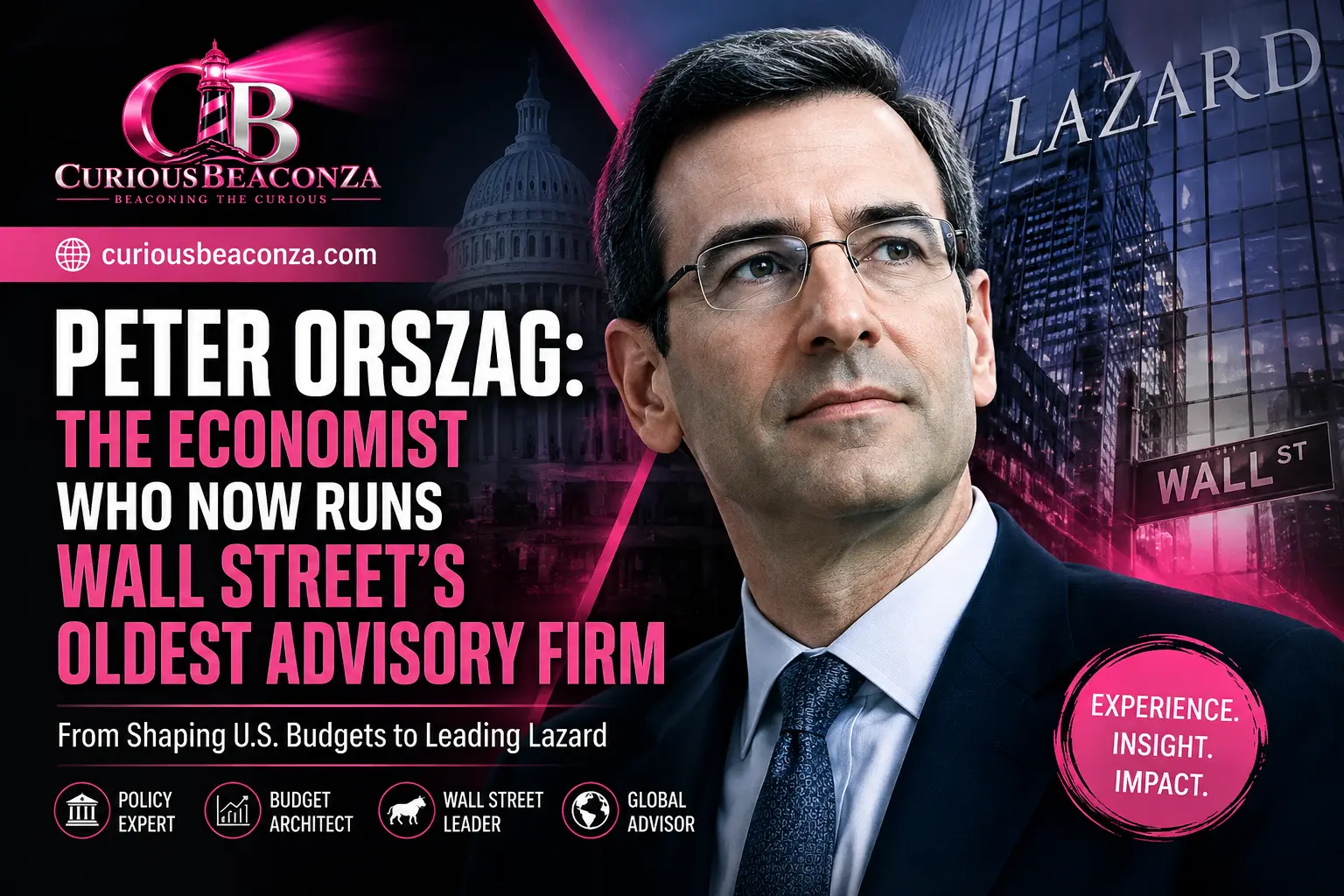
Few people move as smoothly between government and Wall Street as Peter Orszag has. He spent years shaping federal budgets in Washington, then reinvented himself as one of the most influential dealmakers in global finance. His unique perspective, honed from navigating the complexities of fiscal policy, has allowed him to bridge the often disparate worlds of public service and private enterprise, making him a sought-after advisor for both policymakers and corporate leaders alike.
Today, as CEO and Chairman of Lazard, he sits at the intersection of policy, economics, and high-stakes corporate strategy a rare combination that makes his career worth understanding, whether you follow finance, economics, or leadership more broadly.
This article breaks down who Peter Orszag is, how he got here, what he’s doing now, and why his story matters even if you’ve never worked in investment banking.
Who Is Peter Orszag?
Peter R. Orszag is an American economist and finance executive best known for two very different chapters of his career. In the first, he was one of the most prominent economic policy voices in Washington, D.C., serving as Director of the Congressional Budget Office (CBO) and later as Director of the Office of Management and Budget (OMB) under President Barack Obama. In the second, he became a senior leader at Lazard, the storied global financial advisory firm, eventually rising to become its CEO and Chairman.
What makes Orszag genuinely interesting isn’t just that he switched lanes plenty of policy wonks eventually land in finance. It’s that he built real credibility in both worlds, rather than simply cashing in a government résumé for a corporate title. His academic training in economics, combined with hands-on experience managing the country’s federal budget, gave him a rare fluency in the kind of macroeconomic and geopolitical analysis that today’s dealmakers increasingly need.
Early Life and Education
Orszag’s academic foundation is a big part of why he’s taken seriously in both policy and finance circles. He graduated summa cum laude from Princeton University, then went on to earn a Ph.D. in economics from the London School of Economics and Political Science. That combination an Ivy League undergraduate degree paired with a doctorate from one of Europe’s top economics programs set him up for a career built on rigorous analysis rather than gut instinct.
This academic grounding shows up again and again throughout his career. Whether he was estimating the long-term costs of federal programs or advising corporate boards on complex mergers, Orszag has consistently leaned on data-driven reasoning instead of political or market noise.
Peter Orszag’s Career in Washington
Before he ever set foot on Wall Street, Orszag built a reputation inside the U.S. government as a serious, technically sharp economist.
Council of Economic Advisers and the Clinton Administration
Orszag’s government career began during the Clinton administration, where he worked at the Council of Economic Advisers and later served as Special Assistant to the President for Economic Policy. This early experience gave him a front-row seat to how economic policy actually gets made not in theory, but through negotiation, compromise, and constant pressure-testing of assumptions.
Director of the Congressional Budget Office
One of the defining roles of his early career was serving as Director of the Congressional Budget Office. The CBO is a nonpartisan agency that produces the economic and budgetary analysis lawmakers rely on when debating legislation. Leading it requires a reputation for objectivity, since both political parties depend on CBO numbers to make their case. Orszag’s tenure there cemented his image as a credible, nonpartisan economic analyst — someone trusted to call the numbers as they are, not as either side wants them to be.
Director of the Office of Management and Budget
Orszag’s most high-profile government role came when he was appointed the 37th Director of the Office of Management and Budget under President Obama. As OMB Director, he was responsible for overseeing the federal budget process during one of the most turbulent economic periods in modern U.S. history — the aftermath of the 2008 financial crisis. He played a central role in shaping early Obama-era fiscal policy, including debates around healthcare costs, stimulus spending, and long-term deficit projections.
This period is arguably what gave Orszag his most valuable long-term asset: a deep, practical understanding of how government decisions ripple through markets, industries, and corporate balance sheets knowledge that would later become extremely valuable in his advisory work.
The Move to Wall Street
After leaving the Obama administration, Orszag transitioned into the private sector, eventually joining Lazard in 2016. This wasn’t a random career pivot. Lazard has a long history of blending financial advisory work with geopolitical and policy insight, making it a natural fit for someone with Orszag’s background.
At Lazard, he first led the firm’s Financial Advisory business, where he was closely involved in expanding the firm’s use of data analytics and artificial intelligence within its banking and asset management operations. He also created Lazard Geopolitical Advisory, a practice built specifically to help clients navigate the kind of political and regulatory risk that traditional Wall Street analysis often misses. It was a smart use of his background: very few investment bankers can speak with real authority about how a shift in fiscal policy or a regulatory change will actually play out, because very few of them have sat inside the rooms where those decisions get made.
Peter Orszag as CEO and Chairman of Lazard
In 2023, Lazard’s board unanimously elected Orszag to become the firm’s CEO, a role he officially stepped into on October 1, 2023. It was a significant moment for a firm founded all the way back in 1848 one of the oldest and most respected names in financial advisory. Then, effective January 1, 2025, his role expanded further when he also took on the title of Chairman of Lazard’s Board of Directors, giving him full control over both the strategic and governance direction of the firm.
Under his leadership, Lazard has continued to position itself around what the firm calls “contextual alpha” essentially the idea that judgment, geopolitical insight, and macroeconomic understanding are just as important to client outcomes as traditional deal execution. That framing lines up closely with Orszag’s own background, and it’s become a defining theme of his tenure.
A few notable developments during his time as CEO and Chairman include:
- Lazard reported growing assets under management, with figures reaching into the hundreds of billions of dollars during 2026.
- The firm agreed to acquire Campbell Lutyens, a move expected to strengthen its private capital advisory and fund placement capabilities, with meaningful projected revenue contribution starting in 2027.
- Lazard’s Private Capital Advisory team has become one of the most active players in the private markets secondary trading space, a fast-growing corner of finance involving the resale of stakes in private equity funds.
- Orszag has continued to publish economic commentary and analysis, including work on inflation risk and the broader relationship between U.S. markets and artificial intelligence-driven growth.
Quick Facts: Peter Orszag at a Glance
| Category | Details |
|---|---|
| Full Name | Peter R. Orszag |
| Current Role | CEO and Chairman, Lazard, Inc. |
| Joined Lazard | 2016 |
| Became CEO | October 1, 2023 |
| Became Chairman | January 1, 2025 |
| Previous Government Roles | Director, OMB (Obama Administration); Director, CBO |
| Earlier Roles | Council of Economic Advisers; Special Assistant to the President for Economic Policy (Clinton Administration) |
| Education | B.A., Princeton University (summa cum laude); Ph.D. Economics, London School of Economics |
| Notable Affiliations | National Academy of Medicine; Council on Foreign Relations; Aspen Economic Strategy Group |
| Board Memberships | Institute for Advanced Study; Peterson Institute for International Economics; Mount Sinai Hospital |
Boards, Affiliations, and Public Influence
Beyond his day job, Orszag maintains an active presence in policy and academic circles. He’s a member of the National Academy of Medicine and the Council on Foreign Relations, and he participates in the Aspen Economic Strategy Group all organizations that shape serious, nonpartisan thinking on economic and health policy. He also sits on the boards of the Institute for Advanced Study, the Peterson Institute for International Economics, and Mount Sinai Hospital.
This kind of portfolio matters. It signals that Orszag isn’t just a corporate executive with a government résumé line — he’s actively engaged in the kind of institutional, big-picture thinking that shaped his early career, and he’s kept that thread alive even while running one of Wall Street’s most recognizable firms.
Why Peter Orszag’s Career Matters
Here’s my honest take: Orszag’s career is a useful case study in what happens when someone treats expertise as portable rather than industry-specific. A lot of executives spend decades in one lane finance, government, academia and rarely cross over successfully. Orszag did it twice, and did it credibly both times, which is genuinely rare.
What stands out most isn’t the résumé itself, but the consistency underneath it. Whether he was estimating budget deficits for Congress or advising clients on multibillion-dollar transactions, the core skill has always been the same: taking a complicated, politically or financially loaded situation and explaining, clearly and honestly, what the numbers actually say. That’s a harder skill to fake than it sounds, and it’s probably the real reason both government officials and corporate boards have trusted him with high-stakes decisions.
For anyone interested in economics, leadership, or the increasingly blurry line between public policy and private finance, Peter Orszag’s career offers a useful lesson: deep expertise, paired with intellectual honesty, tends to travel well even across very different worlds.
Frequently Asked Questions About Peter Orszag
What is Peter Orszag known for?
He’s known for two major career chapters serving as Director of the Congressional Budget Office and later the Office of Management and Budget under President Obama, and currently serving as CEO and Chairman of Lazard.
What company does Peter Orszag lead?
He leads Lazard, Inc. (NYSE: LAZ), a global financial advisory and asset management firm founded in 1848.
When did Peter Orszag become CEO of Lazard?
He became CEO effective October 1, 2023, and later added the role of Chairman on January 1, 2025.
What did Peter Orszag do before Lazard?
Before joining Lazard in 2016, he served in senior U.S. government economic roles, including as OMB Director and CBO Director, and earlier worked at the Council of Economic Advisers during the Clinton administration.
Where did Peter Orszag go to school?
He graduated summa cum laude from Princeton University and earned a Ph.D. in economics from the London School of Economics and Political Science.
Read Also: Brad Pitt: The Remarkable Story of Hollywood’s Enduring Star
[…] Read Also: Peter Orszag: The Remarkable Economist Leading Wall Street […]
[…] Read Also: Peter Orszag: The Remarkable Economist Leading Wall Street […]
[…] roughly $18 million to more than $14 billion, while delivering an average annual return that left Wall Street stunned. He didn’t do it with complex derivatives or algorithmic trading models. He did it […]
[…] venture, or some secret collaboration between a Belgian-American fashion designer and the former CEO of the world’s largest retailer, I want to be upfront with you: that partnership […]